Friday, September 10, 2010

Thursday, September 09, 2010

Blessed are the troublemakers?

The chief American soldier in Afghanistan has pleaded with them to stop; church leaders from around the world have appealed for them to re-think; protests are building around the Islamic world, and countless Christians are absolutely appalled; yet a tiny church in Florida remains the centre of an international media frenzy because of its plans to burn copies of the Koran on the anniversary of 9/11.

Here are six reasons why this group should immediately call off their planned bonfire:

1. Their proposed action is deeply unChristian.

Nowhere in the Bible do we find people involved in Christian mission insulting the culture to which they are bearing witness for Christ. Rather, we find in the ministry of people like The Apostle Paul, a deep engagement with the people to whom he was sharing the message of Jesus. Acts pictures Paul hiring lecture halls, debating publicly, and drawing on local customs as entry points for his message into people's understanding. The manner in which Christians are to conduct themselves towards those outside the faith (according to the Bible) is "with gentleness and respect." (1) Furthermore, the New Testament is full of injunctions to live at peace with those with whom we share the world, "as far as it depends on you - live at peace with all men" it says. (2), likewise Jesus proclaimed, "Blessed are the peacemakers." (3) To take deliberate actions to hurt others, insult their culture and to stir enmity between peoples, is to take an unChristian stance.


2. Burning the Koran brings the gospel of Christ into disrepute

The New Testament indicates that Christian believers should conduct themselves in such a way as way as to make the gospel of Jesus accessible and attractive to others. The way in which a church, and its pastor act in the public sphere should be to inspire those who see the broadcast to want to investigate Christianity themselves. Now there is nothing wrong with speaking boldly, speaking with faith and conviction, and even saying things which are unpopular in order to demonstrate integrity; but insulting others in Christ's name in order to gain self-publicity brings the gospel into disrepute. I know several Christian people who live in Muslim-majority countries, or who live in towns in the UK in which most of their neighbours are from a Muslim background. They have many fascinating discussions about religious matters with their friends and neighbours, and they answer the many questions about Christianity which they get asked; from people who have almost no information about it. They do so politely, respectfully, gently and they listen to their friends perspectives too! The very last thing they would do would be to insult the things their friends hold to be true - how ever much they disagree, or discuss or debate. This church in Florida, I suggest has no knowledge or experience of genuine interactions or friendships with ordinary muslims. The actions of these ill-informed Floridan's simply sets the church back decades in Muslim-majority counties.


3. Burning the Koran endangers lives

General Patraeous has asked this church to halt their plans as he knows that it will be used as a pretext to stir up hatred and violence amongst radicalising Islamists across Afghanistan. His claim is that this is an act of provocation which will cost the lives of many of his soldiers. However, US troops in other countries are only part of the issue as they are a heavily armed occupying force. Of far greater concern is the effect that these actions will have on Christians who live in muslim-majority countries many of whom already face persecutions. Where states curtail the civil liberties of Christians or seek to impose Sharia law on non-Muslims, or where Islamist mobs seek to destroy Christians, foolish people engaging in 9/11 publicity stunts of this nature will threaten their safety. While such regimes or mobs are undoubtedly responsible for their own actions, the reality is that in a world containing so many extremists, exacerbating volatile situations can have dire consequences. This means that this Florida church is also extremely selfish. I doubt that in Florida they will suffer much for these actions - however, it maybe that Christians in North Africa, Indonesia, or Pakistan will pay a heavy price.


4. Koran burning plays into the cynical media's hands

In the UK today the Christian church faces a very hostile media which seems to take a peculiar interest in stories about the antics of fallen-Vicars or unrepresentative extreme groups. In the furore surrounding the BBC's decision to air Jerry Springer the Opera, the calm and reasoned voices of the Church of England media office and the Evangelical Alliance, or even the BBC Governor Baroness Amos were almost completely unheard. Instead, the ranting self-publicist Steven Green of "Christian Voice" was allowed to use the event to launch his tiny organisation to a UK-wide audience. This church in Florida, has apparently only fifty members. They are not part of any major organisation or denomination and represent no-one but themselves. Their planned actions have been rejected by almost everyone. So why have they been able to gain the attention they so obviously crave? I suggest that it is in the interests of two groups to fuel this nonsense (a) the secular media (b) Islamist radicalisers.

The secular media has a consistently hostile editorial line towards Christianity and as such wants to seize on the fringe and pretend that it is in some way representative of the whole. They also want to be free to condemn Islamic extremism without seeming to be biased, and point out that they have savaged Christians too (fair enough!). This is why a church of 50 people in Florida planning an act of insult and foolishness gain their attention, while my church in the UK of over 200 people fundraising for Pakistan's flood victims through "Save the Children" - will never be even a footnote in the regional news; never mind a national lead story! American Evangelical journalist Cal Thomas told a researcher about the way the media works: "they'd have all these professors from Princetown or wherever on Good Morning America, representing the secular perspectives, then they'd have this West Virgina hick with a missing couple of front teeth representing the Evangelical perspective... and they'd all laugh it up because all these religious nuts are... religious nuts." Likewise Christian PR man Mark de Moss complains that influential shows like Larry King Live in the USA will not carry moderate, weighty or considered Christian commentators because they want to "prop-up a stereotype" of Christians who are "red-faced, angry and wanting to pronounce judgement on the world".(4)

Islamist radicalisers obviously feed on stories like this, as it enables them to paint the whole of the West and the Christian church as seeking to destroy them. For all their public venting of anger, the only people who stand to gain from this church's actions are the radical Islamists. They have driven the propagation of the story around the world.


5. Burning books is not the act of assured people of faith; but of cultural philistines!

Book burning itself has a very dodgy history. By joining in such actions, this minority church alies itself with Stalin, The Nazis, The Taliban, Mao Zedong, and totalitarians the world over. Books are not meant to be burnt, but read, debated, discussed, wrestled with and engaged with. I have a copy of the Koran and have read much of it. I neither wish to set-fire to it, nor to embrace it as a flawless tome descended from heaven, which I do not believe it to be. But it is a volume worthy of our attention, as one of the most influential books of our age. It is a book which should be considered if one wishes to understand today's world - and to engage meaningfully with those people who seek to live by it. Destroying copies of important historical texts are the actions, not of people who are at ease with themselves in their own faith; but of the paranoid, the desperate, the agitated, and those who feel threatened by opponents. This church in Florida should engage not destroy!


6. Burning the Koran in response to 9/11 is a foolish political mistake.

It is a noteworthy fact - and one that this church in Florida do not seem to have appreciated - that on 9/11, Al Queda did not fly their plane into a church building. Washington, London, New York, all have enormous landmark Cathedrals which would have made impressive symbols if they had been targeted. Or perhaps Al Quaeda could have taken-over a plane and flown it into St Peter's square during a massive Papal mass or into a football stadium during a Billy Graham rally. But they didn't. The target in 9/11 was not the Christian infrastructure, but the heart of American capitalism and government. Part of Al Quaeda's rationale is that American Capitalism is colonial and expansionist, and one of their key demands is the withdrawal of western troops from what they deem to be 'Muslim lands'. Primarily 9/11 was a war between Islamic radicals and secular, Western consumer-capitalism. When a church burns Koran's in response to this, it abolishes the distinction between the church and consumer-capitalism, seeing the church and the American economy and Foreign-policy as two arms of the same entity. This is a political, and theological error of almost unimaginable proportions. Western Consumer Capitalism and its colonial aspirations are not to be 'baptized' by the church in this way - but critiqued by the church using the yardstick of the Bible's standards. The church should be raising up a prophetic voice against both the dangers of Islamic fundamentalism and its enormous threat to basic civil liberties around the globe; as well as to the insatiable greed of consumer capitalism and the violence and corruption of much western foreign policy. The church has no place to be the cheerleader for either side in this escalating crisis - but in faithfulness to Christ should strive to be the servant and witness to both. This church in its headline mongering stunt, has allowed the 'religicisation' of this tension from the Christian side - something which the likes of Al Queada are anxious to propagate. No wonder President Obama has called this a 'recruitment bonanza' for the terrorists.

A Christian response to this situation should be based on the teaching of Christ. Rather than, blessed are the trouble-makers, the self-publicists and the agitators; in The sermon on the mount, Jesus puts it like this: “You have heard that it was said, ‘Love your neighbour and hate your enemy.’ But I tell you: Love your enemiesi and pray for those who persecute you, that you may be sons of your Father in heaven. He causes his sun to rise on the evil and the good, and sends rain on the righteous and the unrighteous. If you love those who love you, what reward will you get? Are not even the tax collectors doing that? And if you greet only your brothers, what are you doing more than others? Do not even pagans do that? Be perfect, therefore, as your heavenly Father is perfect.

____________
Notes

1. 1 Peter 3:15
2. Romans 12:18
3. Matthew 5:9
4. D. Michael Lindsay. "Faith in the Halls of Power" p 150

Monday, September 06, 2010

Saturday, September 04, 2010

Marriage Time (and quite a room-name!)

Several years ago when Mrs H. & I, did the 'Marriage Course', we realised that the thing our marriage needed most was ... time. Before we were married, we had loads of it, we were students with long holidays, we had few commitments, no children, no house to maintain etc etc etc. Several years later and with the hours in the week disappearing under ever-deepening layers of things-to-be-done, we realised how much we missed the time we once had for each other. The Marriage Course recommends setting aside 'marriage time' for each other on a weekly basis. This involves switching off the computer (for me), switching off the TV (for her), and doing something different that will enable us to talk at length. Our usual is a nice French coffee shop in the town.

In addition to that, the recommendation for those with small children is to try and engineer a few days away without them, once a year. Thankfully, my parents volunteered (or did we volunteer them - I don't remember!?) to look after Boris, Norris and Doris to enable us to escape. The sad truth about the UK is that the fastest growth in separation, divorce and marital breakdown is amongst the age-group whose children are leaving home. The analysis suggests that swamped by the rigours of parenting, many couples lose their close relationship, setting instead for a functionality masked by busyness - which unravels when the parenting pressures ease.

With 4/5 days to play with, we grabbed some cheap flights (Ryan Air stinks - but hey, it was cheap) to Carcassonne in southern France and booked into the wonderful Chateau du Cavanac, a haven of sunshine, and glorious French Cuisine. We were most entertained to notice that our room was entitled "Amour en Cage" (trans: "The Love Cage")... ! The chateau, is the centre of a wine-making estate, and they are very keen to let guests sample their wines as well as enjoy their amazing food. One of the things about France is that they appreciate that a good meal should not be rushed. Instead of serving one massive course, as so many places do here, we loved the way that a series of smaller courses was brought to us over the space of a couple of hours. This is perfect 'marriage time' stuff, hours to sit in the chateau courtyards, in the evening sunshine, sipping the local wine, and talking.

Marriage is much on our minds today. We have friends getting married far away - and sadly for us, too far for us to get to. We would just have loved to have been able to be with them. Alongside the obvious message that faithfulness, both to each other and to God is the foundation of a lifelong marriage; our experience has been that the investment of time for each other is essential, vital, and actually really enjoyable. It's easy to let it slip, its hard to carve out space in ever-filling diaries, and there are pressures from work, kids, church, and other responsibilities all of which are important but all of which can rob marriage of the time it needs to breathe. We've been back a week from France - and I am shocked by how little we have seen of each other in the frenetic busyness of everyday life. Making sure that marriage time happens, will require ongoing commitment and planning! We're already looking forward to a few days away next year!

Friday, September 03, 2010

On Cruachan's mighty ridges...

Most people who visit Ben Cruachan do so in order to view its insides - the famous underground hydro-electric power station, with its visitor centre. It is (apparently) Scotland's best subterranean tourist attraction. 'Victor Meldrew' & I visited the great mountain yesterday, but rather than using the plentiful car-park for the visitors centre, and underground tour, we wedged the car on the verge by the station, in order to make for the ridges.

Guide-books are divided as to the best way up on to Cruachan. Paths follow both sides of the burn that tumble down from the dam to the lochside. Older books favour the little lane that goes up by the railway arches, to the west bank of the stream. Newer books tend to recommend the steps up to the station, under the tracks and up the path on the burns east-side. We went up the west and down the east and found the eastern path from the station to be in better condition, whereas the older path on the other side of the stream is quite overgrown in places.


From the dam we took the west bank of the loch and then the incredibly steep path up to Cruachan. In blazing sunshine and awesome views from Ben Nevis to Ben More, Schiehallion to Mull, we followed the ridge from Cruachan to Stob Diamh and then back to the dam. In good weather this is simply wonderful, easy and breathtaking ridge walking, although in fog it would require careful attention in a couple of places. The much vaunted 'bad-step' which the local mountain rescue team describe as a 'fatality waiting to happen' (!) proved to be only a 'marginally awkward step' which presented no obstacle when ascending it (ie going west to east) in dry conditions. Descending it in ice could be pretty hairy however.
Having viewed Ben Cruachan's unusual summit from so many angles, so many places, and so many other summits - I was delighted to be able to climb it - and on such a cracking good day too. McNeish rates it the finest ridge walk in the Southern Highlands and he's probably right, it is quite superlative. A wonderful day out.


*

Canal du Midi

Posted by Picasa

Fishy Drainpipes

Posted by Picasa

Thursday, September 02, 2010

Film Notes: The Beat That My Heart Skipped

Jacques Audiard's film, "The Beat That My Heart Skipped" revolves around a young man, who is caught between two worlds. When we meet Thomas Seyr, (superbly played by Romain Duris) he is in the thick of corrupt property deals, violent evacuation of tenants, and affairs with various women who share his life in the Paris underworld. We soon discover that this is a world into which he has followed his father Robert (Niels Arestrup), who is now a vulnerable, drink-sodden victim of the property deals he once had the power to enforce.

The story gains its extra dimension when Thomas encounters some people who belong to a quite different world - that represented by his late mother. Rather than being a player in the world of property and organised crime, his mother was a creative artist with a huge reputation as a classical concert pianist. Thomas himself had shown (we infer) huge potential as a child pianist, but had abandoned the instrument upon his mother's death, and disappeared into his father's world.

As the gift of music is slowly but passionately re-awakened within him, Thomas is pulled in two different directions. His father's world; with deals to make, partners obligations to meet, evictions to force and most importantly scores to settle, is incessant in its desire to claim him. Yet - the force of music, the desire to create and inhabit a world of purity, integrity and beauty grows within him. The collision between these two moral universes is inevitable.

As the last half an hour of the film unravels, there is a straight conflict between the two worlds, the two forces, between which he must chose: criminal sensuality versus the creative spirit. Finally and dramatically forced to choose which will win, only at the end of the film do we discover whether this film is a dark, sinister exploration of the dark recesses of the human condition, or a redemption-narrative, with music cast in the role of saviour...

Brilliantly acted, directed, and with a luscious soundtrack, "The Beat That My Heart Skipped" was a worthy winner of its 'foreign language' BAFTA a couple of years ago.
(cert 15, strong language/adult themes. French with English subtitles)

Wednesday, September 01, 2010

House Grafitti!

Someone in Carcassonne has a 'Hugh Laurie' stencil, and enjoys spraying his 'House' face on walls around the city! But why? Hugh Laurie fanatics? House fab-club meeting places? A strange code, passing mysterious messages between secret agents? A bizarre religious cult? Does anyone know?

Carcassonne, old and new

Le Parking!

Le Parking!!

Flying Stone

Posted by Picasa

Gargoyle

Posted by Picasa

Carcassonne again...

Posted by Picasa

Book Notes: Faith in the halls of Power by D. Michael Lindsay

"Faith in the Halls of Power" is sociologist D. Michael Lindsay's exploration of American Evangelicalisms relationship with power. Given that it is an extremely thoroughly researched book, written by an academic sociologist, it is a surprisingly fun read - and is absolutely fascinating from cover to cover.

Lindsay, after some introductions about the term 'evangelical' and the definition that he works with, charts the course of this movement within Protestant Christianity. His particular concern is to map the way in which Evangelicalism moved from the margins of American society, to a place close to its centre. Landmarks include the birth of the neo-evangelical movement in the early 20thC, and the work of Francis Schaeffer who propelled the movement towards cultural, philosophical and political engagement with society, rejecting the fundamentalist drive towards withdrawal into voluntary ghetto-isation.

He shows that ways in which parachurch organisations, close social-networks of leaders, and deliberate cultivation of new leaders, have enabled evangelicals to penetrate the worlds of academia, politics and business, more successfully than they have showbiz and entertainment. Thankfully Lindsay is too good a researcher to simply write a parody of the 'religious right' but explores the complexity of the movement, the 'evangelical left', and the vibrant role given to Christian faith within the organisations of the Democratic party. His conclusion is that while US Evangelicals have taken a seat at the top table of American society, their influence as one of many voices at the higher echelons of the various hierarchies has actually been very limited. This despite the sympathies of Carter, Reagan, Clinton and George W. Bush.

Perhaps symbolic of the whole of the book is the section on C. Everett Koop. He was Reagan's controversial choice as USA Surgeon general, whose approval by Congress was only confirmed after a lot of political wrangling. The choice was controversial because while Koop's abilities as a clinician were not in doubt, his Evangelical Christian faith made him deeply opposed to abortion. Once in office, Koop made no lasting impact on abortion legislation, but angered conservatives by opening the eyes of the US government and public to the threat of HIV aids in the early 1980s, and sponsoring public education about safe-sex and the dangers of needle-sharing.

Helpfully detailing the differences between 'populist' and 'cosmopolitan' Evangelicals, Lindsay makes some fascinating observations about the successes and challenges the movement is likely to face over coming decades.

Too many people in the UK respond to a media-caricature of American Evangelicalism. Lindsay's book (written as a critical, if sympathetic, outsider) explores more deeply into the shades and complexities of the movement and its relationships with elite circles in America. For anyone interested in politics and American religious movements, in the 'religious right' and power, and the multi-faceted nature of US Evangelicalism, this is a great place to start reading.

Monday, August 30, 2010

Are you a dead fish?

Only dead fish follow the current ...
are you a dead fish?

Glen Coe

Posted by Picasa

Book Notes: The Living Mountain by Nan Shepherd


Nan Shepherd, the early 20thC Aberdeenshire novelist, had a lifelong love of the Cairngorm Mountains. She spent vast amounts of time exploring its lochs, glens, summits, the high plateau and the mountain passes that slice through it. "The Living Mountain" is her reflections on a life spent in the high mountains, amongst its landscape, flora, fauna and people.

Shepherd's knowledge, and powers of observation and ability to articulate the experience of being in the mountains; makes this a book which is charming, captivating, and delightful. It is unlike any other mountain book I have ever read, being neither a route-guide, nor an account of heroics, but rather a reflection on the life of the mountains themselves and how we are affected by time spent in amongst its life.

Her chapter on 'water' contains many recollections, observations and an engaging discussion on the way in which water in the mountains can be clear, gentle, soft and inviting, yet a river in spate ripping into the terrain can be a thing of dread. The following two paragraphs are a nice example of her writing, again from the 'water' chapter, but here on the feel and sound of mountain water.

Half a century or more ago, when Nan Shepherd walked the mountains, she noted with sadness the decline of traditional Highland crofting. She writes with deep affection of these people of the Cairngorms and their unbelievably tough lives, meagre comforts and hard, hard work in the harsh environment. When she walked she was welcomed to stay in countless crofts which dotted the landscape, by farmers who while they often thought hillwalking to be utter folly; would gather together on freezing blizzard-strewn nights, to search for missing climbers.

She writes of the pleasures of sleeping in mountains, of mountain plants, and animals, of hillwalking companions and of the landscape itself. While she speaks of the mountain in almost personal terms, usually she does so in metaphorical anthropomorphisms, although perhaps her language stays beyond that towards a perhaps a pantheistic perspective. While I was with her on the first, the latter seemed to me to be a cul-de-sac. This is because while everything she writes about the mountain is so true, so poised, so beautiful and resonant with my own mountain experiences; I remain convinced that this beauty is not the end of the matter. To me the fawn grazing in the sunrise, the deep water of Avon, the cliffs of Braeriach, the arch of a icy-cornice, the lives of the characters who once lived in these hills all bear the imprint of a personal creator, whose exuberant creativity is displayed here.

This book is a treasure trove for lovers of the Highlands in general and the Cairngorms in particular. While every description of the mountain, or of days spent there creates a longing in me to return there. Yet while I cannot, Shepherd's book is the closest thing to being transported there that I can imagine.

Sunday, August 29, 2010

My Little Sister's Wedding!

Guests being arranged for a photo..

Last Saturday was a significant day in our family, my little sister got married! The girls spent the morning at the hairdressers (etc!), while the boys chose the more hair-raising and adrenaline rushing option of canyoning for essential pre-wedding preparation. However, come the afternoon there was serious business to attend to, and the real reason we were all actually there; a wedding!

The ceremony itself took place on the banks of Loch Leven near Ballachulish at the North end of Glen Coe. With the Mamore Mountains, and the Pap of Glencoe across the loch behind the bride and groom - it was hard to imagine a more idyllic backdrop for the occasion. The registrar who led the proceedings maintained a nice balance in making it an informal, but yet serious event - striking exactly the right tone. Mrs Hideous & I were asked as the official witnesses to stand with them as they said their vows, and signed the register too. My Mum & I read poems in the ceremony, my Dad 'gave here away' in traditional fashion, while my daughter was a gorgeous little bridesmaid!

Having an outdoor wedding in the Western Highlands carries a certain amount of risk. The annual rainfall up there is staggeringly high, and the chances of sunshine dismally low. If you were fortunate enough to have chosen a sunny day for the wedding, the possibility of being eaten by midgies is just too terrifying to contemplate! Happily, the clouds parted, the sun shone, and a gentle wind blew in across the loch to tame the midgie menace, for most of the afternoon!

A meal, some speeches and a few tears later we sat chatting listening to live music in the bar, and eating the cupcakes that Mrs Hideous, my Mum and Lady Lucan had spent days preparing. Spotting that many people in the bar area were not with the wedding party, young 'Doris' decided to guard the cupcakes and challenge anyone who she thought shouldn't be eating one.

One by one we all said our goodbyes and went off to our beds, carrying various bundles of sleepy, but over-excited children! Eventually, even the singer in the bar called it a night, and with hugs and congratulations to the happy couple, we too brought the great day to an end. It was great to be with them on their special day, with all their friends and family. Now I just have to get used to the idea that my little sister is someone called Mrs Richardson!

Tuesday, August 24, 2010

Canyoning!

Although the picture isn't mine (it comes from visitscotland), it is a good representation of the way that we spent Saturday morning! We had driven up to Glencoe on Friday evening, for my little sister's wedding on Saturday afternoon. My sister, my daughter (who was the bridesmaid) and my wife were all off for the morning getting hair, make-up, dresses and so forth organised. Thankfully less than five hours before he got married, my sister's soon-to-be-husband had organised an altogether more exhilarating trip for the boys; up to Inchree to the Vertical Descent centre for a few hours of Canyoning.

In case Canyoning or Gorge-walking is something with which you are unfamiliar, the concept it quite simple. The instructor explained it something like this: we climb into the river, and make our way down the gorge, and over the waterfalls using a combination of swimming, sliding, zip-lines and jumping. So, in wet-suits, life-jackets and climbing helmets we took to the water. The first few slides (yes, just lie on your back and float over a waterfall!) were great. The boys were a little nervous, but loved it. Young 'Norris' was wrapped in so many layers of wet-suit that he couldn't move, so had to be piggy-backed or towed through the water.

The instructor took all the younger ones for a climb on a ledge behind a major cascade. This brought them out onto a rocky ledge about 8/9 ft above the water. One by one they all took the plunge down into the water below! It was wonderful to watch each very anxious face on the ledge, with a leap and a splash emerge from the water with a huge ear-to-ear grin! Another highlight was a steep zip-line which enabled us to leap from the top of a huge set of falls, whiz down the cable and splash into the pool below. Another fun slide, took us into a 'washing machine' where the rotating water tries to pull the swimmer back, time and time again. Only with some good handholds on the rock can you pull free of the swirling bubbly water!

The younger ones were taken back to the centre to dry off, but the adults were taken to the last challenge - a huge leap! The steep path ended suddenly, 32ft above a dark pool, with a waterfall crashing into it. It looked impossibly high, but the instructors assured us that as long as you leapt far enough out and landed in the 'black water', it was 16m deep, and perfectly safe! Unable to see the first people jump - I was simply horrified as there was almost a second's delay between when they yelled as they leapt off - and when they splashed. When I got to the top of the climb and looked down at the swirling waters far below, I had the most unnerving adrenaline rush and dizzy feeling. The secret I discovered was to remove my glasses! I had to do so, or risk losing them on impacting the water. Given a little extra courage by the resulting loss of clarity I took a step to the edge, and then another step - out into air... Technically, it was hopeless. Unable to stop my legs rising up, instead of silently slipping beneath the skin of the water like a vertical pencil; my legs slapped it, with a thud. Within seconds I swam back to the surface and off to the side, shaking with terror, and grinning inanely. I'm glad I managed it, but (like several of the group) not entirely sure I could do so again!

My personal opinion is that all weddings should start like this!

Monday, August 23, 2010

Book Notes: Death by Love by Mark Driscoll & Gerry Breshears

This is a quite extraordinary book. As is typical of the ever controversial Driscoll, he is in turns brilliant, perplexing, bewildering, fabulous and irritating. This book may bear all those hallmarks of Driscoll - but taken as a whole is a compellingly brilliant read. It is stimulating to the mind, challenging to the core, refreshing to the soul and, ultimately glorifying to Christ.

There has been something of a theological spat in recent years over differing ways of interpreting the death of Jesus Christ on the cross; what it achieves and how it relates to us. Different models, such as 'propitiation', 'Christus Victor' or 'expiation', have been sometimes claimed to be the only valid interpretive model. Driscoll cuts through this argument with two bold strokes. The first is that all of the models which the Bible uses are valid, and are like a diamond's facets, and are not in competition with each other. Christus Exemplar is not the preserve of Liberals, and Propitiation not the preserve of fundamentalists; but all of the scriptural devices used to explain this most important event should be explored, accepted and embraced. The second is that the different models of understanding this 'atonement', can be especially helpful for people in different life situations. Expiation might be especially potent for someone who feels defiled by sin, while Christus Exemplar might especially help someone struggling to remain faithful to their calling while enduring hardship.

These are significant and helpful insights. The way that the authors develop them is then an enormous surprise - especially if you expect such matters to be the subject of impossibly weighty theses. Instead each chapter contains a character sketch of a person that the authors know well, and the situation they face. We meet the angry, the vulnerable, the wicked, the gentle, the molested, the liar. Each chapter is then a pastoral letter which seeks to explain the aspect of the atonement that will especially confront, help and ultimately free the person. As so many reviewers have noted, the authors do not denounce counselling or psychology, but they do expect that embracing these orthodox Christian understandings of the cross will liberate these people. Some of these pen portraits are deeply moving. The explanations of the theological models usually pretty clear, and passionately argued. It makes this book a brilliant little resource for understanding the differing aspects of the cross, and feasting the soul on Christ as your appreciation for him grows.

There are, of course, some reservations. For all his brilliance as a communicator of theological ideas, Driscoll is an irrepressible sensationalist. All the pastoral situations are rather extreme, although regular folks might see themselves in them a bit! Likewise, Driscoll seems to want to use the doctrine of hell to shock, mentioning it in one chapter more than the whole of the New Testament. Now this might not indicate error, but it certainly doesn't suggest balance. Obviously the thrust of propitiation is that Christ bore the wrath of God in our place; and so it is boldly and obviously relevant, but not as a shock-tactic, as if this was tabloid theology. Stott's The Cross of Christ, which Driscoll cites approvingly, manages not to evade hard teaching, but succeeds in weighting the argument to give the overall a more biblical shape. Likewise, Driscoll's hard-line views on gender-roles are a rather odd intrusion into a book about the atonement, and one hobby-horse that could be given a day-off once in a while.

The most irritating thing about Driscoll though is his uniformly flattering self-references! Although he does admit that before his conversion he was something of a rat. I am always uncomfortable with authors and speakers who want to tell their audience about quite how wonderfully they have succeeded in an area of life or faith. I think there is a cultural gap here between the states and the UK here though. I suspect that in the UK in a somewhat more diffident culture, such self-references come across as raging arrogance, whereas audiences in the States are more keen to know that a speaker has tried, and tested the message he is propounding. What passes as authenticity there, just sticks in our throats here! Frankly, I really, really gained in knowledge and understanding of the cross, and of Christ, but really, really didn't need to know about what a great husband/father/role model Mark Driscoll is in his own estimation. Sorry.

This is one of the best books I have read all year. I have learned more, grown more, and gained more from it than from a whole host of other things. Yes - there are some serous problems with it. The greatest tragedy would be that some of the unnecessary eccentricities in the book prevented some readers grappling with its core - the majestic handling of the cross of Christ, and its application to real situations, to real people - that is to real sinners like us.

Monday, August 16, 2010

The Last Miner (Edinburgh Fringe show)

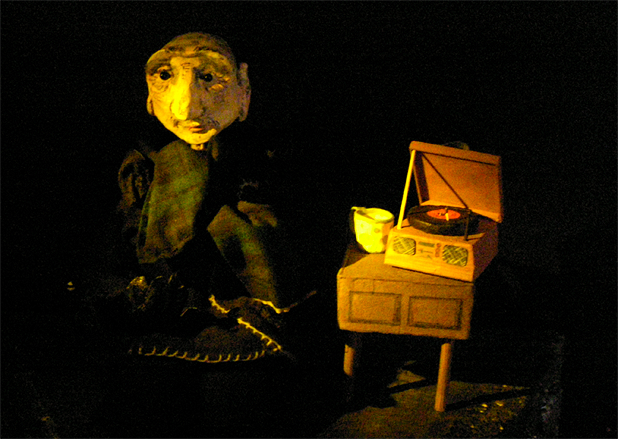
"The Last Miner" is the latest production from innovative theatre company Tortoise in a Nutshell. In 45 extraordinary and intriguing minutes, the touching premise (that a miner unable to face the closure of the pit around which his life had centred, refuses to vacate it, but lives on underground in a world of memories, and hopeless nostalgia) is outworked through puppetry, music, lighting and set.

We first meet the miner (with the complete absence of dialogue - we never even discover his name!) living in the dank underground. With evident love and sadness, he continues to service and maintain the subterranean equipment that once drilled and transported men and coal through the caverns. Whether he hopes that one day the mine might possibly re-open, or whether he is just unable to let go of the past, we don't know - either way, he cuts a tragic and isolated figure as he toils in the darkness to keep his dream alive.

The audience is once given a window into the memory-world in which the Last Miner lives. When he takes his wife's wedding dress out of its chest for cleaning, it sparks off a dream sequence in which the past comes alive. Not only is his love still alive, but the pit is alive too, as is the community surrounding it. But dreams must end - and the reality is that despite the company of his canary and a pit pony, his days in the pit cannot go on indefinitely. Roof-falls, and bad-air threaten his existence and the Last Miner is faced with a difficult choice. He must either stay down below, clinging to the past, and memories and the way he wishes things were - a choice which will kill him. Or he must head for the surface, to face the new realities of a changing world, a world he fears, distrusts and doesn't comprehend. In the final scene he makes his greatest decision...

The play transported me back to the 1980s. Studying A-levels during the Thatcher years, I had a politically aware Geography teacher who took us to see one of the pit towns in the wake of the closure of the industry around which their whole community had revolved. Many of the people there faced The Last Miner's dilemma, (although not literally underground). Some wanted to fight to defend an old way of life, others gave up and fled the place into the uncertain outside. The play need not be interpreted so literally however. While the mining context might be a brilliant device, it could be equally be aimed at anyone facing a situation of unwelcome change; and facing haunting choices between clinging to a decaying memory or striding into an uncertain future.

What makes The Last Miner so effective in unearthing these feelings is that the story is disarmingly told through puppets. What is remarkable is the pathos and emotion that a puppet with an expressionless face is able to convey when in the control of skilled hands. Someone I was with commented that the sadness of the old miner was transmitted through the tenderness, and love with which puppeteer Arran Howie cradled and manipulated the puppet with her hands. An astute and telling observation.

I was interested in the way in which the different members of my family reacted to the play. The adults were intrigued. Our ten year old really enjoyed it - and understood what it was about. Billed as being for 7+ we didn't expect our five year old to grasp it - and it was far too subtle for her. Our 8 year old in the middle however was interested enough to be bothered that he didn't 'get it', but he had observed well enough for it to come alive in his mind with some explanation afterwards. Interestingly, on the afternoon we were there, the audience was almost entirely adult. I would say, as a parent, that it is worth taking under 10s to The Last Miner, but it might also be worthwhile giving them some explanation beforehand about the play, its themes and things to look out for.

This company's show last year was a psychedelic carnival of laughter, characters and fantasy called Twine. The Last Miner could not be more different, it is thoughtful, poignant, sombre and memorable. It deserves the good reviews it has been receiving too.

The Last Miner plays at the Hill Street Theatre, daily at 3pm (except Tuesdays).

Stob Ghabhar & Stob a Choire Odhair

The hills of the Black Mount are often overlooked. This is probably because they have the misfortune (as far as their own reputation is concerned) of being merely the prelude to the grandeur of Glen Coe, on the drive Northwards up Scotland's west coast. If these hills did not keep such august company, they would be better known, I am sure.

The whitewashed Bridge of Orchy hotel is a well-known landmark on the A82 - and a place in which I have enjoyed several fine post-hillwalking meals. Yesterday, after meeting 'Roymondo' at Crianlarich, we took the backroad that leaves the A82 by the hotel and skirts Loch Tulla before culminating at a walkers car-park at the end of the public road.

In perfectly still, warm muggy humid air, with no sunshine, this tree-surrounded car park contained an unbearable frenzy of midgies. I haven't experienced midgies like it - in years. They were fierce, biting, swarming, itching - absolutely horrific. Giving up all thoughts of leisurely changing, we grabbed all our stuff from the car boot and jumped straight back into the car, putting the 'blowers' on full, to pack our rucksacks and insert feet into walking boots. As we did so - we watched the car windows steadily blackening with scores of midgies, which continued to plague us for much of the day.

The route, from Victoria bridge and over these two munros is fairly straightforward. We continued along the road over the bridge to the lodge, turned westards along the track alongside the river and continued until a little green tin shack, at which we took the path northwards up the glen. The stalkers path which climbs up the slopes of Stob a Choire Odhair from the main path is easy to miss - nevertheless if you take to the hills immediately after crossing a significant burn the path becomes obvious within 30/40m - and barely disappears for the rest of the day.

The summit of Stob a Choire Odhair is straightforwardly enough reached at the head of a zig-zagging path, and rewards the walker with fine views in return for fairly modest effort. In between clouds, and through hazy light Glen Coe's great shapes were as visible looking Northwards as the Orchy hills and views across the watery expanses of Rannoch Moor were the other. A well-worn path threads its way down the hill, along a ridge and up the bouldery slopes of Stob Ghabhar. Stob Ghabhar is undoubtedly the finer - as well as being the higher of the two hills. We were denied the massive view which this peak should have afforded by our ascent into the cloud base. On balance however this was good thing! As is so often the case, while the air below the clouds can be still, hot and humid - once in the cloud it can be windy and chilly. This meant that at last we could sit and eat lunch in conditions which presented a good challenge for the midgies!

Two ridges protrude southwards from Stob Ghabhar, one is long, grassy and gentle, the other known as the Aonach Eagach, ends in a blunt nose of rock requiring some scrambling. We selected the easier of the two routes and followed the ridge down, on an occasionally appearing path, to a river crossing - which took us back on to the same route we taken into the hills.

These are charming hills, with easy access and fast walking onto pleasant ridges with far-reaching views. As two simple Munros in great walking country, they don't attract the vast crowds of Glen Coe and are all the better for it. They don't present an enormous physical challenge but provide an excellent day of solid and enjoyable hillwalking.