Saturday, August 20, 2011

Scotland: Relationship Central Conference, Perth October 1

Alpha Scotland will be holding it's 'Relationship Central' conference at Perth Baptist Church Centre on Saturday October 1st 2011. The aim of the conference is to envision and equip the churches to serve families by using the Marriage and Parenting resources they have developed.

While the Marriage Course and Marriage Preparation Course have been running very successfully all over Scotland for some years, this year sees the addition of the Parenting and Parenting Teenagers Courses, to the portfolio of opportunities that Alpha are now offering to churches.

Alongside times of prayer and worship, the day will equip churches to run these courses in their communities - through demonstration of the resources, and of how a typical session would work - alongside the chance to chat with others already running the courses. Course authors Nicky and Sila Lee from Holy Trinity Brompton will be on to share the vision they have for this work - as well as give practical advice from their many years of running such courses.

Click on the image above to see the scan of the flyer in a decent size! All detail of costs, what is provided and online booking are on there. More details are online here .

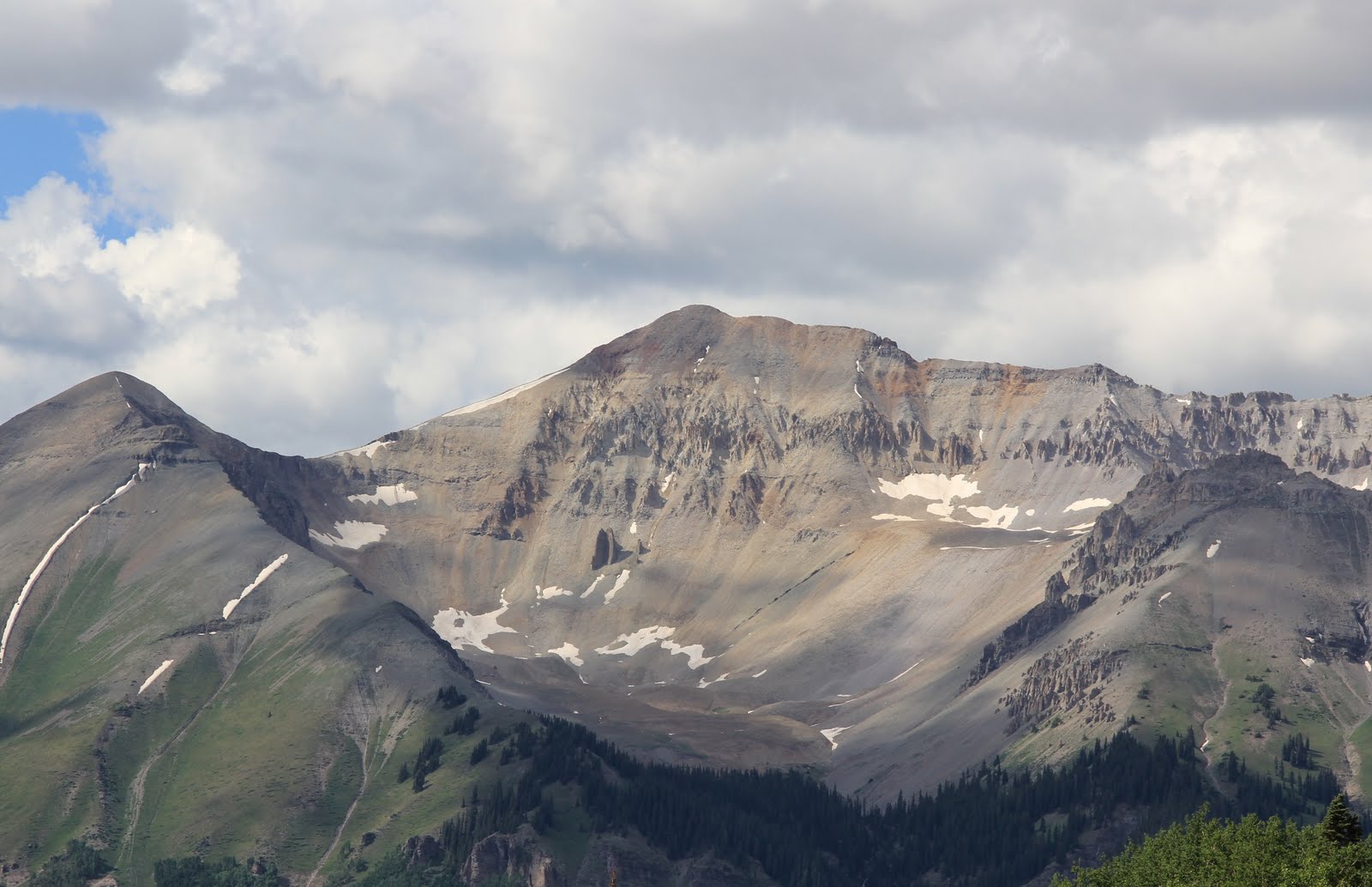
Great Ridges: Teluride


Could there be a more ideal shop? : Teluride


Crazy Crenellations!: Teluride


At Teluride


Posted by Picasa

Teluride

Teluride - a charming tourist-trap of a town at the head of a box-canyon, dwarfed by the enormous mountains that rise up on three sides.

Thursday, August 18, 2011

Osprey: Haviland Lake


Wildflowers: Engineer Mountain

While going up Engineer Mountain (we didn't get all the way!) all I noticed was the awe-inspiring grandeur of the mountain scenery. Descending, my attention was arrested by the carpets of flowers lining our route.

The Meadows: Engineer Mountain

Just about high enough above sea level to notice the reduced oxygen available when climbing!

Self Portrait - on the Million Dollar Highway


Posted by Picasa

On the 'Million Dollar Highway'

US Route 550 winds its way precariously from Silverton to Ouray - threading its way on ledges, cuttings and through hair-pin bends through the San Juan Mountains. The road is narrow, windy, and for every stupendous view it offers up to the peaks - offers a lethal drop down thousands of feet into the abyss below. The road has no safety barriers, and in some places, hardly any clearly defined edges. The temptation for the driver to take his eyes off the road to enjoy the view or to draw breath at the sight of a soaring eagle is great - but in my case more than offset by the terrified screams of the passengers closest to the edge pointing out that our wheels were 'less than two feet from certain death'.

Driving the 'million dollar highway' (a nickname is gained because of the expense of its construction) is a great experience during the day. We were glad we were back through it before nightfall, as further down beyond Silverton we drove through the most intense lighting storm I have ever seen. The rain was so heavy that visibility was dreadful, while the road turned into a torrent of water. The road/river bed looked black and menacing - and was lit up every few seconds by the arcs of lightning slicing and dancing down from the clouds into the trees either side like incessant strobe lighting. Every mile-an-hour we had to slow down meant longer out in worsening conditions, and so the pressure to keep moving at a reasonable speed fought against the fact that sometimes the beams of our headlights revealed nothing at all! The lack of any reflective edges to the road or junctions meant that they were peering hopelessly into the darkness. What the 'million dollar highway' would have been like by that point I cannot imagine. One bookshop owner in Durango told me of the nightmares she had as child about the car going over the edge up there. Apparently her uncle knew the road like the back of his proverbial hand, and would drive it in the dark at break-neck speed - and in those days it was a rough dirt track.

We carried sleeping children from cars back into our holiday house through the still streaming rain, as lightning continued to flash and the lights flickered. Collapsing into deep sofas with huge cups of inordinately strong coffee seemed an appropriate end to the days adventures.

Wednesday, August 17, 2011

Book Notes: A Meal With Jesus by Tim Chester

Although Tim Chester's book weighs in at a slender 138 easy-reading pages, it delivers a massive heavyweight punch in the penetrating insights it offers into the life of Christ - and their implications for the lives of his followers.

Chester's subject is the unlikely one of food - or more precisely meals. 'Unlikely' is a provocative term to use in this context because part of Chester's point is that meal-times were critical in Christ's ministry (especially in Luke's gospel), a pattern that the early church copied - but which we have rendered 'unlikely'. Through looking at the nine meals that Jesus shared with others in that gospel, 'A Meal with Jesus' sets out to re-capture our meal-tables as a place of grace, gospel, community, fellowship, hope, encouragement, and communion. In doing so it presents us with a wonderful theology of food, which is both instructive and inspiring. Anyone familiar with Chester's previous works will know that all these insights he brings will not be presented in a moralistic/legalist framework, but in a grace-soaked gospel-responsive way. This means that the Christian reading this book might well be confronted with several of their own misunderstandings and shortcomings - but will be so in a way that will inspire a joyful closer imitation of Christ!

There is a cliche in Christian circles that, 'worship isn't what you do in a Sunday service, its what you do with the whole of your life'. It's often repeated - but rarely explored. The implications of this for mealtimes that Chester shares are truly fascinating! The default understanding for many people is that while fasting is something we do for God, eating is for us. This book demolishes such thinking as well as the rather dubious Gnostic foundations upon which it rests. "The Son of Man came eating and drinking" the gospel insists and much of the life Jesus lived in perfect communion with The Father, was spent around the meal-table! The meal-table is a place of worship. Chester points out that the Biblical creation-fall-redemption narrative applies to food as much as to anything else. Eden=provision, Fall=alienation which leads to various problems of (i) ingratitude (ii) greed (iii) illness. But then he asks us, what will redemption look like as we apply it to this area and sit down and eat together? Our answer is found in the meals that Jesus shared.

In summary then, here are some notes and quotes through the book:

Meals enact grace. Sinners (that's us folks!) are invited. To eat with a person in Biblical times was to accept them and share fellowship with them. The Pharisees sought to exclude the prostitutes and others 'sinners' from the table-fellowship -but Jesus welcomes sinners. As we are welcomed, so we must welcome!

Meals as enacted community. The church was never intended to be an institution - but a community of faith, in which grace is the determinative attitude. Hospitality (messy, awkward, time-consuming hospitality) is therefore an essential element in sharing life together. This doesn't mean the 'institutionalised' hospitality of the pot-luck in the church hall but the sharing of normal meals. Being 'given to hospitality' was a requirement in the New Testament for the precise reason that the premises were a home and the church meeting primarily a feast!

Meals as enacted hope. The church community, as well as being a group of people who will seek to subdue their 'flesh' through fasting, will also be a people who celebrate the provision of God through feasting! God's physical provision, show his goodness. God's provision of a messiah, is the most wonderful moment in the history of the world. Just as the Old Testament people brought a thankful tithe to Jerusalem, and recognised the provision of God - and then feasted together; how much more should the messianic-community be one in which there are thankful, hopeful feasts!

Meals as enacted mission! (p89) "Jesus didn't run projects, establish ministries, create programs, or put on events. He ate meals. If you routinely share meals, and have a passion for Jesus, then you'll be doing mission. It's not that meals save people. People are saved through the gospel message. But meals will create natural opportunities to share that message in a context that resonates so powerfully with what you are saying". If meals are integral to Christian living in a secular world, Chester also points out that the meal-table of the early church was the place where the lonely came for conversation and the hungry for bread.

Meals as enacted salvation. Just as the fall is pictured as a rebellious act of eating - so salvation through Jesus Christ is embodied in a meal - The Lord's Supper, (Eucharist or Communion). The bread and wine of communion call us to participate in the death and resurrection of Christ and anticipate his return. But Chester argues we have robbed communion of much of its significance by separating it from the meal-table. (p118-9) "The Lord's Supper should be a meal we "earnestly desire" to eat. We should approach it with anticipation. With longing. With excitement. With joy. The Lord's Supper should be a joyous occasion. A vibrant meal with friends. A feast. Our earnest desire must surely affect how we celebrate The Lord's Supper. Today it has commonly become ritualised. We're the group in town whose central meal involves a fragment of bread and a small sip of wine. How is this a foretaste of the messianic banquet? .... Communion should be the feast of friends shared with laughter, tears, prayers and stories. We celebrate the community life that God gives us through the cross and in the Spirit. we can't celebrate it with heads bowed and eyes closed, alone in our private thoughts and strangely solitary even as we're surrounded other people. When we recapture the Lord's Supper as a feast of friends celebrated as a meal in the presence of the Spirit, then it will become something we earnestly desire. It will become the high point in our life together as the people of God." I am so grateful to Chester for making this point so powerfully and eloquently. I am convinced he is right.

Meals as enacted promise. Chester concludes his book with the 'trick' question: 'what are meals for?'. The question is a trick he reveals because in the Bible - everything else is there for the meal! The whole point of everything is that we share in restored fellowship and communion with God and each other through Christ, and in Biblical terms this is usually pictured and celebrated as a meal. (Rev3:20) Here I am! I stand at the door and knock. If anyone hears my voice and opens the door, I will come in and eat with that person, and they with me. Placing the gospel and the church it births in relational, rather than institutional, terms places the meal table back at the centre of church life.

That summary is but a brief glimpse into the many, many things this book contains. A Meal with Jesus is one of the most stimulating Christian books I have read in a long time. It is wise, stirring, grace-filled, heart-warming and action requiring. It is utterly soaked in the gospel of Christ - but yet profoundly challenges many of the patterns into which our families and church fellowships have lapsed, summoning them back to an altogether more authentic, and joyful existence.

One word of warning however. If you are a reader in the UK, make sure when you get this book you get the version published in the UK by IVP, not the Crossway/reLit version. I bought mine in the States and it has been hugely Americanised, both in content and language to the point that it will distract the UK-English speaker significantly. The UK edition is apparently due out soon.

For those of us who endorse that old cliche about worship, ('it's not what you do on a Sunday morning in church, but the whole of life') but want to break worship out from within the confines of worship services so that all of life becomes worship; I cannot think of a better place to start than this book! This is my Christian book recommendation of the year.

Through Red Mountain Pass 3


Through Red Mountain Pass 2


Through Red Mountain Pass 1


Mineral Creek, Colorado

Mineral Creek: dirt roads, hill-trails, fine mountains, campsites - and bear warning signs!

Green Woods, Blues Skies: The San Juans


Posted by Picasa

The San Juan Mountains

(click on photo to enlarge)

The road from Durango to Silverton is one of those drives on which the scenery is so stunning that it is not possible to keep driving. We felt repeatedly compelled to pull over and gape open-mouthed at the mountains. If only pictures could do the experience justice!

Tuesday, August 16, 2011

'Boris' hits the rapids: Pagosa Springs


Get More Out of Life with Coffee! Sign: Pagosa Springs


The riverside cafe in Pagosa Springs seems to have a fine grasp of priorities - and they serve fine coffee too! "Get More Out of Life - with Coffee, Play Better Golf, Fast Relief from Fatigue!" Love it!

WAPPED!

Blogger recently launched a new toy to enable it to compete with the likes of Wordpress -a WAP facility for the blogs they host. This means that when you are viewing the blog on a small device like a phone it presents (posts-only, no side-bar) it in a smaller, more suitable format. Anyone want to try my blog on a phone and tell me how it looks?

Monday, August 15, 2011

Book Notes: Confederates in the Attic by Tony Horwitz

Tony Horwitz' book about the ongoing significance of America's Civil War manages to be fast-paced, educational, incisive, and thought-provoking whilst being a hugely entertaining romp through American landscapes, history, and culture. The title of the book is in itself worth commenting on. The 'attic' refers not merely to the sense that the Confederacy is present but hidden within America (like 'reds under the bed'!), but also more literally to the attic bedroom adorned with Civil War memorabilia that Horwitz occupied as a youngster, prior to coming to public attention as an award-winning international journalist. The sub-title of the book, "Dispatches from the Unfinished Civil War" may come as a surprise to anyone who assumes that the South lost its cause when Lee surrendered to Grant or with the final fall of Richmond, VA. Horwitz' travels demonstrate that the iconic battles of 1861-5, remain psychologically and politically potent forces in the lives of many Americans today.

While in Europe, the victors of wars over the last century have developed a potent folklore and iconography of the conflict, the losers have sought to forge a new identity for themselves (don't mention the war, I did once, but I think I got away with it - Basil Fawlty). In Horwitz' estimation, the opposite has happened with the American Civil War. In the North, the 'American Civil War' has assumed a normal place in the history of the nation. However, for many of the Southerners he meets, 'The War of Northern Aggression', or the 'War Between States' - The Lost Cause still has remarkable cultural potency. Names such as Gen. Robert E. Lee, the patrician warrior, Stonewall Jackson the consummate soldier and 'martyr', and even the fearless, dangerous and psychopathic Nathan Bedford Forrest inspire awe. They also inspire legions of re-enactors, (like the chap on the book's cover, Robert Lee Hodge), some of whom take their re-enacting so seriously that they imitate the precise clothing, hardship, cold and malnutrition of Lee's outgunned, out-manned, outnumbered and under-supplied army. Huddled together for warmth on the precise place where the regiments camped, and fought, at precisely the right hour of the right day of the year, Horwitz travels with the hard-core re-enactors as they seek to relive something of the horrors of 1860s army life, and the terrors of battle at Gettysburg, Antietam, Shiloh, Wilderness, and Vicksburg.

In his travels through the battlefield of the South Horwitz meets the Sons and Daughters of the Confederacy, who at the soft end of the movement seek to honour fallen great-grandparents - but at the more sinister end espouse openly racist ideas. He meets the last surviving Confederate Widow (!), investigates the myths surrounding Gone With the Wind, and tells the appalling story of Andersonville the Confederate concentration camp in which 13,000 Union troops perished in the 'care' of war criminal Henry Wirz. He recoils at the way that the museum seeks to water-down or justify the genocide, and watches in disbelief at the Wirz memorial service. He also encounters African Americans who don't believe the war achieved anything, and espouse separation of races, as well as the family of a young man shot for displaying a Confederate flag.

While he does describe much of the history of the Civil War, Horwitz is as concerned with what it means now. He finds many intriguing and worry things as he goes. The young white man shot by Blacks 'for' displaying the Confederate flag both may have been provoking them in other ways and personally had little or no understanding of the meaning of the flag he displayed. The fact that racist groups have given money to the family and sought to make him the last Confederate martyr - demonstrates more about the ongoing potency of the Civil War imagery in contemporary interracial strife than it does about the actual incident.

Horwitz also explores whether it is possible to celebrate the Confederacy today without endorsing a white, right-wing, semi-fascist agenda. Confederate apologists like to re-cast the conflict in terms of a struggle for States rights in which they the underdog, the victim were overwhelmed by the overbearing power of the advancing Federal government (Tea-party, anyone?!). Northern attempts to portray Lincoln's war as an act of self-sacrifice from the North on behalf of its oppressed Southern Black citizens are equally spin-doctored. Horwitz describes himself as a Northern Liberal Jew - but yet as a child he had huge admiration for the dashing Confederate troops who fought so bravely, in such dreadful conditions in an unwinable war of attrition against a superior enemy. Despite the Southern romantic legend of Stonewall Jackson - and standing where he lost his arm in his final fatal injury, Horwitz can't face wearing the Southern Uniform with the re-enactors. The war may have been about 'States Rights', but the 'right' in question they wished to exercise was that of oppressing millions of people into the savagery of indentured servitude. He continues his trip with the hard core re-enactors, but in the dark-blue of the North.

He finds other people too who struggle handle the legacy of the Civil War. In Richmond, Virginia, from where Jeff Davis ruled the doomed Confederacy, Horwitz finds statues of him and the great Generals of the slave-state, like Lee, Jackson and JEB Stuart, all built while whites were reclaiming the South after Reconstruction. To some Virginianians these are great symbols of Southern Pride - and a statement of defiance against Northern Federal dominance. To others they represent the memories of fallen ancestors. To others they represent the twisted aspiration to reverse the progress of the Civil Rights Movement of the 1950s & 60s and restore a Jim Crow system. When Horwitz was there a debate was raging about these statues. Should they be pulled down in honour of Black-equality and political power in the contemporary city - or left as historical markers. More potent than that - the suggestion had been made to cast a statue of local Black hero, tennis legend Arthur Ashe and place it in Monument Avenue. Arthur's statue was to be much smaller than Jackson, Davis or Lee - but would his presence there be a sign of progress or would it demean his legacy by placing him in the shadow of those who would have oppressed his grand-parents? More significantly - would placing Ashe there play-down the crimes of the Confederacy's racist war? Today Ashe stands proudly in Richmond. The past may not be reconciled, but its complexity is represented.

This is a really, really good read. Horwitz is an astute observer, and a very good writer. His storytelling from history is as good as his interactions with the present. He is as solid in his rejection of bigotry as he is in his good-natured appreciation for people with all their eccentricities, and history. The book is actually more amusing because he resists the obvious writer's temptation to mock or ridicule people who want to lie in wet-trenches dressed in 1860s battle fatigues (etc); but lies with them, smiles with them and seeks to enter their world and experience. The nod to the 'real world' of friends and family who thinks such weekend pastimes are ludicrous, is then not condemnatory, but shared with his friends lying with him in the Gettysburg field

I recently blogged about how much I had enjoyed reading Stuart Maconie's book about Britain, in which he mixes travel-writing, autobiography, history, culture and politics by travelling around key British historical sites and examining how their legacy interacts with the present. I hadn't come across anyone else writing in that strange intersection of genres - but when I got to the States and stumbled across Horwitz, I was delighted. This is great stuff.

'Norris' loses his hippie-hair!

While in Scotland, young Norris had spent at least a term cultivating and sporting an increasingly splendid mound of hippy hair. Wearing 'nature's-scarf' in this way is probably quite sensible in Perth where summer can last anything up to twenty minutes, and scale the dizzy heights of 12'C. Sadly, Arizona was just too hot for all that loft insulation and it had to be removed. The result was a straightforward trade in which he lost his flowing locks and style and gained physical comfort. The photo is the bag of hair we collected at the end of the procedure...

Silverton 'Station'


Posted by Picasa

Silverton Warning Sign


Desert Architecture

The scale of these dunes and towers is only apparent when
you notice the 'huge' pylon (bottom left).
Utah, USA.
Posted by Picasa

Don't Panic...


Caution: Big scary beasties!
Monument Valley, Utah.
(squirrel photo, by 'Boris')

The Mittens

Monument Valley, Utah
Posted by Picasa

Wednesday, July 13, 2011

Book Notes: Hope & Glory (The Days That Made Britain) by Stuart Maconie

Over the last few years, genial BBC Radio host, Stuart Maconie has produced a series of books about Britain. These books, (Pies and Prejudice, Adventures on the High Teas, and now Hope and Glory) don't fall easily into any one particular category, but roam through travel, music, autobiography, history, culture, TV etc etc. In fact they roam like the thoughts of an astute radio host, engaging, provoking, and observing.

The latest of these, Hope and Glory is as good as anything in 'Pies' and far better than 'High Teas'. Maconie might be writing in a slightly odd genre that is all his own - but he does it with such style, and warmth that the result is almost perfect holiday reading - in that it is neither vacuous drivel about nothing like the archetypal airport novel, but neither is it academic research and argument requiring great concentration. Rather, Maconie succeeds in taking the reader on a journey around Britain, and through a century of its history, and does so gently, wittily and on occasion rather movingly.

The premise of 'Hope and Glory' is this: To mark ten critical dates from the 20th Century which have come to define Britain, visit the places concerned, and write a observational reflective travelogue on the experience and the history. The choosing of the dates, as well as the content of each foray is directed entirely by Maconie's personal whims. He does not pretend to be an objective historian but comes across as a well-informed friend taking us on a tour of his neighbourhood. So we encounter the first day of the Somme, the '66 cup final, the miners strike, Live Aid, the invention of TV, the Silver Jubilee, Enoch Powell and the Windrush, The 1997 New-Labour victory, and more.

When Maconie tells the stories of whole families of sons wiped out on the first day of the Battle of the Somme, he does so with affecting empathy. He, of course was a journalist before a Radio host, and can write with telling pathos when required. He also visits some of the 'thankful villages', places where no memorial was built because every soldier returned from the trenches. Remarkable stuff, well told.

These are no mere history lessons however, when exploring Alexandra Palace and investigating the origins of TV, BBC and Lord Reith, he uses it as a tangent to explore (vent!) his feelings about where TV has taken us:

"Sometimes the togetherness that the TV community engenders can be comforting: a big football match, occasions of state, the Morecambe and Wise Christmas specials of the 70s. But more and more, I find this consensus weird, false and deadeningly stupid. I've lost count of the number of times that I've been told 'everyone watches the X-factor', that it's not meant to be deep, it's just entertainment' and that I'm 'a snob' for not liking it. I, for my part, try and convince these people that I have better things to do. Like nail my own hand to a tree trunk."

Likewise, when assessing the impact of Live Aid, both as a musical event, as a part of the national consciousness and as a major factor in the creation of the modern cult of celebrity with all its wretched vacuousness, Maconie is incisive and persuasive. However, when discussing the famine itself and the terrible suffering of the Ethiopian people, his writing is delicate, sensitive and passionate:

He quotes Michael Buerk's famous report from the Ethiopian refugee camps:

"Dawn, and as the sun breaks through the piercing chill of night on the plains outside Korem, it lights up a biblical famine, now in the twentieth century. This place, say workers here, is the closest thing to hell on earth".

And comments:

"There've been those who've taken issue with Michael Buerk's famous opening words to his landmark piece. They say that the 'biblical' reference implies that what we see is an act of God, unavoidable and accidental. I think that's being deliberately obtuse. What Beurk means, and what we can see for ourselves as the camera pans across a parched landscape of huddled corpses, weeping children and skeletal animals, across a cracked, hellish vista of smoke and dust, is that this is biblical in scale and imagery. This does not look like something from our modern world of cars and computers and skyscrapers. It looks like Golgotha"

The book isn't all sombre however. There are plenty of lighter moments, of entertaining characters, dryly amusing anecdotes and quirky reminiscences en route. Maconie seems to be unusually adept at turning our attention rapidly through all aspects of Britishness from the scars of warfare on the national psyche to the glories and eccentricities of hillwalking or tea-shops.

In all of this, Maconie's personal opinions are writ large. This means that in the course of his travelogue he will upset or infuriate people such as monarchists, Thatcherites, Nick Clegg, and others. He writes with deep affection about the aspects of Britain he finds heroic, which include punk, multiculturalism, the miners, and football! The only sad note for me was the few scattered withering dismissals of Christianity and the church, which while they reflect his own experiences he has documented elsewhere - radically differ from my own. I don't find the community of the church to be 'the life-denying opposite of a library'; but rather life-informing, life-giving and life-enhancing.

This one disappointment aside, Hope and Glory is a thoroughly enjoyable and informative romp through a hundred years of British history as distilled through the mind of Stuart Maconie. His tone is to chat, rather than lecture, and to engage as much as to educate - to provoke as well as to describe; and he does so with disarming wit, and natural eloquence.

Wednesday, July 06, 2011

Book Notes: King's Cross by Timothy Keller

Tim Keller's latest book "King's Cross" shares many things in common with his previous works, but differs from them significantly too. The continuities lie in the theology, in which Keller's trademark emphasis on human sin being conquered by unquenchable divine grace in Christ, is everywhere. Likewise, Keller's insightful reading of the human condition and contemporary Western culture makes his diagnoses of our sins, fears and foibles as hard-hitting -as his invitation to trust in Jesus Christ to address them is winsome.

The differences between this and previous books are in content and structure. Previously Keller has written on Christian Apologetics, Idolatry, Grace and Rebellion and Justice - and these have read as 'books', in that they develop a clear line of argument, as they address one specific aspect of Christian faith and life. King's Cross on the other hand reads more like a series of meditations (probably edited sermons) on the life, death and resurrection of Christ. In eighteen short chapters Keller teases out the significance for us of a series of key events in Mark's action-packed gospel.

This is good, helpful, straightforward reading which could be of enormous benefit to anyone who has read the gospel accounts of the life of Christ but who seeks further insight into their contemporary relevance or what sort of response they demand from us.

Of all Keller's books though it is probably the one which has had the least immediate impact on me. I suspect that this is for a number of reasons including the fact that it is the one from which I have learnt the least. Reason for God was a hugely educational read, Prodigal God was glorious in its celebration of the grace of God; Counterfeit Gods was explosive in its unmasking of our idolatries in contrast to the worship of God; and Generous Justice was compelling in the case it made for Christians to pursue social justice as a response to the gospel of Christ. King's Cross functions more as a persuasive and eloquent re-expression of core Christian ideas which many of us have known for a long time. Additionally, the elements of 'surprise' were more muted than in my previous encounters with Keller. His particular genius is in the threeway interplay between text-theology-and-contemporary culture; and he is at his most helpful when he brings the fruit of these interactions to bear upon us; in ways which have often startled me with their re-awakening of over-familiar stories. To be sure there is a steady supply of such gems throughout King's Cross, and his handling of stories such as the healing of the hemorrhaging woman, the transfiguration of Jesus, and his arrest are wonderful. Perhaps this book had fewer such moments for me than previous books was because I had read/heard Keller on a number of these themes before.

While this book doesn't mark an important shift in my understanding or emphasis, it is still a really worthwhile read. Ultimately Keller takes the reader's attention to Jesus and rivets it there. His desire is to allow the reader to enter the same journey of discovery that the disciples experience in Mark's gospel. It begins with a sense of intrigue in the person of Jesus Christ, but during the gradual process of the unveiling of Jesus' true identity during his life; that intrigue turns first to trust, then to worship and then to obedience.

Tuesday, July 05, 2011

Independence Day: July 4th at Silverton

You haven't seen a real waterfight, until you have seen the firebrigade having one, using fire-engines, and high pressure hoses! In the old mining town of Silverton, high in the San Juan range of the Rocky Mountains, this is exactly how they celebrate American Independence Day.
The competing teams are the fire departments of Silverton and neighbouring Durango. The rules of the contest are pretty straightforward: the firefighters advance towards each other with firehoses on full-blast. The winners are the last ones still standing! The pictures above show Silverton pressing home their advantage.

With several injuries, and many of them sent flying by the water-cannons, amidst much cheering and hilarity - both teams then turn their hoses on the crowds.


Of course, Colorado wasn't involved in the original July 4th Declaration of Independence, but this doesn't stop this unique and jovial patriotic display. All men (sic) are indeed created equal and endowed by their creator with the right to life, liberty and the pursuit of happiness. No effigies of George III were burned and the locals seemed very happy to allow a load of us Brits to join in their celebration of getting rid of us.

Sunday, July 03, 2011

Through Deserts & Mountains: Tucson to Durango


On the map, the journey from Tucson Arizona, through the edge of Utah and on to Durango in Colorado looked a bit tedious. In order to alleviate the potential nine or ten hours of long desert roads, we organised a detour via Monument Valley. Monument Valley is famous for its amazing scenery, its use as a backdrop for many cowboy movies, and being at the heart of the Navajo reservation. It may have added a couple of hours onto our journey, but the sight of these extraordinary, and massive, rock sculptures in the desert was.. 'awesome' (to seek to rediscover a much misused and maligned word).

Below: A shot of "The Mexican Hat" taken from the car window..

Much of the rest of the day did involve long roads through shimmering deserts.

The long drive proved to be more full of interest and variety than I had anticipated, though. The scenery seemed to decisively change gear every fifty miles or so. The sand and cacti of the road out of Tucson was soon joined by ranges of great mountains with amazing ridges, that looked as if they would make great days walking and climbing at a cooler time of year.

Further into the journey we travelled through vast grassy plains, which evoked quite different moods. These were replaced with strange uniform hummocky shapes which looked like row upon row of eggs in a box, as we got nearer they proved to be massive sand dunes which had been shaped by desert winds, then covered in a fine layer of grasses. Beyond these we entered a barren rocky region where from roadside to hilltop there was no trace of soil, just bare solid rock. One or two bushes managed to cling to life by rooting into fissures in the rock, but they were the only thing which persuaded the eye that we hadn't ended up on the moon. Then we would round a corner, or enter a new valley and be mesmerised by extraordinary rock patterns, contours and colours.


Next, the road we were on would be something built on piers over hundreds of deep, narrow canyons disappearing into the earth below and around us. Then as we climbed towards the San Juan range of the Rocky Mountains, crossing the bright blue river of the same name, we once again crossed grassy plains before the sun left us to complete our trip in dark. Our anticipated ten hours of motoring boredom turned out to be full of surprise, delight and amazement at every turn.

Friday, July 01, 2011

Perth to Tucson

Our friend Stan very kindly drove us to Edinburgh Airport at 5:30am, to allow us to start our travels to the USA. Along with kindness, one of his other great qualities is exuberant ebullience - something which even the ridiculously early hour was unable to diminish. We grunted our bleary-eyed thanks and watched our car disappear Perthwards. Edinburgh check-in was straightforward and we boarded a Bae 146 for Paris.

Flying directly over my hometown was an interesting experience. Cloudy Scotland gave way to a sunny southeast England, and almost perfect visibility. Heathrow Airport caught my eye initially, followed by the distinctive shape of The Queen Mary reservoir, Ashford Manor Golf Course, and Fordbridge Roundabout. These shapes helped me locate Fordbridge Road, Stanwell Road - and the house I lived in for most of my childhood, and all of my teenage years. Fordbridge Park, the scene of countless hours of football was still there, as was the River Ash, presumably still full of stickleback fish awaiting children's nets. Stranger still was the thought that my parents were 30,000ft below us, and that the last glimpse of my childhood home before they sell it will have been from so far above.

They joy of travel was rudely interrupted by The French. I know that invoking national stereotypes is uncultured, rude, ignorant and I make huge efforts to avoid such crass writing. However, in France I can't help sometimes feeling that they are invoking the stereotype themselves and laughing at us. Suffice to say, my experience is that they are as good as cooking as they are bad at organising airports, and that the collective national 'gallic-shrug' as the proposed solution to these shortcomings doesn't diffuse the rising tension all around!

The late flight meant a lost connection it Atlanta, Georgia. Delta Airlines 767s might be a little old, tired, and worn looking, but the staff are really efficient and friendly. They knew we would be late, and had arranged hotel accommodation and food vouchers for us. The security regime at Atlanta was unbelievable. I liked the fact that while US Immigration staff have learnt the art of politeness and smiling since my last visit, they were as thorough as ever. I was dreading having made an error on my ESTA applications for the family, and our holiday ending abruptly and sadly! What I couldn't believe was that at Atlanta you have to go through security to get OUT of the airport! We'd done rigorous security twice in Paris already, then to have to take off the same shoes and belts, and unpack the same laptops and cameras for scanning again, just to get out of the place- seemed bizarre.

Nevertheless, a night's sleep later we were airborne again, in a terrible old 737 with broken toilets. It took us high over the Deep South, over the Mississippi Delta, into the desert. The descent between the mountains of Tuscon was amazing. Jagged ridges and high peaks encircled the city, spread out in typical US grid-pattern below.

On the ground in Tucson I was as pleased to see the ever-affable 'Percy Cowpat' as I was shocked at the intensity of the desert heat which pressed in on the skin the second we stepped out of the air-conditioned terminal. The short drive through the city underlined the truth of the old sarcastic cliche that the UK and the US are 'two cultures divided by a common language'. The differences here are massive, and obvious everywhere in the dry, dry air of Tucson in mid-summer. The dry river-beds which dissect the city, were as alien a sight to us as the architecture designed to deflect as much of the power of the sun as possible. The wide main-streets look so different than ours with their ubiquitous low-rise buildings and high-rise advertising hoardings. I have spent many weeks in the NE USA in places such as Philadelphia. Philly 'felt' like being in a foreign country, either in the high-rise of centre-city, or the projects (social housing) just outside it. Tucson 'feels' like a foreign country again, but apart from the fact that English is understood, its hard to believe that it's the same country as Pennsylvania.

Rest from travel finally came our way at the house of our dear friends. ("so good to see you" "wow, haven't they grown...!). Rest, that was rudely interrupted by my jet-lagged body-clock whose idea of a joke was to wake my weary limbs at 2am insisting that it must be getting-up time by now. I need to sleep, tomorrow we drive 10hrs to the Colorado Rockies.