Showing posts with label Parenting. Show all posts

Wednesday, July 04, 2018

Inchmahome and Lake of Mentieth


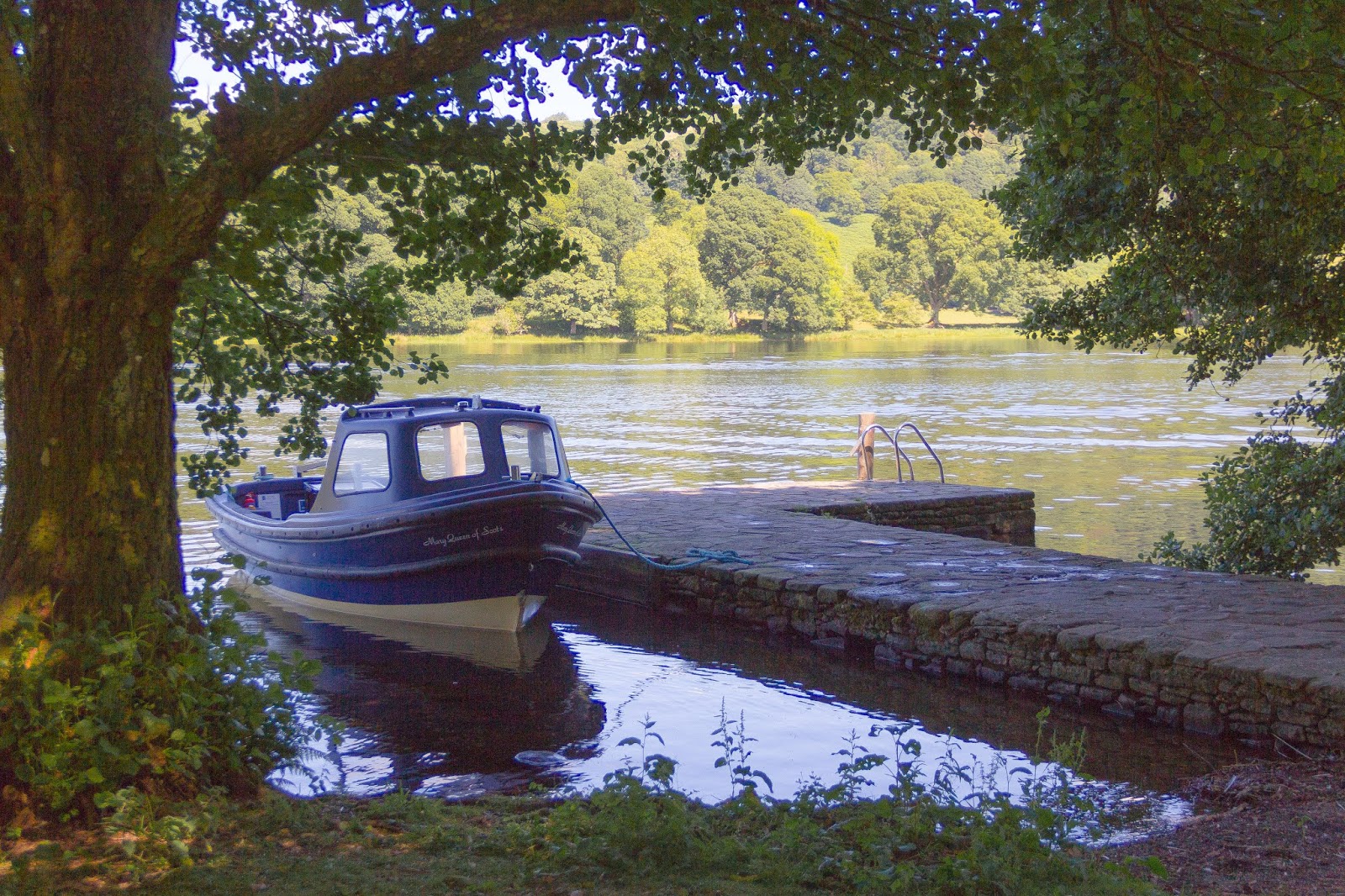
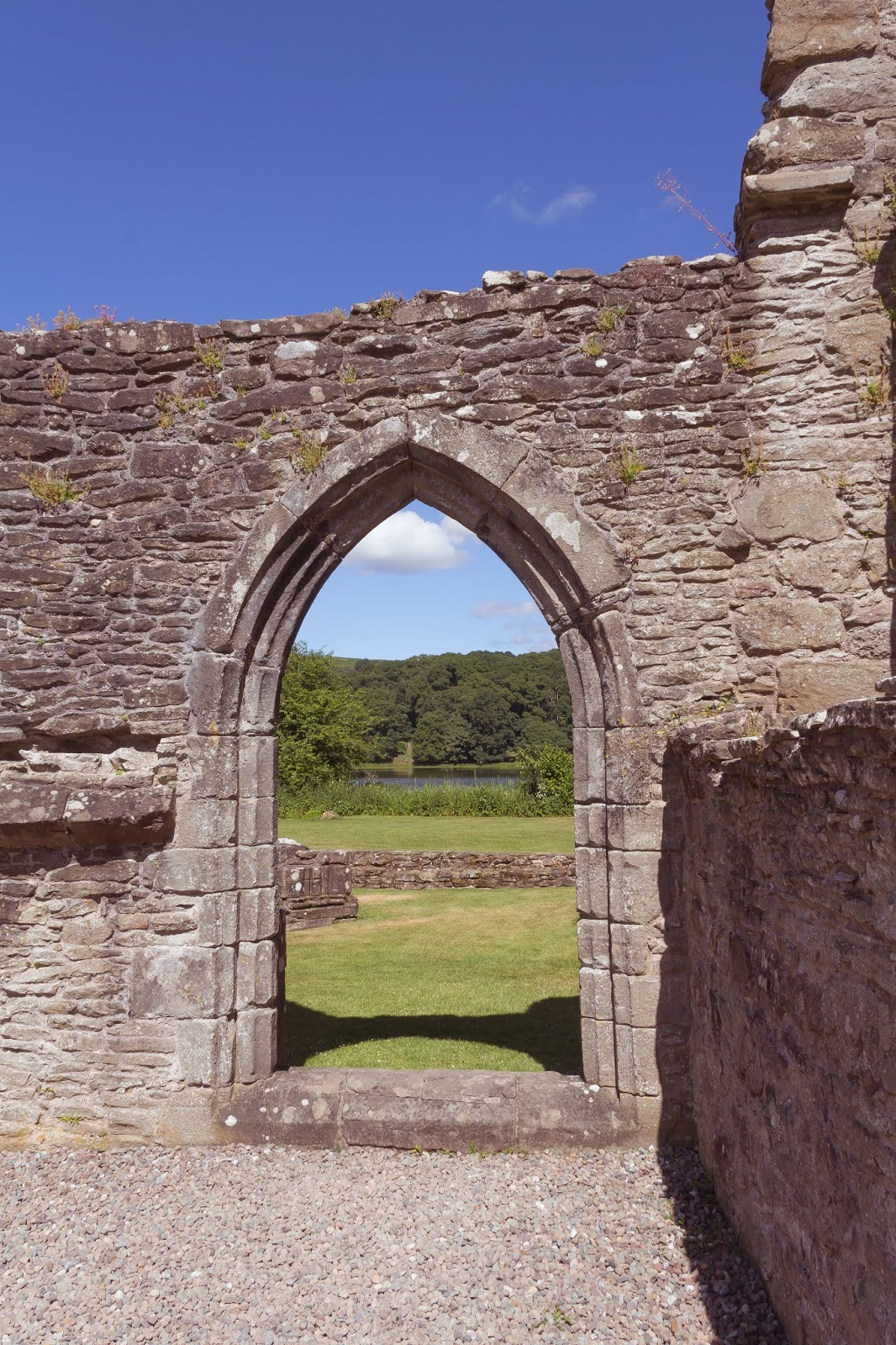
My daughter has been reading about Mary Queen of Scots, at school. That seemed like enough of an excuse to go out for the day to Inchmahome Priory ruins on the island in The Lake of Mentieth. It was here that the young Mary was taken from her home in Stirling, to conceal her when Scotland was under threat of English invasion.

Apart from all that, it's a lovely place for a day out, a picnic and time with my daughter......


Saturday, March 04, 2017

Book Notes: Out There by Chris Townsend

I first became aware of Chris Townsend as the equipment reviewer for TGO (The Great Outdoors) magazine, telling me which boots were badly made, which stoves are useless in a moderate breeze, or which tents are easiest to pack-away in a storm! There was usually a little thumbnail picture of his face alongside the review, and I think I may have actually seen him on a hill near Ullapool once, over a decade ago. Without any doubt I once saw Cameron McNeish (who contributes a forward to this volume) filling his car up at the Auchenkilns service station north of Glasgow, many, many years ago before the road was upgraded. I was going to say hello, but he was in a hurry, with his head down - and didn't look especially approachable! So, when I was given a copy of Townsend's Out There for Christmas, I was aware of him, but had no idea what the book would be like. It turned out to be an unusual and rather lovely book, quite unlike any other outdoor book I have read.

Out There, is not a route book, it's not a technical how-to book, it's not a macho 'conquer the wild' survival guide, or even an endurance and survival memoir - it doesn't fit into any of those well-rehearsed genres of outdoor writing. Rather uniquely Out There, is a series of essays about different aspects of the wild environment, the value of it, being in it, the sensations it produces, great past writing about it, pioneers of it's exploration and preservation, of walks, camps and backpacks up small hills and across vast continents. Although what I am about to write sounds as if the book is dreadfully cliched and cheesy, Out There reads less like an outdoor manual, and more like a series of love-letters and eulogies to wild country. Townsend just loves wild land, in fact he seems to like it the more wild and unaffected by humanity he can get it. The book isn't romantic in the sense of a romantic poet gushing over the countryside in mystical whimsy; rather every paragraph of this delightful book is simply pulsing with Townsends love of the outdoors. His writing I found especially moving was were his descriptions of places I have seen, especially those in the Scottish Highlands which he has explored extensively; and where I have had many, many wonderful days.

Although this is about North America, this is how he remembers a night under the stars:
"On the first few days, I was captivated by the way the rocks changed colour with the passing of the hours - black, dark grey, deep red, gold, pale yellow, cream then darkening back to black - and the way shafts of sunlight lit up the shaggy red bark of an incense cedar, the way the creeks sparkled as they slid over speckled ganite" (p125)
This passion comes through whether Townsend is writing about long-distance paths like the Cape Wrath Trail, of encounters with wolves or bears, of battling the elements in the Arctic, or camping in a gentle woodland. I have to confess that some of Townsend's exploits are beyond those that most of us could ever contemplate; either in terms fitness, time or cost. Not many people get to walk the length of America - even if they were so inclined. It is tempting to think about such schemes, and to look at maps of the Pacific Crest Trail  - only to be brought back to the sober reality, that my last attempt to climb a modest Corbett were stymied by the need to pick kids up from school!

This is just a wonderful read for anyone who loves the outdoors. My most regular walk is a circuit of little Kinnoull Hill in Perth - at the other end of the spectrum to Townsend's huge achievements. But for a modest hill plodder like myself, there is so much in this book which is inspiring. Happily, the book avoids being diverted into other discussions - particularly politics, which add an unwelcome tension to some hill writers works. This is about Townsend's love of the wild, and little else. The best chapters are those in which he writes about the benefits of the wild, how to appreciate them most, and of his appreciation of it. The less interesting are those at the end which tend to be more straightforward memoirs of places, and trips; although those these too are good reads.

The book describes Townsend as amongst other things a photographer - and so I was a little disappointed that there were no photos in the book. I found that reading the book with a Google image search to hand was enjoyable, as the vast majority of places he describes, have been photographed by others. I subsequently discovered that he has his own website, http://www.christownsendoutdoors.com/ which does contain some images.

Townsend quotes John Muir - something of a hero in the book; who wrote:
"Everyboody needs beauty as well as bread, places to play in and pray in, where nature may heal and give strength to body and soul alike." (p149)
It is early March, and the rain is currently lashing the roof slates on my house, which makes my study tucked in the very top of the building, rattle and vibrate. In fact, it sounds not unlike some of Townsend's descriptions of wild nights under canvass! I have been on 'parent duty' all day - which isn't something I begrudge by the way; but with Out There, open on my desk; I am itching to get my boots back on, feel a pack on my back, and see the hills again. I need beauty as well as bread.

Tuesday, February 28, 2017

Book Notes: A Better Story: God, Sex and Human Flourishing by Glynn Harrison

Glynn Harrison who was until recently Professor of Psychiatry at the University of Bristol, is also a Christian with orthodox/conservative Christian views about sexual ethics, family life and so forth. This unusual combination of expertise and convictions come together in his new, and rather unusual book: A Better Story. 

I think it is important to grasp who this book is aimed at, in order to appreciate the contribution it makes to these discussions; and understand what this book is not, as well as what it is. Beginning with the 'what it is not' then, A Better Story is not a detailed biblical or theological argument as to why Christians should continue to maintain their traditional ethics. Neither is it a defence of the procedure of deferring to the Bible, as the final authority for a Christian or a church's faith and practise. So, if you are looking for a book which engages with liberal theology (which seeks to move the ethical debate beyond the Bible), or with the 'evangelical left', and its radically revisionist readings of scripture; this is not the book for you. Rather, in these pages, Harrison writes for people who have reached broadly similar conclusions to himself about these foundational matters; but who are bewildered about how to relate to the contemporary world. 

Harrison manages to achieve these aims with great skill, combining serious academic rigour, with remarkably accessible language; while coupling orthodoxy with pastoral sensitivity. This makes the book worth reading in itself; however there is more. A Better Story isn't a church rule book, or a blue-print as to handle awkward ethical dilemmas in the life of the church. In fact, in his discussion of matters such as the case of a polygamous family who became Christians and sought to join a church; he demonstrates just how difficult these matters are. But this book is not a short-cut, which will offer a church a series of answers with which to avoid thinking; rather it is an invitation to think long and hard about what it means to be a biblical church in the particular circumstances in which we now find ourselves.

The book is divided into three sections, and within these, each chapter comes with a helpful summary at the end. These are especially useful for reminding the reader of the main points of earlier chapters, when the book moves so rapidly from one area to the next. 

Section One explains the so-called 'sexual revolution' not just in terms of social history, but also in philosophical and theological categories - including the re-emergence of Gnosticism, and the triumph of hyper-individualism, how moral systems are constructed and propagated, and the effects these changes have had on society and individuals.  A particularly fascinating chapter explains to the church how to adjust to being a 'cognitive minority'; who need to spend more effort in maintaining group ethos, than a previous generation of Christians who generally swam in cultural waters moving in the same direction as themselves.

Section Two begins with a critique of the church's dealing with sexual matters in the light of the sexual revolution he mapped out in section one. Interestingly, Harrison is not entirely negative in his assessment of all the changes brought about by the sexual revolution, noting that prior to it, the linking of sex with shame and secrecy was as unbiblical as what replaced it - and that the church was frequently complicit in this error. Then Harrison turns his attention to the effects of the sexual revolution revealing some interesting research which suggests that "the sexual revolution promised more and better sex, but failed to deliver". While sex might be more visible in the media, and all over social media, and society has become increasingly porn saturated; surveys suggest that the amount actual sex taking place, and people reporting sexual satisfaction is dropping. The value of, and decline in the institution of marriage is examined next, with an array of studies cited demonstrating the correlation of marriage with a whole host of benefits (without assuming crass cause and effects where they can't be demonstrated btw). One finding is of particular significance. Harrison notes that while the middle and upper-classes have led the liberal assault on the primacy of the marriage relationship and its historic definition; they continue to have higher rates of marital stability. On the other hand, the more vulnerable socio-economic groups have embraced this cultural shift, and failed to capitalise on all the demonstrable social goods that flow from the institution. Finally, in this section, Harrison turns his attention to the nature of identity - as it is today located in radically individualistic terms; and where the search for 'authenticity' is seen as a turning inwards to one's individual perception of their true-self; as opposed to an outward view in which external verification is sought, from biology, society, or God.

Section Three is where Harrison turns his attention to the distinctive Christian response to these issues; where the three subjects of the book's subtitle (God, Sex, Human Flourishing) come together. He develops several lines of argument, all of which are rich with ideas, insights and wisdom. His first task is to start with the basic Christian message, and to demonstrate the way in which the gospel provides a context and meaning for the whole of life; a big story of which the issues at hand are but a part. The concept of human flourishing which emerges here is that of redemption by Christ, and growth into his image, secure in his identity. Harrison then addresses how human sexuality is an important part of that flourishing, both as expressed in the covenant of marriage, and equally in the single life. Both, he demonstrates equally reflect different aspects of the gospel narrative, and the nature of God. As such, sexual desire should be shorn of any shame, and singleness of any social awkwardness, because both are important parts of what God planned for us, and things with which we glorify him. He moves on to look at the importance of marriage, family and church community as medium-level institutions, in which human flourishing is promoted. These are the opposite of the echo-chambers of social media where people mix in circles of people just like them; but where long-term relationships are forged with people we might not always choose! Then, he takes the church to task for failing to address this radically positive view of sexuality in the Christian life, (in other words only being known for what we are against), and states that every church should have a programme supporting marriage and parenting!

A thread running through all this material is that of the importance "story", of narratives which define the argument, which have more power than mere facts in moving and persuading people. By this, he doesn't just mean individual stories (important though they are), but also the narratives which are used to define debates, and interpret cultures. A dominant narrative today might be that we have finally thrown off the shackles of Christian guilt and can enjoy and explore sex more fully than previous generations. This is the sort of narrative that Harrison is challenging in this book; but he is anxious to tell us that we cannot do so just by quoting reports, and statistics alone - but that we need to construct and tell "a better story". On pages 180-182, he maps out what this better story might look like. It begins like this:


And continues, mapping out what a Christian and biblical view of human sexuality and flourishing looks like today, concluding with a repudiation of 'Christendom' style models of imposing our morality on others, in favour of a more gracious invitation to all to join us on this path.

For people and churches who share Harrison's core convictions, "A Better Story", is essential reading, as it is insightful, wise, scholarly, accessible, stirring to read and challenging the church both to faithfulness to its message and to repentance for its errors. It gives unusually clear access to complex areas of discussion and social analysis, without dumbing these issues down. It also gives orthodox Christians a great guide for beginning to think more engagingly and creatively about these difficult subjects. Christian morality will no doubt continue to be accused of being limiting, oppressive and immoral; but Harrison believes that it is enriching, and good for us all. For those who do not share Harrison's starting point, he provides a suggested reading list under various headings which explore these ideas in greater detail. This book deserves to be widely read - not least by revisionists who wish to move Christian ethics away from its biblical roots, and towards contemporary norms. Engaging with Harrison would be a helpful way for such folks to at least understand their opponents! The book also deserves to be widely read by those in broad agreement with Harrison; not least because doing so will help to prevent them either avoiding these issues and handing the ground by default to the wider culture, with all the problems that involves; but also because Harrison is a wise-guide in helping to ensure that such engagement will not be crass, controlling, or involve resurrecting the shame-culture of a bygone age.

---
Glynn Harrison was Professor and Head of the Department of Psychiatry, University of Bristol, where he was also a Consultant Psychiatrist. He now researches and writes about the relationship between Christian  faith and psychology, neuroscience and psychiatry.

Wednesday, October 14, 2015

Lochs, Rivers, Bridges and Leaping Salmon - The Faskally Circuit

Despite the beautiful autumnal sunshine, clear weather forecast and almost perfectly still air, we didn't head for the high mountains. Sadly, my wife is carrying a bit of an injury to her right shin/ankle which seems to get aggravated by hard walking. Instead, we went to Pitlochry and walked the paths and roads which form a circuit of Loch Faskally and its two main feeding rivers, The Tummel and The Garry.

The Car Park near Pitlochry Station has a road which leads under the tracks and down towards the Hydro-Electric dam, which is one of the town's most well known features. The dam, which blocked the River Tummel just after WWII, created Loch Faskally, and provides 15MW of power for the National Grid. While some artificial lochs look very artificial, Faskally has a remarkably natural feel to it, given how short a period of time it has been part of the landscape. It is also home to a network of easily navigable waymarked paths which form pleasant and undemanding walking routes.

We struck Northwards up the East side of the loch. The route begins on a shore-hugging footpath, then diverts around some housing and picks up a minor road out to a boat club. Here, the town is left behind and the lochside path, decked in autumn colours is delightful.

The first landmark in the route is the bridge which takes the A9 trunk road high over the loch. Its amazing to think that until 1981, all the North-South traffic between The Central Belt and The Highlands was funnelled through Pitlochry High Street on the old A9. My Grandparents regularly drove (or moped-ed) the old A9, on their highland holidays, which often began with a Motorail journey through England - which itself had no complete motorway network in those days. The queues in Pitlochry High Street in the summer must have been demoralising for tourists and locals alike. These days the A9 is slewed across the glen and back, and Pitlochry is but a series of roofs and spires on the far side, as far as most travellers are concerned. The only negative aspect of this is that the railway line has not been upgraded over the years in which untold millions has been spent on (and is continuing to be spent on) the A9. That, and the fact that most travellers to the North are carried high above the lovely lochs, woods and rivers that surround Pitlochry, which are simply not visible from the tarmac and crash-barriers. Looking up from under the A9 bridge over which we have driven maybe hundreds of times, we realised what we had been missing!

Immediately under the A9 bridge, a footbridge crosses the river, we didn't cross it, but continued up the East
side of the Tummel - that bridge would be part of our return route, and the last in a series of remarkable and dramatic footbridges which have been hurled across the rivers here. The path follows the bank of the river, past the confluence of the Tummel and The Garry and the majestic Faskally House. eventually passing under the soaring bridge of the Loch Rannoch, Rannoch Station and Rannoch Moor road. Nearly a quarter of a century ago my wife and I drove over along that road on one of our first dates; today we walked under it with two of our three children, while our oldest (who earlier in the day received confirmation that he is entered on the electoral role and vote in the Scottish elections next year), stayed at home to revise for his exams: tempus fugit!

A few hundred yards past the high road bridge, an amazing footbridge crosses the river. A path continues to Killiecrankie, but time prevented us from going further, and we crossed to begin our return walk down the west side of the river and loch. Crossing the bridge, my wife realised that she had seen this view before - but wasn't sure where. Suddenly she unearthed a memory.... these bridges in the Pass of Killiecrankie had been on the cover of the University of Dundee 1990 Prospectus which she had received prior to going there to read medicine. It turned out that this was a walk she had been intending to do since then!

The path back down the west side of the Garry is charming, with open fields and farms complementing the fast-flowing torrent now on the left. The return walk is longer than the outward leg, as the River Tummel, joining the Garry from the West, presents an uncross-able obstacle at the confluence. A diversion of a mile or two up the Tummel to another (wonderful) footbridge is required in order to resume southward progress. This however is no bad thing, as the excursion up the Linn of Tummel is one of the highlights of the walk. As we were there, the waters were crashing over the rocks, with Salmon hurling themselves into the fray in their annual upriver migration. It would be worth coming our here for this alone!


Once over the Tummel, the route joins an unclassified road which runs behind the Clunie power station, and on to the first footbridge by the A9 road, and the completion of the circuit. All that remains is a gentle plod along the side of Loch Faskally back to Pitlochry - and the inevitable coffee shop visit before the drive home. This may not have been an epic mountain day, and McNeish might be optimistic in calling this one of "Scotland's 100 Greatest Walks", but it is a charming and delightful place, full of interest and beauty, perfect for a Winter walk, or to enjoy in autumn colours.


Monday, September 07, 2015

Beinn Bhuidhe

Beinn Bhuidhe (which I am told is pronounced byn voowee) is a mountain which quite exceeded my expectations when I plodded up in on Saturday with one of my neighbours and our respective sons. What I was expecting was a fairly dull hill (perhaps the name had put me off), to be climbed in mediocre weather, with limited views. So we agreed to go for a walk with a bit of a reluctant sense of  "oh well - it's better to be out than sitting at home, or doing the chores, (or the days alternative activity) - shopping with our wives and daughters!"  Readers need not be concerned for my well-being at this point, as I am fairly confident that my wife never ever reads my blog!

In truth was that Beinn Bhuidhe tuned out to be a lovely hill, which was bathed in sunshine all day. The ever-pessimistic Mountain Weather Information Service were gloomily warning about the air temperature on the summit feeling like -5'C (with windchill taken into account). Sitting on the top in T-shirts in bright sunshine, I tried and failed to make my son understand why I had insisted he carried warm layers and hats and gloves up the hill. This was weight he thought he could have done without, but was forced to lug up 3000+ft because of what he sees as my excess caution!

Walking in September means that there is a fair possibility of encountering stalking on the hills. The estate on which Beinn Bhuidhe sits, provides general information on their answerphone, which we consulted the night before we left. It mostly insisted that we "stick to the accepted route", which we tried to do, although as we had read two different mountain guidebooks (SMC and McNeish), it wasn't at all clear which route was the agreed one. Perhaps if estates want us walkers to keep out of their way they could provide better information? I for one, am happy to change my routes and plans so as not to disrupt estate business (or get accidentally shot!)

A car park is provided at the head of Loch Fyne. It is hidden amongst the trees on the unclassified road which swings away from the main road alongside the River Fyne. The walking books are absolutely correct to point walkers over the river and up the track on the East side of Glen Fyne. The track past the saw-mill and power station on the West side of the Glen end up in the middle of some ghastly quarry workings which can't even be seen from the attractive path on the other side of the glen.

The track leads all the way to an abandoned cottage called Inverchorachan. There were no signs of life when we past the cottage, although someone had clearly spent time and money keeping the roof and windows watertight. At Inverchorachan. the upper reaches of Glen Fyne draw the eye Northwards to the mighty bulk of magnificent Ben Lui at Tyndrum. Later as height is gained, its neighbours Beinn Oss and Beinn Dubhcraig loom into view as well.

Just beyond the cottage, a gate bars the way forward. Within five yards or so of the gate a feint path heads left into the hill through the deep bracken, picking its muddy way between rocks and up alongside the Allt na Faing river. The path becomes clearer as it progresses, but is quite overgrown and easy to miss at its start.

The path leads up through a wet scrambly and slippery gorge before breaking out into a marshy plateau at 
around  700m. By this stage the views were really starting to become exciting, and the grim reading of the weather forecast the night before a fading memory. Once the summit is sighted it also becomes clear just what a big walk this is. Strangely,McNeish's "Munros" book both under-estimates the time and distance of this walk significantly. I usually find his timings pretty reasonable, but something went wrong on this page of the book. We reckoned the walk was about 4 miles longer than he writes, and an hour more too.

Once the marshy plateau is crossed, a steep (but obvious) path picks its way up side of the summit ridge. The gradient is brutal, but the views get better with every step. When the path finally breaches the ridge, the view is just stunning. The ridges of Ben Cruachan above The Pass of Brander and Loch Awe grab the attention immediately. They are massive, and beautiful. Then as the eye searches wider, The Arrochar Alps fill the East and Mull to the West. Then Ben More at Crianlarich roams into view. To the North, Glen Coe, The Mamores and the distinctive shape of Ben Nevis slumbering in unaccustomed hazy sunshine. What an absolute treat to lie in the sun and soak this all in.

The mistake which we (and many other walkers) made on descent was to take the new hydro road back to the glen floor. Don't! Is is relentlessly destructive to the soles of the feet, is a ghastly visual eyesore scarred into the side of an otherwise lovely mountain, and brings you down on the track that leads to through the industrial quarry workings. They are the ugliest thing I have ever seen in a Scottish Glen. The only good thing about them is that they are shielded by trees and therefore not visible from the track up the East side of the river. 

Bheinn Bhuidhe was full of surprises - not the dull lump of moss I had been expecting at all!


Tuesday, August 18, 2015

Meall Buidhe (Knoydart)

There are various mountains called Meall Buidhe scattered around Scotland, most of which are at the less-exciting end of the scale! This cannot be said for Meall Buidhe on Knoydart, which is a truly splendid mountain, with graceful lines, lovely ridges, steep sides, and some of the finest views imaginable. There are a clutch of Munros which have taken me two attempts to climb. Beinn na Lap (beaten back by bad weather), Ben Lui (problems parking and then deep snow), Ben Chonzie (white out), Cruach Ardrain (couldn't find summit cairn in blizzard), and Meall Buidhe (Knoydart). On a previous expedition, with a church walking group, we'd trekked in from Kinloch Hourn and camped at Barrisdale Bay. Our expedition over Ladhar Bheinn had been wonderful, but on our second day (in dreadful weather) we failed to find the ridge from Luinne Bheinn to Meall Buidhe. The compass readings seemed to be a bit odd, and there was some concern that iron in the rocks was giving us false readings, and so a decision was taken to abandon the walk and head back to the tents. It turned into a glorious evening too, with the sun sparkling on the waters of Loch Hourn. Nevertheless, the failure to gain the summit of Meall Buidhe meant that it was a challenge deferred.

That trip was over fifteen years ago, shortly after the birth of my first son, and years before my second son had even been contemplated! However, it was #2 son who accompanied me on my return to Knoydart last weekend. This time, we avoided the long walk in from Kinloch Hourn, and took the easier option of the boat from Mallaig to Inverie.

The campsite at Long Beach, Inverie provides plenty of space for tents, fire-places, logs for sale,  a washing up area, a tap and a toilet. The situation of the site is perhaps a little unfortunate in that, even when there is a breeze by the pier in 'downtown Inverie' (!), Long Beach is so protected that the motionless air is a haven for midgies. To compensate for this, most campers had prepared open fires which were designed as smoke-bombs, to deter the ghastly little biters. At one point I cooked outside the tent, with a midgie-net over my head, and skin-so-soft on my hands, and passed the food into the tent so that my son could eat without himself being eaten! The water supply at the site has two interesting and
contrasting notices on it. The first is an official-looking Scottish Water one which warns campers of the dangers of drinking this untreated water, and advises that (as it is a potential carrier of bacterial infection), it should be boiled or chemically sterilised. The second is a local sign which re-assures campers that this is the same water that supplies all the local houses, that they are fine with it, and that we are welcome to sample the local water at our own risk! We risked it, and have not yet experienced any troublesome side-effects...

Using the 'composting toilet' is an interesting experience! I think that users should be
offered the same advise as those taken climbing in Skye. "You are going to be fine - just don't look down!"

On Saturday morning, we bade farewell to out little tent, the midgies and the seashore and began our ascent of Meall Buidhe. There seems to be one main track leading from the village towards the mountains, behind Inverie House, and past the dramatically positioned monument on the little Torr a Bhalbhain above the Inverie River. Looking upstream, the valley splits into two, lying in a "Y-shape", with Meall Buidhe sitting right at the centre. To the left of the mountain, the track reaches Mam Barrisdale, the high pass over to Barrisdale Bay. The right hand fork, up the Gleann Meadail eventually reaches Mam Meadail, the bealach on the pass towards Sourlies Bothy and the great mountains of Glen Dessary and the "Rough Bounds of Knoydart". My son pointed out that not only does the scenery of Knoydart look like Middle-Earth, but that the place names here are also Tokeinesque. He added that Tolkein would have written Knoydar, without the "T" though.

Our first mistake of the day was to miss the right turn on the track which lead to the bridge over the Inverie River. We were too engaged in conversation, and by the time we realised it, had gone way too far along the main track towards the Loch-an-Dubh-Lochain. Cutting across the grass towards the bridge was a big mistake though. We ended up in really rough, and horribly boggy ground, which for my son meant a whole day of walking ahead of him with a soaking right foot.

Once we found the bridge, we were happily back on dry land for a few hours. The track past the Druim Bothy into Gleann Meadail is a decent one, and it leads all the way up the glen, with views back towards Inverie which become ever more impressive as height is gained. The Alt Gleann Meadail has a series of spectacular waterfalls to enjoy in the upper half of the glen too. After the soaking wet 'summer' we have endured this year, these were in full spate on Saturday and looked marvellous.

At Mam Meadail, the path turns SEwards and descends sharply down towards Sourlies. From here there is no obvious path leading up the
mountain, but several possible lines of ascent, all of which look marked with the boot-prints of hundreds of previous walkers. We pointed the compass at a line just East of due North and struck up the steepest section of the days walking. Wet, slippery, in a couple of places a bit scrambly we pulled ourselves up the 250m or so onto the ridge. The greatest danger here is not from exposure, as there isn't much of that, but from scree falling onto walkers below. One one occasion one very large boulder I stood on, began to slide down the hill, stopping not far from my son scrambling up behind me. After sustained heavy rain, this hillside is quite unstable and should be handled with some caution. Once the ridged is gained, all such difficulties vanish, and are replaced by a remarkably pleasant, broad grassy ridge running over a top and up to the Munro.

It was as we approached the cairn, that we realised that my son had dropped his GoPro camera when he had stumbled somewhere on the climb. He was absolutely gutted. It was sealed within its watertight case,
and so should be fine for some time up there. If you are reading this before heading up there, please keep your eyes open. If you see it, drop me a note in the comments! Despite this loss, we were gob-smacked by the views, with great mountains such as Ladhar Beinn and Sgurr na Ciche appearing and disappearing into cloud along with vast panoramas of mountains in  tangles of peaks, impossible to identify individually. 
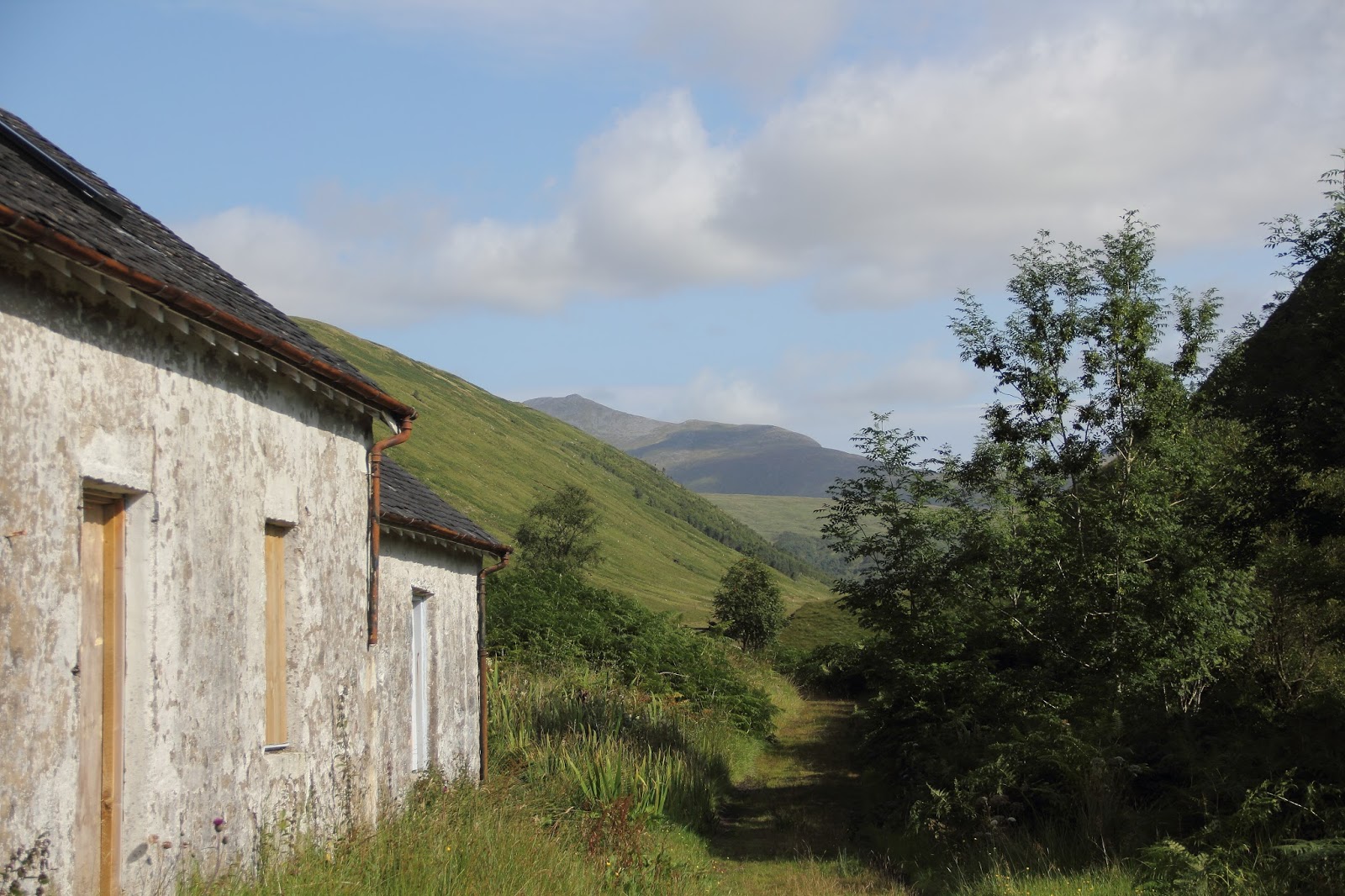
The top of Meall Buidhe is a great ridge which the 1:25,000 gives various names to. "Meall Buidhe" at it's highest Eastern end, "An t-Uriolloch" in the centre, and "Drium Righeanaich" it's long western arm, descending towards the base of the glen. Just as we stopped for lunch we were arrested by the sight of a

Golden Eagle circling in the Glen below us. Massive, distinctive and stunningly beautiful, it soared on the mountain winds for a few moments before changing its mind and flying off towards Beinn Buidhe to the South.

After descending the Druim Righeanaich to the valley floor, we headed straight for the bridge we could see, about a mile ahead of us, on the far side of what looked like a grassy field. In fact, in places this was more like a swamp, an sodden marsh of saturated peat and floating vegetation which was extremely awkward to cross without getting extremely wet. Progress across this last obstacle of the day was horribly
slow, and with a table booked at The Old Forge, we had a deadline to meet. After chatting to the only other walkers we saw all day, as they overtook us on the marsh, we made the track, the campsite, dry clothes and walked to the pub, just making our booked time.

On the map, Meall Buidhe doesn't look like too much of a challenge. It's only one major climb, and the complete circuit is only about 14 miles. In reality however, it is a serious walk. While up on the mountain's glorious ridges the walking is undiluted joy; getting up onto, and then off, the ridges requires extensive battling with pretty hard-going underfoot conditions. After very heavy rain, these present quite tricky obstacles. The views that Meall Buidhe provides however, are simply unmissable!

Meall Buidhe from the campsite