Showing posts with label Health. Show all posts
Wednesday, March 30, 2016
The "Tour de Tay"!
Anyone who lives in Perth, Dundee (or intervening points), who owns a bike should have a go at this! The "Tour de Tay", is a well known circuit to local cyclists, who have been recommending it to me for years. Today I finally had a crack at it, and it really is a splendid ride.
This ride is a circuit of the tidal Tay estuary, a loop with the Tay Road Bridge in Dundee at one end, and The Queen's Bridge over the Tay in Perth at the other. The two cities are connected by a series of marked cycle routes for the entire length of the Northern leg through Perthshire and Dundee City, and for about half the Southern leg through Fife.
I had a dilemma about whether to do the circuit clockwise or anti-clockwise. I was starting and ending the route in Perth and knew that (i) the hardest climb on the route was around Kinnoull Hill near Perth on the southern leg; (ii) a strong Westerly wind was blowing all day; (iii) the Southern leg was more undulating and forested, whereas the Northern route was very wind exposed. Putting all this together I elected to go anti-clockwise.
Attacking the Tour de Tay anticlockwise from Perth necessitates a big climb to start proceedings. Coming from the East of the city, I worked my way up steep Manse road, through the new housing, before joining the official cycle route over the Jubilee, past Balthayock and down to Glencarse. Here the A90 is crossed and the 'B' road to Dundee via Errol picked up. I was blown along this road at a rate of knots by a delicious tail wind that would become a menacing headwind on the return journey.
The massive redevelopment of Dundee's waterfront, means that the cycle route to the Tay Bridge is a bit convoluted, but it is reasonably well marked, Bizarrely, cyclists are required to take a lift up onto the Tay Bridge, where they are greeted with a very strange surface to cycle on. It seems to be a series of wooden boards coated with tar, which creak and rattle as you cycle over them!
Once off the bridge, I turned to face the wind, and realised that getting back to Perth would take some concerted effort. While in terms of raw speed, this was obviously bad - there is a plus side. Last week I was informed that I am overweight, and that my cholesterol is too high. Coupled with my family history of cardiac related issues, I was told it was time to take some action. A headwind then is my friend - akin to turning up the resistance on an exercise bike! I tried to tell myself this, but of course in truth I was dreading the thought of the ascents in Fife being into the wind! The worst of this was on the hard climb from the delightfully named Bottomcraig up to Hazelton Walls, after which the terrain became much easier. Cholesterol issues or not, such effort required some chocolate!
The cycle routes are all well marked on this ride, and take the rider from Dundee all the way to Newburgh, where the waymarked route dives South towards Auchtermuchty. Along the South side of the Tay the views beyond Perth to the snow-capped high mountains are stunning. Ben Vorlich to the west and Bheinn a Ghlo to the North were especially impressive. Road-wise, the route back to Perth from here is pretty grim, its fast, busy roads with little scope for admiring the lovely views. The Baiglie Straight, leads into Bridge of Earn, which in turn leads into Perth over a final climb, before dropping into the town via the Edinburgh Road.
54 miles in 4hrs isn't a fast run - but it's a lovely route!
Monday, January 11, 2016
Film Notes: Amour
WARNING - this review contains major plot spoilers!
Amour is a film which leaves an indelible impression upon the viewer. It is a film which provokes discussion amongst those who watch it, and will no doubt continue to divide opinion for years to come. Amour is both a stunningly beautiful and yet ultimately dark film. Unsurprisingly it garnered 2 Baftas and 5 Oscar nominations, and a Cannes Palme D'Or.
Jean-Louis Trintignant and Emmanuel Riva lead the cast as Georges and Anne Laurent, an elderly French couple, who are both retired music teachers in their late 80s. Their acting is spellbindingly brilliant, and the characters they create in their delivery of a 'difficult' story are both completely convincing, and emotionally engaging. I have seen too many films in which wooden or melodramatic acting has left me disengaged, and disinterested in the fate of the characters. Trintignant and Riva are the opposite of this, as the elderly couple negotiate joy, pain, sorrow, tenderness and rage; they do so, so with such depth and subtlety that I for one couldn't take my eyes off the screen for a second. It is sadly unusual to see elderly people expressing deep affection,
tenderness and love in films. Perhaps Hollywood is especially guilty in this regard; and it takes an Austrian film-maker, working in French to do so. Hollywood tends to think that love is the exclusive preserve of the smooth-skinned and fertile; whereas the real world contains people like Georges and Anne Laurent; life-long lovers and inseparable friends who gently and tenderly help each other with their daily tasks.
The film is brilliantly shot, and virtually every scene takes place in their apartment. The viewer feels completely drawn in to both the characters and the place. The camera's detailed studies of the faces of both Georges and Anne, are hugely impressive; and only add to the power of the performances by Tritignant and Riva.
Central to the story is the stroke suffered by Anne Laurent, in front of her husband. Riva is just superb, in her transmission of the strange combination of physical adjustment, fear, sadness and dignified resilience. Alongside her, Tritignant is wonderful as the husband both sorrowful at his wife's debilitation, but yet stoical in doing everything he can to help her recover as much as is possible. One scene I found especially moving was when George helps Anne with her recovery physio, working to try and coax life and response from her reluctant limbs.
Why then, is this a dark film? The reason is that as the story develops, George receives no help from family, friends, neighbours or the state and as he is left as the sole carer for Anne, and begins to personally unravel. Anne expresses her desire to refuse water and die, but he persists with his dogged caring regime, whilst internally disintegrating, to the point where he slaps his wife and collapses in regret. This emotionally jarring scene rams home the message that as the patient, Anne's physical deterioration is matched by Georges, her carer's, parallel psychological descent.
Finally, in a complex and difficult emotional scene, George grabs a pillow and smothers his wife; scatters her body with flowers and runs away. The viewer is left with a tangled sense of relief that Anne's suffering has come to an end, but horror at the way in which it has occurred; involuntary euthanasia - which is murder. There is also the acute sense that somewhere off-screen, Georges' psychological torment has only just begun.
The film has received differing reviews. While there seems to be unanimity about the undoubted quality of the cinematography and the acting; the film's moral message has caused some consternation because the film seems to be promoting euthanasia as the final act of love: "Amour". The film delivers a mighty amount of angst and emotional recoil from "the slap" scene; but appears to invite the viewer to share in the idea of euthanasia as a 'good ending'.
Margaret Morganroth Gullete, in her insightful review of 'Amour', for The Guardian writes:
‘One of the implicit convictions of the film is that a carer – even one as assiduous as Jean-Louis Trintignant's Georges – will crack under the strain of caring for a stroke victim… yet the circumstances shown in Amour are highly unusual. Money is no object for this couple. The carer has no pressing health issues of his own. He is also a man. And, though highly educated, he is a man who apparently has never received any advice about caregiving.’
This set of circumstances, she argues, is rather contrived:
‘Carers are now advised to arrange respite care: to get out, eat properly, enjoy a social life. It's understood that their own health and mental wellbeing is at stake. As well as this, Georges could easily have secured more help from other agencies… a daughter better educated about disability might have said words of love to her mother, and persuaded her – while it was still possible – to go out for tea, out in her wheelchair, to visit a friend. The family doctor, who makes house calls, could certainly have provided adequate pain medication for Anne; morphine could have eased her passing. Georges had more compassionate alternatives available to him than smothering his wife with a pillow.’
P.J. Saunders goes further, (perhaps his argument is in breach of Godwin's Law), as he draws a parallel between Amour and the German film Ich klag an, which was used in 1941 as a way of making German public opinion sympathetic to euthanasia, as a prelude to the killing of significant numbers of sick and disabled people. However, one need not draw (or endorse) such an extreme parallel to Amour, to be deeply concerned about the moral undercurrent behind the film.
Finally 'Amour' is a brilliant piece of film-making containing simply stunning acting, but it is harnessed to deliver a dubious moral message.
Wednesday, December 03, 2014
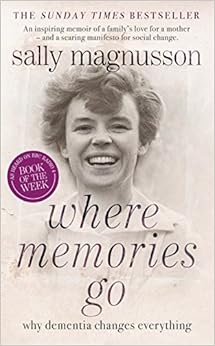
Book Notes: Where Memories Go by Sally Magnusson
I first came across this book when I heard the author reading an edited version of it on Radio4.. I was doing something as mundane as driving home with the weekly shopping, but couldn't leave the car until the end of the episode. It is not just that I recognised her voice (she is after all on 'Reporting Scotland' every week), or that one of the first 'proper books' I ever read was her biography of Eric Liddel; my attention was so arrested because this book used the most beautifully moving prose to open up a dark and painful world about which I knew almost nothing.
Magnusson writes as if directly to her mother, the celebrated Scottish journalist Mamie Baird, observing her, as dementia steadily weakens, confuses, frightens, bewilders and detaches her; and finally takes her life. Magnusson writes so well and loads her narrative with such telling recollections and observations that the reader is drawn right into what would otherwise be a very private tragedy. As such it is no easy reading, not because it is academically or intellectually demanding, but because it is so very real. It is always the case that love has the power to amplify loss and this is a book written out of a deep and affecting love. Who cannot help but be profoundly affected when they read that in a rare moment of lucidity her mother says, "I am travelling down a long road away from myself"? Who, but the utterly stone-hearted could fail to ache with empathy when they read of this family saying to their confused and angry Mother, "Why do you have to fight?" to be told "Because that's all I can do now."?
The book skilfully weaves together memories of Mamie Baird in all her vivacious, and eccentric vigour before dementia took her prisoner, with the story of her decline. Alongside this are recorded the reactions and coping strategies of family, friends and carers who struggled to come to terms with the disturbing effects of this ghastly brain disease. What adds an extra dimension to the book though is that Magnusson takes well-informed and highly informative excursions into understanding the physical processes of dementia; savagely critiques much of the care offered to sufferers today, and gropes towards an understanding of the disease which allows her to honour the remaining intact parts of her beloved mother.
And 'honour' is an important concept here for me. While reading this book, I happened to be helping a local church with some of their Sunday services and we were working through The Ten Commandments. When we reached "Honour your Father and Your Mother" I had always placed an emphasis on the difficulty which following this principle had posed to people who's parents were profoundly dishonourable: the woeful, the negligent and the abusive. I had never really considered what it would mean to act honourably towards parents who are declining, who are on that 'long road away from themselves'.. This book is not just very loving, but also deeply honouring to Magnusson's Mother. What I found most satisfying in that regard was the way in which Sally and her family honoured their Mum, throughout the long ordeal of her illness. They honoured who she now "was", as the same person as who she "used to be". This makes "Where Memories Go" a very sad book indeed; but yet a rather noble one.
Equally fascinating was Magusson's account of the way in which music played a profound role in helping to connect with her Mother deep into the progression of the illness. Mamie Baird had, we read, always loved music and was a singer and mouth-organ player with a large repertoire of songs. These songs played a critical role in connecting, calming and reaching her - sometimes during very dark days indeed. Magnusson's interview with a brain specialist about this power of music is especially insightful. She learns that music contains multiple simultaneous stimuli, (music, lyrics, arrangement, accents) which have been re-enforced by repetition over many years, and that these are powerfully connected to memories. That simultaneous multiple stimuli increases the chances of connectivity through a diseased brain in which so many of the pathways are not functioning. There were times when Sally Magnusson's mother was unable to speak coherently, but could sing old songs. Following this she has set up a charity, "Playlist for Life" facilitating the provision of personally significant music for dementia sufferers - which can be so significant for sufferers and carers alike. Their video follows:
I have not personally encountered dementia of the kind that so damaged Sally Magnusson's mother, and caused so much pain to her and her family. I do have friends who are experiencing this in their parents, and Sally Magnusson's important book has given me far greater insight into the kinds of difficulties, pains, joys and sorrows through which they are now travelling. "Where memories go" is intensely moving, and utterly compelling, quite heartbreaking in the loss it details, yet quite beautifully constructed.
There is a facebook group dedicated to the book available here.
Thursday, November 06, 2014
Balding with Stan - Sponsored Head Shave for Cancer Research

Tuesday, March 19, 2013
A Good Death
A Good Death from PRN Films on Vimeo.
A Good Death is a film about end-of-life care by my friend Robin Taylor
Wednesday, October 24, 2012
Book Notes: Bad Pharma by Ben Goldacre
Ben Goldacre, who's newspaper column and book "Bad Science" has done so much to expose myth posing as science; has now turned his attention to the pharmaceutical industry. While his previous works have mentioned pharmaceuticals many times (he is after all, by trade, a medical doctor), "Bad Pharma" is his book-length expose of what he believes is wrong in this multi-billion dollar global industry. The results are quite shocking.
The basic thesis of the book is that the prescribing of drugs that takes place in clinics and hospitals is based on faulty evidence, and so is untrustworthy. The body of literature, of published peer-reviewed research, which are reviewed to produce drug liscencing and prescribing formularies has been (by a legion of distortions) systematically skewed by the trade in order to protect their profits and make their products appear to be more beneficial and less harmful than transparently fair trials could ever claim.
A major chunk of the book is given over to the problem of "missing data". That is the practice of simply hushing-up any trial result that does not produce a commercially beneficial result. The flip side of that is the selection of odd bits of trial data that look good (weird anomalies, or from unrepresentative sub-groups) and publishing just this data as if it were a whole trial. Goldacre explains and exposes this practice, with some poignant examples. He also demonstrates the ways in which this problem has been identified but not addressed by governments and regulators. Promises to open-up future research are, he argues, totally inadequate - as prescribing practice is based on the whole body of published research, accumulated over a few decades. He is demanding that drug companies, and regulators immediately release the results of all unpublished trials...
The rest of the book follows the steps a drug must go through in order to become licensed, marketed, and finally prescribed by doctors and then swallowed by us. These include research articles getting published in journals, regulators assessing the published evidence and issuing guidelines, and the process of marketing to doctors (and patients where countries permit this). What Goldacre alarmingly demonstrates is that the smallest distortions and biases at each stage of this process produce outcomes which are far-from the evidence-based prescribing to which all the Drs I know aspire and strive. So, journals funded by advertising from drug companies, or even owned by them, allow misrepresentations and publish selectively. New drugs which "work" gain headline status and influence prescribing, while serious head-to-head trials to demonstrate which is best are neglected. Regulators, say Goldacre, set the bar too low for approving medicines - in many cases only demanding that they beat placebo in trials, not demanding that they represent any advance on previous medicines. The scam of almost identical drugs being manufactured in order to basically renew copyright on older products is exposed; as is the manipulation of both doctors and patients through the billions spent on "marketing" products and "educating" doctors. Goldacre comprehensively explains these processes and how they should work, demonstrates the ways in which they have been distorted, and suggests ways in which these can be corrected. So, for example, he suggests that GP's do not allow drug-reps into their buildings as evidence shows that despite the rules and best intentions in practice they demonstrably influence prescribing.
Most disturbingly in all this, Goldacre shows that these distortions to process, openness and proper regulation have not simply kept doctors and patients in the dark; not even merely allowed us to be recipients of "less than best" medicines, not merely cost health services unnecessary millions; but in several documented cases have actually caused harm. One example involves a pain killer which had an unfortunate side effect (unusual numbers of people taking it died), the drug company knew this - but buried the research for years until the product was withdrawn.
At each of these stages, Goldacre shows that various governments, politicians and industry whistle-blowers have identified the problems he describes, and attempted to fix them. To cite one example; in theory all trials should be published now - whether or not the results suit the industry. However - he continues by showing that these 'fixes' have been illusory, the data-bases of trials being conducted are hopeless, and there is no effective policing of the industry to enforce compliance, he argues. At each stage, he shows that while the problems he highlights are recognised across the world; the fixes in place are failing.
One of the most extraordinary things has been the reaction to the book from the industry. A spokesman from the Bristish Pharmaceutical Industry issued a rebuttal of the book which was demonstrated primarily that he hadn't actually read it. Goldacre in at least three instances anticipates the industry excuses, and answers them in detail; only for the industry just to trot them out as if they were convincing and final. So for instance, Goldacre details some of the huge fines levied on Glaxo-Smith-Kline in the USA for malpractice. He goes onto show that they are a British based company, whose drugs, practises and personnel involved in the American scandal are involved in, and affect their European operations; arguing that it is no-use for GSK to say in the UK that the American situation was nothing to do with them. So - when they pop and say, "nothing to do with us" they are using an excuse which has not only been anticipated but answered.
It is clear that if even half of what Ben Goldacre has so meticulously documented here is true - then there is a huge scandal as big or bigger than the banking crisis going on all around us every day. This isn't an ideological rant against big-business- this concerns the health and well-being of anyone who takes medicines and whether they can do so with confidence that the chemicals they are putting in their bodies really are the best treatment for them; or whether the choice of what drug they are taking has actually shaped by selective or mis-information, advertising budgets, dubious education programmes for doctors, all undetected by poor and secretive regulation. Frankly, the pill I have to take every morning for a minor stomach-complaint: to what extent has my long term well-being been in tension with the share-price of its manufacturer, and to what extent has the flow of information from lab to journal to regulator to doctor been distorted by that tension?
Bad Pharma suffers in places from being over-long, and is a little repetitive in places. These flaws should not stop anyone from getting it, and being appalled. Goldacre suggests various responses that should be made, which are directed at researchers, drug companies, doctors, regulators and us patients too. Many of these are no more than robustly enforcing the kind of regulation which has long-been promised but never delivered. The most urgent call for the public though is to start campaigning for an end to the scandal of missing data. That means, not to promise to details all future trials and publish all results; but to release all the hidden data from the buried trials which skew the systematic reviews of research on which prescribing formularies are based. It seems clear to me that the only way that the industry can prove that it has nothing to hide, is to hide nothing.
The rest of the book follows the steps a drug must go through in order to become licensed, marketed, and finally prescribed by doctors and then swallowed by us. These include research articles getting published in journals, regulators assessing the published evidence and issuing guidelines, and the process of marketing to doctors (and patients where countries permit this). What Goldacre alarmingly demonstrates is that the smallest distortions and biases at each stage of this process produce outcomes which are far-from the evidence-based prescribing to which all the Drs I know aspire and strive. So, journals funded by advertising from drug companies, or even owned by them, allow misrepresentations and publish selectively. New drugs which "work" gain headline status and influence prescribing, while serious head-to-head trials to demonstrate which is best are neglected. Regulators, say Goldacre, set the bar too low for approving medicines - in many cases only demanding that they beat placebo in trials, not demanding that they represent any advance on previous medicines. The scam of almost identical drugs being manufactured in order to basically renew copyright on older products is exposed; as is the manipulation of both doctors and patients through the billions spent on "marketing" products and "educating" doctors. Goldacre comprehensively explains these processes and how they should work, demonstrates the ways in which they have been distorted, and suggests ways in which these can be corrected. So, for example, he suggests that GP's do not allow drug-reps into their buildings as evidence shows that despite the rules and best intentions in practice they demonstrably influence prescribing.
Most disturbingly in all this, Goldacre shows that these distortions to process, openness and proper regulation have not simply kept doctors and patients in the dark; not even merely allowed us to be recipients of "less than best" medicines, not merely cost health services unnecessary millions; but in several documented cases have actually caused harm. One example involves a pain killer which had an unfortunate side effect (unusual numbers of people taking it died), the drug company knew this - but buried the research for years until the product was withdrawn.
At each of these stages, Goldacre shows that various governments, politicians and industry whistle-blowers have identified the problems he describes, and attempted to fix them. To cite one example; in theory all trials should be published now - whether or not the results suit the industry. However - he continues by showing that these 'fixes' have been illusory, the data-bases of trials being conducted are hopeless, and there is no effective policing of the industry to enforce compliance, he argues. At each stage, he shows that while the problems he highlights are recognised across the world; the fixes in place are failing.
One of the most extraordinary things has been the reaction to the book from the industry. A spokesman from the Bristish Pharmaceutical Industry issued a rebuttal of the book which was demonstrated primarily that he hadn't actually read it. Goldacre in at least three instances anticipates the industry excuses, and answers them in detail; only for the industry just to trot them out as if they were convincing and final. So for instance, Goldacre details some of the huge fines levied on Glaxo-Smith-Kline in the USA for malpractice. He goes onto show that they are a British based company, whose drugs, practises and personnel involved in the American scandal are involved in, and affect their European operations; arguing that it is no-use for GSK to say in the UK that the American situation was nothing to do with them. So - when they pop and say, "nothing to do with us" they are using an excuse which has not only been anticipated but answered.
It is clear that if even half of what Ben Goldacre has so meticulously documented here is true - then there is a huge scandal as big or bigger than the banking crisis going on all around us every day. This isn't an ideological rant against big-business- this concerns the health and well-being of anyone who takes medicines and whether they can do so with confidence that the chemicals they are putting in their bodies really are the best treatment for them; or whether the choice of what drug they are taking has actually shaped by selective or mis-information, advertising budgets, dubious education programmes for doctors, all undetected by poor and secretive regulation. Frankly, the pill I have to take every morning for a minor stomach-complaint: to what extent has my long term well-being been in tension with the share-price of its manufacturer, and to what extent has the flow of information from lab to journal to regulator to doctor been distorted by that tension?
Bad Pharma suffers in places from being over-long, and is a little repetitive in places. These flaws should not stop anyone from getting it, and being appalled. Goldacre suggests various responses that should be made, which are directed at researchers, drug companies, doctors, regulators and us patients too. Many of these are no more than robustly enforcing the kind of regulation which has long-been promised but never delivered. The most urgent call for the public though is to start campaigning for an end to the scandal of missing data. That means, not to promise to details all future trials and publish all results; but to release all the hidden data from the buried trials which skew the systematic reviews of research on which prescribing formularies are based. It seems clear to me that the only way that the industry can prove that it has nothing to hide, is to hide nothing.
Wednesday, October 19, 2011
Roll Wyn James - live at Perth Concert Hall

Perth Concert Hall's Norrie Miller Suite was packed-out for a fine evening of guitar-driven blues last night. Alongside their genuinely exciting playing, Perth-based Blues band Roll Wyn James, brought an extra dimension to the evening by talking about the gradual return to music of founder member Alwyn James following a catastrophic stroke over a decade ago. James himself had organised the gig as a fundraiser for Chest Heart and Stroke Scotland and contributed on keys and harmonica throughout the night.
Alongside Alwyn James, the band is built around the fabulous rhythm section of Chris Agnew (bass) and Kevin Smith whose drumming was as creative as his facial expressions which might even scare Ginger Baker! Front-man Paul Henderson's vocals held-up well for most of the evening but his lead-guitar work was stunning throughout. Able to play with speed and power where necessary, but also having the discipline to use space and to play the long-bends that give Blues-guitar its pathos, there were moments reminiscent of the late, great Gary Moore - or even Peter Green.
Grooving, driving, kicking and bluesing through a set of both their own material and blues standards, the band used the songs as a platform for some exciting improvisations and trading solos. Highlights for me were some of the numbers when bassist Chris Agnew took the vocals, and guitarist Henderson was really let loose. Their instrumental Chrome Blues, is a fiery hybrid of songs like Caldonia and Gary Moore's Texas Strut brought their main set to a fabulous finale. Joined at the end by frenetic guitarist Duncan Findlay, and wonderfully melodic saxman Paul Towndrow, the band delivered a very fine evening of electrifying music (and all for charidee, mate!).
What will linger in the memory as long as the music and the atmosphere of the evening, was learning more about Stroke and Aphasia. The evening began with two short films about Alwyn James' long and brave rehabilitation. The STV interview with James and his daughter in the centre near Dundee where he has been enabled to re-discover musical creativity, was fascinating; while the more reflective piece by Hazel Baillie about the nature of the condition was very moving indeed.
Altogether a really great evening, which was memorable for more than its music alone.
Wednesday, June 02, 2010
I'm going slightly mad..
My memory has never been that great. Although some odd facts seem to stick in mind with a weird permanence, I have never been one of those people who could recall phone numbers, car registration plates or other details and sequences. For some strange reason, ideas, concepts and abstract theories I find easier to grasp and recall, than facts, figures and specifics. I found understanding history a lot easier than remembering the precise events of which it is made - and always scored far higher in coursework than exams as a result.
Recently however, I have began to notice that my memory is, if anything, getting worse. It maybe of course, that I simply have a lot more to remember. Where once I just had myself to be concerned with, I now have all that- plus job, family, kids etc. Maybe it's age, maybe its the first signs of my mental decline, or maybe its me just catching up with what everyone else already knows. Whatever the cause, I have found myself on several occasions straining and fighting to recall things I should know - but just can't find.
Today's memory loss is a little unsettling. I have a 'Munro-Map' that lists all the Scottish mountains over the height of 3000ft. It's an old, battered, out-of-date and much loved map. It has the dates of many, many mountain expeditions across all parts of the country on it. Each summit is marked with a triangle - the white ones are yet to climb, the black ones I have stood on top of! In a column at the side is a space to write the date in, alongside each peak. This map, is a fantastic piece of personal memorabilia for me. As I cast my eye across its crumply paper, I immediately recall so many great days; The Forcan Ridge with Roymondo, Creag Meagaidh with Victor Meldrew, An Teallach with Stumpy Greenisland, the pouring rain on Bruach na Frithe, the little Buachaille with Mrs H., the blazing sun with the church group on Slioch, the adrenaline pumping on The Curved Ridge, the midgies in Glen Derry.... the memories go on and on. They are clear, vivid, and wonderful to bask in.
Looking at my Munro Map today I noticed that by Crianlarich, An Caisteal and Beinn a Chroin are marked off. There is a date and time - about six years ago. Strangely, although I can clearly recall climbing the adjacent mountains - I have no memory of this at all. Thinking that I might have filled in the wrong hills, I went to my mountain log-book. There is a detailed entry dated 28/04/04 which describes the route, the weather, the views, the walk-out and a series of dramatic rainbows above Glen Falloch that illuminated the descent! It all matches up - definitely no mistake about the hills in question. And yet.... I don't remember a single solitary thing about it. I mean nothing! I think I can recall details of almost every other hill - but it is as if this bit of data has been randomly erased from the hard-drive.
It's actually a bit freaky!
Wednesday, February 24, 2010
A truly loathsome T-shirt: and I the proud owner!
Being married to a Dr. means that I am frequently subjected to that profession's notoriously dark biological sense of humour which inappropriately finds amusement in all things bodily. If the subject be digestive, reproductive, malodorous, embarrassing or just plain appalling - then so much the better.
A while ago I blogged about finding a copy of the delightful "Bristol Stool Form Scale" on the printer at home (click here to view this charming diagnostic aid). Imagine my joy and delight therefore when my wife appeared home tonight from a medical conference with a weird look on her face and the words, "I have a present for you" upon her lips...
What should come out of her bag, but a lovely T-shirt, with nothing less than the legendary Bristol Stool Form Scale itself printed across the back, and the name of a well-known laxative emblazoned on the front! Truly this is most loathsome T-shirt ever to have been printed.
I am, naturally proud to be the owner of such an ultimately lamentable garment, but am trying to imagine a context in which I might wear it. Once every couple of years I have a trip to the hospital to see the Consultant who is treating me for a mild bowel disorder. Next time I am at Perth Royal Infirmary I think that the T-shirt might well have to be worn. But when else? It's not really the sort of thing for trips to Tesco's - I got weird enough looks there last time I wore my "Interpretive Dance" T-shirt; what would happen with this one I can't begin to imagine.
But for those of you who missed it the first time, here's the infamous chart; coming soon to a T-shirt near you!
Thursday, August 20, 2009
Book Notes: Medicine Balls by Phil Hammond
Phil Hammond's book, "Medicine Balls" is something of a schizophrenic effort in that it is unsure whether it is a serious medico-political commentary or a satirical series of medical anecdotes, with the traditional black humour beloved of medics and undertakers alike. Its curious mixture of investigative style journalism and scurrilous satire is somewhat akin to Private Eye magazine - of which (under the pseudonym "M.D.") he is the medical correspondent. Its easy and enjoyable reading, featuring some disturbing reflections on the state of contemporary medicine, and some transcripts of ludicrous consultations in which he invites us to mock the foibles of the great British public, and to be fair to him, to have a few laughs at his expense too.The following quote is a piece of his examination of contemporary medicine.
The other side of this book can be seen in the following quote. It is a transcript from one of his ludicrous consultations - which does contain some strong language.
Monday, November 17, 2008
The Ring Story
There lies my severed wedding-ring, its symbolic 'unbroken-circle' of never ending love, in tatters. The Dr in the "Accident and Emergency" department of Edinburgh Royal Infirmary examined it and announced with a grin, that, "We'll either have to cut off the ring, or the finger". Well - better the ring than the finger I thought, and so they set to work, grinding through the only piece of jewellery that I have ever really worn, and which has been on my hand for twelve and a half years!
The trouble all began at the Hon. Percy Cowpat's house in Edinburgh where we were staying. My ring finger was a bit sore around the knuckle, and so I asked my (Dr) wife to look at it. She advised me to take off the ring, which I did. All was well, until I tried using logic. My thought was that if I left it lying around, it would get lost - not what I wanted. If I tried putting it on my little finger, if would fall off - also not what I wanted. Then I came up with what I thought was the perfect answer - to put the ring on the fourth finger of my other hand. It, I reasoned foolishly, wasn't aching, and so would be the same size as the fourth finger on my left hand and so would be the perfect place to keep the ring until the usual finger was better. Well, so I thought..
What I hadn't bargained for was the fact that my right hand is larger than my left (I have since discovered that in right-handed people this is almost always the case). The ring went on, smoothly enough, but then began to ache, and then began to really ache. My wife (The Dr) noted with concern (not a usual reaction to my many ailments I might add) that the aching finger was swelling and going blue, facts much more pertinent than the crescendo of pain beginning to accelerate into my arm. So with various lubricants they set to work, trying to pull the ring off. Sadly all their attempts came to nothing, the ring got firmly stuck over my knuckle and the finger began to go numb. I was duly dispatched to A&E where the cutters came out.
To be fair to the good doctors of E.R.I. they did give me the option of finger amputation. It would probably have been quicker than the cutters they did have. It took at least ten minutes of grinding to cut through the ring, the worst of which was the heat that the cutting generated.
The question now is whether to be a sentimentalist (melt this ring down and make a new ring from exactly this piece of gold, as put on my finger Aug 3rd, 2006) or a pragmatist (its only a symbol, get a new one). The latter option is by far the cheaper, however there is still a discussion to be had as my wife is more of a pragmatist about such things than I am. I am, no doubt, a tragic sentimentalist!
Monday, October 27, 2008
Slapstick
The excitement of the day has been caused by yet another of my infamous unplanned slapstick routines. Stumbling about in the kitchen trying to tidy up, I dropped a mug. Clearing up the broken pieces of china, I managed to step on an especially sharp slice which got wedged in my heel. The offending little blighter is pictured below.
Now - my next dilemma. Does anyone know how to get blood stains out of woollen carpets?
Monday, October 20, 2008
Number Two's (Three's, Four's Five's Sixes and Seven's)
One of the perils of being married to a doctor is the weird and wonderful things that I find on my computer screen, and/or on the printer. Tonight I was met with the following delight -
"What in the .....?!" I exclaimed - only to be met with the answer, "I'm doing a clinical presentation at the meeting tomorrow night, I could print these posters off for everyone, and have them laminated." These things, it appears, are very important. It wouldn't be beyond the realms of possibility to see one of these being framed and put up on the wall in some doctor's consulting room (if you want to really educate yourself about such important matters, the picture enlarges if you click on it).
The important thing is to make sure that this particularly vivid educational tool is hidden from the sight of Boris, Norris and Doris - who would not only find it absolutely hilarious, but would insist on an undue level of clinical reporting over the coming months. This is something I can probably do without. One thing is clear however - the kids telling us that they are off for a 'number two' is no longer going to be considered scientifically accurate, after all, it might be a three, four, five, six or seven!
(For this entire post, I ask your apologies.)
"What in the .....?!" I exclaimed - only to be met with the answer, "I'm doing a clinical presentation at the meeting tomorrow night, I could print these posters off for everyone, and have them laminated." These things, it appears, are very important. It wouldn't be beyond the realms of possibility to see one of these being framed and put up on the wall in some doctor's consulting room (if you want to really educate yourself about such important matters, the picture enlarges if you click on it).The important thing is to make sure that this particularly vivid educational tool is hidden from the sight of Boris, Norris and Doris - who would not only find it absolutely hilarious, but would insist on an undue level of clinical reporting over the coming months. This is something I can probably do without. One thing is clear however - the kids telling us that they are off for a 'number two' is no longer going to be considered scientifically accurate, after all, it might be a three, four, five, six or seven!
(For this entire post, I ask your apologies.)
Tuesday, September 23, 2008
Ted Herbert on Faith and Cancer
Although much of my studying was done by distance-learning etc, I did attend some classes while doing my degree. One of those courses was an Old Testament module taught by Dr Ted Herbert, the vice-principal of International Christian College in Glasgow. Ted is a brilliant scholar (Dead Sea Scrolls his speciality) and a passionate communicator of his vast knowledge. He is above all that a man of great faith, as is apparent in the clip in which he talks at his church in Glasgow about his recent diagnosis of advanced inoperable terminal cancer. I spotted this clip on Colin Adams' blog unashamed workman, this morning, and thought it was worth also embedding it here.
Saturday, November 10, 2007
Pus-finger!
"Pus-finger... he's the man with the septic touch!"
Poor Norris, his thumb has ballooned with an infection which is painful, pus-ridden and has kept him (and thus us) awake for much of the night. It burst in the bath shortly after this photo was taken, spilling a quite extraordinary amount of stinking pus into the water. The antibiotics he's had seem to be calming the rest of it down now. He'll be glad when its healed up, not just because of the physical discomfort, but because he'll be spared other members of the family doing their Shirley-Bassey Bond-theme re-hash while waving their fingers about!
Friday, September 28, 2007
Gonads!

I am not asking for your sympathy, merely offering you the chance to quietly laugh at me as you see me moving cautiously, doing the John-Wayne-waddle. My long-anticipated trip to the day-surgery unit has finally been completed and I have the scars to prove it!
For ten years I have sired far too many children, with quite alarming regularity. Now however, the breeding is over, the big-V, the decommissioning of the gonads is complete, and all weapons of mass reproduction have been put finally and verifiably beyond use.
Now clearly I am feeling sorry for myself, and believe that I am paying a high price! This is however not a view shared by my wife, who points out that bearing all our kids was, on balance, a little worse. So if you see me, hobbling about, with a sheepish-grin, feel free to laugh, mock and point out that it's all self inflicted. Of course when you have a 'surprise addition to the family' when you are 50 years old, it will no doubt be equally hilarious!
Monday, March 12, 2007
Week of the Raging Sinus
This week I have been grumpy and uncommunicative (and not blogging either). This has been due to a resurgence of my long-standing sinus problem which has irritated me on and off since I was a kid. I remember well a trip to London as a seven year old to see a specialist whose sum total of help was to suggest that it might be uncomfortable at times.Decongestants, steam inhalations, steroid sprays and far too much ibuprofen didn't clear it up by last weekend and then I went on a flight. Chronic sinusitis and flying are a dreadful combination, avoid it at all costs.
Now I am on steroid 'nasules' which according to she who knows, is a more effective delivery method for steroids - which seem to be helping, and on the waiting list for an ENT referral. I gather the waiting lists for ENT are "improving" - they were at 18 months not too long ago. I only hope that tis time they come up with something more constructive than, "it might be uncomfortable at times".
Tuesday, February 20, 2007
Sponsored by Dettol?
In the unlikely event that this blog were to acquire corporate sponsorship, I'd have to give long and serious consideration to the kind of firm with which I would wish to be publically associated (so Tesco's and BAE-Systems please don't bother to get in touch as rejection only causes ill-feeling). The Bean Shop or Craigdon Mountain Sports however, would illicit a far more favourable response.Today however, this hideous household should be sponsored by Dettol, as we are, quite literally in the throws of tummy bugs! It all started with little Doris, who developed a high temperature and was grizzly for a few days before spectacularly vomitting all over Lord and Lady Lucan's floor. Next was Norris who has dissappeared into bed with a soaring temperature, while we await the coming explosion. As for Boris, he exploded in the kitchen this evening. He did so suddenly, violently, profusely, without warning, and simultaneosly vented both ends of his alimentary canal. Nice!
The house stinks of Dettol. It's better than the alternative though!
Friday, February 02, 2007
Jabba the Hut
I am now officially "overweight" as confirmed by the medical profession, with a bmi (blubbery midrift index) several notches higher than what it should be! The fact that science has confirmed what the wife has long been telling me is (apparently) the required motivation for eating less enjoyable food from now on.I have to admit that I knew that there was more of me than was perhaps ideal, but was surprised at how far off the 'green' section of the graph I proved to be.
I remember seeing a piece of research done by some psychologists who had got a flexible mirror and asked people to press a button to indicate when the mirror was flat - ie. when it was reflecting a true image of themselves. The results made interesting reading, because "most" men perceived themselves to be a few degrees thinner than reality while "most" women perceived themselves to be several degrees larger than they actually are! I think if subjcted to such a test, the wife and I would conform to type on this score at least!
However, all such denials on my part have fallen by the wayside now, as the wife is patrolling the menu and the bmi scores; while Boris wants to know when I will be taking up Sumo.
Friday, January 19, 2007
One Day, Two Hospitals
Young Norris (aged 4) has enjoyed visits to two hospitals today, one planned, one unplanned! First of this morning we took him to Ninewells hospital in Dundee for a check-up on his ears which was fine - even though he has lost one of the two grommets inserted last year.
The second hospital visit was less routine! I was at the counter in the Wesley-Owen shop in George Street in Edinburgh trying to find some decent materials for small group studies in the Pentateuch while Norris was bumbling around investigating things. He seemed especially taken with the sale items which were mostly garish Yuletide tat, being flogged off in January to people who aren't going to risk leaving their Merry Kitchmas preparations to the last minute.
Thinking that he was safe, I searched through the various offerings from the Christian press and was bemoaning the quality of the available studies, when Norris decided to sprint across the store. I'm not sure at what point in the ageing process the body ceases to be overwhelmed with the sudden and spontaneous need to run; however at 35 I don't have it, and at 4 Norris does. His spontaneous dashes around his immediate environment are usually fairly trouble free, however today he was wearing his big brothers shoes, which were (somewhat unsurprisingly) bigger than his feet. At full speed, his feet tangled together, he tripped and fell, spectacularly splitting open his head on the corner of a bookcase.
First there was the noise. The sound of leather-on-willow is frequently attested to have mysterious joy imparting properties. The sound of skull-on-bookshelf is equally distinctive, but lacks something of the romantic allure.
Then there was a silence. Norris crashed to the floor and lay still for a second or two. The shop also went quiet as everyone turned to look, unsure how to react.
Then there was a commotion. At the same point as the adults in the room all rushed towards Norris, he sat up. And screamed! Then he stood up and screamed. And then he screamed some more, all the while clutching his head.
Then the blood started to run out between his fingers on his forehead and to run all down his face. So not unnaturally I asked the staff if they had a first-aider on the staff who would come and assist. The staff, on balance felt that rather than getting a first aider with suitable equipment it would be more productive to panic a bit. It was good to have someone to do that particular task for me, freeing me up to look after the now frightened Norris.
Then a lady (a fellow-customer) reached into her bag and brought out a few clean cloths which we put on Norris' head to stem the bleeding. It's lovely to think that if Norris achieves even minor celebrity status in years to come, these bloodied cloths will end up on ebay.
Everyone agreed that he should be taken to A&E, but I didn't know the way. So the lady with the cloths offered to drive us there. Instead of that (I didn't want a parking ticket!) we ran towards our respective cars so that I could follow her.
The shop staff stopped me to ask me to remove my hands from the cloth stopping the blood flow in order to fill out an accident report. I advised them otherwise with some emphasis.
Then we drove fast through Edinburgh, me trying to keep with her car (a non-descript Ford emblazoned with stickers advertising the Alpha course) all the way to the Sick Kids hospital. Half-way there she stopped her car, lept out, ran around the the boot and brought out from a thermos box, an ice-pack. She ran to our car with it and gave to me. Norris duly held it to his head which meant that by the time we got to the hospital most of the bleeding had stopped. Here, our new friend, showed us the way to the A&E before driving off in to the grimy Edinburgh drizzle.
In A&E a nurse cleaned out the wound. This was tricky because a lot of his hair had congealed into it, and picking this out threatened to restart bleeding. Nevertheless this was done successfully before a charming German doctor came along to glue the cut back together. Once she was done, we were left to go. A mighty relieved Dad, and a very pale looking and rather shaky little boy, headed home with a story to tell Mum!
And whoever you are shopping in Wesley-Owen in Edinburgh today with the supply of clean cloths, who showed us the way to the kids A&E in your "Alpha" stickered car. Thank you!
Subscribe to:
Posts (Atom)