Friday, June 30, 2006

Hypocrisy's Sweet, Sweet, Aroma


What follows is a verbatim record of a conversation between myself (ME), the wife (W), and young Boris (B) aged 6.
ME: Hello wife - I didn't expect to see you this lunchtime, your meeting must have been cancelled. Here, have some of my chips.
W: No. I would rather come in and eat something healthy - and chips are NOT healthy food.
B: Mummy, you said you wanted a healthy lunch, but I can see you taking a penguin biscuit from the treat box. That isn't very healthy food is it, mum? Mum!?... Mum.....!!
B: Daddy, where has Mummy gone?

Thursday, June 29, 2006

Espresso Perfecto

For ages I have been trying to make espresso's as well as they do in a cafe in Perth called, "Bean Good". I have a good machine, I use the same excellent coffee as they do - bought from "The Bean Shop" in Perth, who import, roast and blend their own fantastic coffees. Why then, were my espresso's less creamy and more bitter and why did I have to run enormous lengths to achieve the kind of creme that rose from the tiny cups at 'Bean Good'?

The cafe and the bean sellers have given me three tips. Firstly use freshly ground beans (this one isn;t possible in my case - but I've taken more care over the freshness of the grinds). Secondly they recommended harder tamping than I had been doing. My Gaggia machine came with a rather flimsy plastic tamper that was only adequate; the Bean Sho[ have sold me a lovely heavyweight metal tamp, with a slight curve to the base - which compresses the coffee perfectly into the basket. This has made a huge difference to the quality of the coffee that comes out; in conjunction with their third tip. After a chat with the folks in the Bean Shop about how my coffee was turning out, they diagnosed that the flow-rate through the coffee was to high. The first answer to this was heavier tamping. Finally though, they adjusted the settings on their grinder slightly finer, again slowing the water flow through the beans in my brew head.

The results have been stunning and highly addictive. Young Norris is a big fan of my coffee machine, and hugely enjoys helping to tamp, and press the buttons. If he had his way, I'd be flying on 20 espresso's a day.

Tuesday, June 27, 2006

Book Notes: It's Not a Runner Bean by Mark Steel

Well this book proved to be a bit of a dissapointment really. His book on the French Revolution is astute, funny, and unashamedly biased historical satire; his "reasons to be cheerful" - in which he satirises his own revolutionary socialism in the Thatcher era, is even better. So, I got this one with high expectations - but was let down. It's not that it is all bad, there are some very good one liners, which raise a laugh - there just aren't many of them. Steel's stock-in-trade gag is the ludicrous comparison - and even these were in short supply. The social comment and political fervour of the other books seemed to be a bit lacking too. It's not that I didn't enjoy this, just that it falls way short of his other stuff.
Perhaps it is just that this is a collection of his articles chucked into a book that is its failing, and that the other books work so much better because they were actually supposed to be, books! Nevertheless, if anyone had enjoyed "The Mark Steel Lectures" on Radio4, and wanted more of the same; they'd be better off with "Reasons..." or "Vive la Revolution".

Sunday, June 25, 2006

Happy as a Pig in Muck: Days in the Fannich Hills

North!

The A9 is a road which never fails to fill me with excited anticipation. Once past Perth, the hills seem to grow higher and steeper with every mile, getting progressively more enticing as the journey unfolds. The long trip up the A9 for me, means the beginning of my annual walking holiday in the Highlands. This year, all the studying mountain books and drooling over OS Maps since Christmas came to a hurried rucksack-packing finale on a June Friday. Unfortunately one of my hill-walking partners was relocated to South America, while the other failed to reach a satisfactory outcome in spousal negotiations, so unusually this year, I was on my own. Any negative thoughts that solo walking meant having to do all the navigating, were soon offset by the joy of being able to indulge my idiosyncratic (my wife uses a less kind adjective) music taste in the car. I arrived in Ullapool mid-evening, in time to buy some fish and chips, and watch the fishing boats unloading the day’s catch, while clouds gathered around the distant shapes of Beinn Dearg and The Fannichs; the latter my destination the next morning.

All I needed was a good night’s sleep – a proposition rendered impossible by an old chap who climbed into the bunk above me at the YHA; and snored voluminously all night - through a vast moustache.


Into the Fannichs (click here for pix).

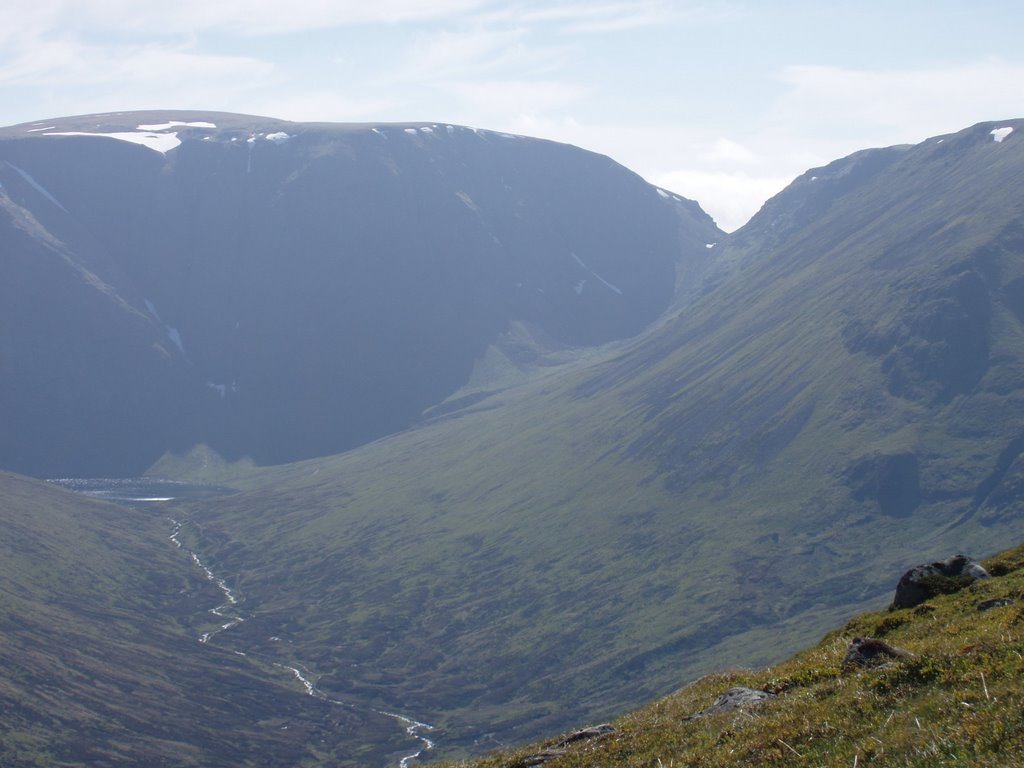
The "Mountain Weather Information Service" is an excellent website which gives helpful guides to hill conditions. Many YHA’s and bunk-houses do walkers the service of displaying their predictions. On the basis of the MWIS forecast, which assured me that the high ridges would have perilously high winds in which I wouldn’t be able to stand up, I opted for a low-level walk on my first day. From the A832, I took the track to Loch a Bhraoin and from the footbridge over its outflow, followed the Allt Breabaig into the glen. It’s a delightful burn, which changes character several times as one ascends its length, meandering widely, carving little gorges, and tumbling through boulders. It also treats the walker to some lovely waterfalls to stop and enjoy en route. The track crosses the river at a ford and then works it way higher along the glen on the East side. This ford is easily missed, but is worth finding because the path which continues on the west bank, soon disappears into a bog.

By mid-morning, I had walked from the A832, round Loch a Bhraoin, and up to the coll above the headwaters of the Allt Breabaig. Realising that wind wasn't as bad as MWIS predicted I thought I'd see what it was like on the ridge, so climbed East onto it, between Sgurr nan Each and Sgurr nan Clach Geala. Again, wind predictions proved to be alarmist, so I climbed the ridge to the first of these, and back. By now the wind had dropped, so I climbed Sgurr nan Clach Geala, probably the finest of the Fannichs. The corrie, between it and Sgurr Mor, is breathtakingly gorgeous and there were enough gaps between clouds to see the whole view, from the grandeur of Torridon to An Teallach’s pinnacles – reaching upwards like a hand trying to grasp the clouds. The first hints of the promised wind started on here, so any thought of going across to Sgurr Mor was abandoned in favour of an exit via the smaller Munro of Meall a Crasgaidh. While it’s summit was a little blustery, it wasn’t dangerous thanks to a quick descent off its sheltered westerly flank.

I got back to Ullapool for the evening, where other walkers told me they that my days experience was by no means uniquw because the MWIS can be prone to a little hyperbole. That night, needing little more than a good sleep I settled into a deep, peaceful slumber when the old fellow in the ‘bunk-upstairs’ started up - now snoring like a distressed animal.


When it’s just too much!

Sometimes the Mountain weather forecasters get it exactly right. My second day in the North was just such a day; with just as much wind, rain, and fog as mwis.org.uk predicted. Summer had turned to winter within 24 hours. The hostel remained full for much of the day with gloomy looking outdoors-types wandering about with maps or staring bleakly through rain lashed windows. Ullapool isn’t such a bad place in the rain, it has several café’s and pubs, at least two bookshops. My highlight was a trip to the harbour, buying some fresh fish and cooking back at the hostel. It was a frustrating day for me, but I made the right decision not to go up. I subsequently discovered that the Mountain Rescue Service had had a very busy day with two hypothermia's and a Duke of Edinburgh expedition party cut-off behind impassably swelling rivers by Slioch.


At least it keeps the midgies away!

With the promise of improving weather, the following day once again I headed off round Loch a Bhraoin and up the track alongside the Allt Breabaig. Two days previously the Allt Breabaig had been a pleasant burn, but two days of heavy rain had transformed it into an angry torrent, the crossing of which was unthinkable. The path was tantalisingly within sight on the far bank of the river, but, stuck on the west bank, I struggled through bogs, peat hags and swelling tributary streams, also in spate. It took nearly three exhausting hours to make the coll, twice as long as the same journey two days before. Anyone walking in the Fannichs planning a descent down the Allt Breabaig should ensure that it is ford-able, or face the prospect of being cut off, miles from the car, when almost at the finish-line!

Sgurr Breac is a charming mountain, nicely situated to the west of the main Fannich ridge, with nicely sculpted corries and steep cliffs. I know this, because I had a great view of it from Sgurr nan Clach Geala two days previously. When I turned Westwards from the coll to climb it, I couldn’t see a thing. A compass bearing lead to a ridge upon which a feint, scratchy path intermittently lead towards the summit. As I sat by the cairn, the wind increased, the visibility reduced and the temperature plummeted. Ah- Scotland in June!

Careful navigation is required on the ridge between Sgurr Breac and A’Challeach in bad weather. I was grateful to have my GPS with me to double-check my compass work. I realised on the ridge that a walk that would have been a pleasant amble in sunshine was turning into quite a challenge. There are times in the hills when you realise just how alone you actually are. The Northern ridge of A’Challeach ends in steep cliffs which need to be avoided, but Eastern side of the ridge is too steep to descend immediately. In fog some pacing is required to ensure a descent eastwards is taken between these obstacles down to the burn flowing from the Loch Toll an Lochain.

Cold, tired, hungry and feeling somewhat battered by wind rain and cold, I got back to the loch, and up the track to the car. I met one person in the hills all day, he trudged past in the gloom and paused, only to lift the gore-tex hood from over his mouth and grimly mutter, "At least it keeps the midgies away".

Back in Ullapoool that night, the old chap in the bunk above me snored like the roaring of an injured sea lion- all night. Next year, I’m going to a B&B!


Happy As a Pig In Muck

On my last day in the North, I set-off to walk the main Fannich ridge, from Beinn Liath Mhor Fannaich, via Sgurr Morr, Meall Gorm and down to An Coilleachan. Although the summits were in cloud, the ridges were clear and I had some breathtaking, if fleeting, views of the whole Fannaich range, of the bulk of Beinn Dearg to the North, and Fannich Lodge down amongst the trees to the South.

The walk-in from the A835's Tromdhu bridge, where the Abhainn an Tourain Duibh enters Loch Glascarnoch in the famous Dirrie More; is long. A new bulldozed and signposted track through the adjacent woodland significantly speeds up the access, as it drops the walker near a footbridge at the bottom of the climb up Creag Dubh Fannich, the first top of the day. The walk from here to the top of the first Munro, Beinn Liath Mhor Fannaich seemed to take an age, but the sight of Loch Gorm and Loch Li nestling underneath the day’s long ridge ahead, spurred me, with lengthening strides, up into the heart of these hills..

The beautiful sweeping curved ridge to the graceful summit of Sgurr Mor is spectacularly wonderful - even in cloud. When I climbed it, only the top of it was truly hidden in cloud, and it looked magically mysterious. This craggy elipse, faded up into the mist above, looking like a helter-skelter descending from the heavens.

Amazingly I didn’t meet a single person on this magnificent walk until I was on the descent from Meall Gorm, the third Munro of the day. On the southwest top of the hill I met a lady in the process of completing the Munros before her 60th birthday.

The bealach between Meall Gorm and An Coilleachan has a distinctive little lochan which is on the 1:25,000 maps, a nice feature to aim for if you approach it through think cloud on a compass bearing, as I did. Gaining the summit of An Coilleachan is a straightforward clamber up through boulders, followed by a return to the lochan on the bealach. The map and compass insisted that from here the descent was due North off the side of the mountain into the fog! It proved to be better than it looked and I was soon down to Loch Gorm.

Here I met the almost Munro-completist that I'd seen earlier in the day, also on her way down. A quick map conference revealed that I was planning a descent the way that she'd come up, by Loch Odhar. She advised against it, saying that it was a quagmire and so instead, together we navigated a route over Meallan Buidhe. She'd also noted where bridges and paths were - which made the return trip easier. These routes in from the North and West, will no doubt become more popular now that access to Fannich Lodge by car is no longer permitted.

It was good to chat to her on the way down too. A Duke of Edinburgh expeditions examiner with a vast amount of hill experience and knowledge - she had many good stories to tell and insights to give. Hill-people are consistently interesting, friendly and engaging. We looked down into Dirrie More, and dreaded the thought of its desecration with vast pylons. Standing on Meallan Buidhe, looking back up into the mountains as the sun illuminated the days route, the vastness of it all was humbling. Some see creation as pointing to a creator above and beyond it, others see the world as simply glorious in its own right. I am of the former persuasion, but amongst us all in the mountains, there is the camaraderie of an acute sense of our own finitude.

Route finding in the far North seems to be much harder than in the Southern Highlands. There are two reasons for this. Firstly the number of people are, far fewer, so even established routes rarely gain good paths; and secondly the cairn-building hobby so marked in the South, has not reached the North yet. In the Southern Highlands, it seems that every navigationally significant point is marked with a cairn; not up North. Whether this is simply because there are just fewer people there (and so therefore less chance of there being people who like building little towers out of stones) or whether it is that the kind of walkers who venture up there are less inclined to this activity; I couldn't say. However - without the aid of these things, and with long walk-ins to truly remote mountains, in pretty foul weather, walking is certainly more tiring, and more consuming of both physical and mental energy.

Percy Cowpat and his little brother referred to me as the "SMB" - which stands for "Sad Munro Bagger", a term of abuse for hillwalkers, dished out with some glee by those who class themselves as "real climbers". They may have a point too, for I left the Fannaichs cold, tired, aching, and with saturated boots. Back home I reclined contentedly in my chair and put 9 small ticks in my Munro book - as happy as a pig in muck.

Book Notes: The Orange Girl by Jostein Gaarder


I've just read "The Orange Girl" by Jostein Gaarder, or as the cover of the book says "by the author of Sophie's World". I bought this book for three reasons, firstly I was eating on my own in a restaurant/bookshop in Ullapool and wanted to read, secondly because I had enjoyed Sophies World so much and thirdly because it was short! It has, however, had a serious effect on me.

The book is written from the perspective of a fifteen-year old boy who discovers a letter, written to him by his late-father during his final illness. The father he barely remembered left him an intriguing and complicated letter, full of puzzles and mysteries. The initial mysteries are well told but quickly solved, but Jan Olaf's letter to his son contains thoughts about life and death from a dying man which take much longer to digest and cope with; never mind answer.

I suppose if I am honest the book is so engagingly disarming that it opened me up to think more seriously about my own mortality than I am entirely comfortable with. The dying father, dropping his beloved son off at nursery, and sitting at his PC to write, was something I could imagine doing if I knew I was incurably ill. The father's desperation not to be severed from his child, and his bitter struggle for life pours from every page. Yet (without spoiling the ending) the book ends up with a wonderfully positive, life-affirming outcome.

Strangely, with these thoughts in mind, at church this morning the sermon was on "the faithfulness of God to all generations" (Psalm 100). The message was that even if we die - God will continue to care for those we leave behind. The minister got four of us to line up in a row on the stage, suggesting four generations. I was representing the father. As each generation died off and left children behind, the message was that God continued to care.
The combination of these thoughts is both disturbing, reassuring, sobering and troubling. There's no point worrying though. As has been noted, its success as a life-extending measure is hardly admirable.

As for the mystery of the identity of "the Orange Girl", I won't spoil that for the reader, suffice to say that her title does not indicate that she's an Ulster Unionist.

Friday, June 16, 2006

Cosmetic Surgery

It may come as a shock to you to know that 'thathideousman' has just undergone some gruelling cosmetic surgery. It has certainly come as a shock to me, and I am the victim of the minor-surgeon's knife.

The wife, (part-time GP, part-time minor surgeon) has, so it appears, become increasingly disgusted at my appearance. What once caused minimal revulsion now causes significant repulsion. So, approaching me with needles, tweezers and scalples at the ready, she set to work upon my disfugurements. Allegedly I had several growths on my skin which needed to be removed.

I am delighted to report that the op was a complete success. However, we did encounter one major obstacle during the course of the surgery. The surgery may have been classed as 'minor', but my stress levels were 'major'. It wasn't the thought of the scalpel coming at me - that was fine. It was more the sight of the wife's evil grin as she approached me with a syringle bursting full of who knows what? As the needle went in, and she said "you won't feel a thing" I expected it to be followed with the chilling words, "ever again....." accompanied by maniacal laughter.

Needleless to say, she had no such devilish schemes afoot, and I emerged minus growths, almost 0.2g lighter than I had begun the evening. I am now requiring a re-branding as the 'marginally less hideous man'. However, given the time and effort spent, the mirror reveals that I am a walking example of the law of diminishing marginal hideousity.

The suggestion has then been raised that the good Mrs Dr, could perform another, more sensitive operation upon my good self. The suggested proceedure has been billed less in terms of aesthetics and more in terms of demographics. However, if you think that I am going to let her anywhere near there with a scalpel - think again. Having bourne three children, the balance of reproductive pain felt in our marriage is still firmly tilted against me. The oportunity to even the score might just be too much for her to resist.
'slightlylesshideousthaniwasman'

Quote of the Day

N.T.Wright, writes:


For seven years I was College Chaplain at Worcester College, Oxford. Each year I used to see the first year undergraduates individually for a few minutes, to welcome them to the college and make a first acquaintance. Most were happy to meet me; but many commented, often with slight embarrassment, “You won’t be seeing much of me; you see, I don’t believe in god.”

I developed stock response: “Oh, that’s interesting; which god is it you don’t believe in?” This used to surprise them; they mostly regarded the word “God” as a univocal, always meaning the same thing. So they would stumble out a few phrases about the god they said they did not believe in: a being who lived up the in the sky, looking down disapprovingly at the world, occasionally “intervening” to do miracles, sending bad people to hell while allowing good people to share his heaven. Again, I had a stock response for this very common statement of “spy-in-the-sky” theology: “Well, I’m not surprised you don’t believe in that god. I don’t believe in that god either.”

At this point the undergraduate would look startled. Then, perhaps, a faint look of recognition; it was sometimes rumored that half the college chaplains at Oxford were atheists. “No,” I would say; “I believe in the god I see revealed in Jesus of Nazareth.”
What most people mean by “god” in late-modern western culture simply is not the mainstream Christian meaning.

(http://www.ntwrightpage.com/Wright_JIG.htm)

Book Notes: God Crucified by Richard Bauckham

If you are unfortunate enough to know anyone who takes Dan Brown remotely seriously, this little book may be the antidote! This book actually pre-dates the Da Vinci Code, and so is not written as a direct response to it in any way. In fact, it does not address many of the issues raised by that film and book (such as it's reliance on discredited sources, and historical innacuracies). The link between the two is that while Brown forwards the line that Jesus was only worshipped as divine when Constantine sought to forward the Trinitarian view for political reasons; Bauckham shows that the deity of Christ was proclaimed by the earliest Christians.

Bauckham goes about this task by demonstrating that amongst some of the earliest Christian texts, such as passages in the Synoptic gospels, 1 Corinthians and others; there is a growing use of divine names, functions and adoration applied to Christ; by Jewish believers, who also maintained Old Testament Monotheism, and Monolatry. This tendency grows in the later New Testament, John's gospel, Colossians and Hebrews especially. Bauckham, who is New Testament prof at St Andrews, includes a special study of the early Christian's use of the last sections of Isaiah (deutero, and Trito -if you dig those distinctions!). He shows that the first Christians vocabulary about Jesus is directly raided from Isaiah's words about God. As this is done in a monotheistic way, Bauckham shows that the New Testament presents inherent Trinitarianism, awaiting the technical vocabulary that the debates of later centuries gave it.

This book is a transcript of the 1996 Didsbury lectures which Prof Bauckham was invited to give, and is published in the UK by Paternoster.
The later documents, gnostic gospels and the like, present a move away from these early ideas - and the recasting of the gospel story in Hellenistic terms. In 97, nicely written pages, Bauckham calls us back to the source, the original and authentic Jesus.

Thursday, June 15, 2006

I Hate Clothes


The title of this post in no way suggests that I am endorsing naturism, or that I joined in last weeks infamous nude cyclcling protest. Indeed, had I done so, what was billed as a great symbolic protest against fossil fuels would have degenerated into a great moment in comedy.

Rather, my purpose in writing is to say that although the T-shirt I am wearing has several holes in it, it is not due for replacement. To do so would mean having to go "clothes shopping" in other words to enter the contemporary setting for Dante's inferno.

I am perhaps ludicrously proud of the fact that I was once described as "the sartorial nightmare" by one of my wife's friends. Now however, the wife, is trying to help me to redifine my self-perception away from "wonderfully free from the pressure to conform", to the arguably more realistic, "socially inept and innapropriate" status it so richly deserves.

The problem is not merely that a visit to a clothes shop has all the miseries of a purgatory without the benefit of any purification of the soul; nor that shopping centres are mind-numbingly dull, predictable, and uniformly bedecked in irritating branding and logo's. No, the problem is far worse than that.

Think on the following:
All clothes cost four times what I think they are worth.
Therefore for £25 worth of clothing you have to pay £100
Then they make you carry the stuff home with you in a bag advertising their brand for which you don't get paid. Let's charge that at a nominal £25.
The clothes will be badly made and eventually fall apart, and are of no lasting value. In fact the knowledge that they were probably made in a sweat-shop in an export processing zone in the developing world, means that along with your purchase you get guilt too!

So far we are down £100.
Then let's consider the fact that this is £100 not available to spend on things that will be of real benefit, say either your favourite 'charidee' or books and CD's.

Our imaginary shopping trip is now looking at £200 quid wasted pursuing £25 worth of goods; (sorry call it £201, I forgot the parking charges).
Next time the wife says to me, "let's go clothes shopping", I need only reply, "Do the math"!

Saturday, June 10, 2006

World Cup Fever?

The whole world is allegedly going football-crazy, football-mad. I'm really trying to join in as well, trying to enter into the spirit of the thing, enjoy the sense of occasion and generally get 'world cup fever'. The problem is, that no matter how much I spend time with those most afflicted with the most virulent strains, and no matter how much I seek to expose myself directly to the source of the infection; to this fever at least, I appear to be peculiarly immune.
I thought that watching "Ing-er-land's" opening game against Paraguay might do the trick. Alas no. Whereas I have been known to leap from my chair screaming at televised sport; England limping home 1-0 left me coldly noting that even that one goal was an own-goal not a real one. Even the sight of the disgraceful refereeing decisions failed to illicit much response, and the final whistle came as a great relief. Yes - there was the relief that England had held onto their flukey lead until the death; but much more pressing was the relief that I no longer had to sit watching this dull spectacle in the hope of some excitement.
I'll stick with it for a few more matches. It has to get better than this.

Friday, June 09, 2006

Creag Meagaidh


There are some hill-days which stick out from all the others as truly memorable. Stob Binnien, my first Munro, the curved ridge on the Buachaille, An Teallach, Beinn Alligin, Liathach, Lochnagar, Ladhar Beinn, the ring of Steall, Ben Lui, and Cairn Toul all spring immediately to mind, as days I hope never to forget.

There are other hill-days which have been lamentable. Failing to find the summit of Ben Chonzie in fog, starting to climb Ben Lui from the wrong car-park and not being able to ford the river, the disgusting weather the 2nd time I climbed Stob Binnien, and having my feet sliced by old boots on some dreary Geal Charn or other, all spring to mind.

Yesterday is a hill day I wil never forget. I am glad to report however that this is for all the right reasons. Perth's self-styled Victor Meldrew, picked me up at 8 and by 9:45, we were heading up the track from Loch Laggan into the Coire Adair - the heart of the great mountain Creag Meagaidh. We gained height gradually, on the maintained path that takes you, first around the farm and then, high into the Glen. The track terminates at a beautiful lochan, with really tasty, clean water, where fish were jumping and where the sun broke through the clouds for the first time that day. Immediately behind the lochan are the most amazing cliffs which drop hundreds of meters sheer down to the water. Vast shards of rock thrust skyward from the valley floor, and we stood in awe underneath the vast triple-buttress which makes this hill famous.

From the Lochan we started up the steep climb up to 'the window' the narrow rocky notch in the ridge through which Bonnie Prince Charlie is said to have effected an escape. 'The window' is a desolate, cold, and rocky place, through which icy winds funnel - even on a hot day like yesterday, it was freezing cold here! We made the mistake of not going through the window to the far side, where a gentler path leads up the back of the mountain, but turned immediately into the steep hillside, soon making the summit plateau. The summit was cloudy, but by following the Northern cliff-edge we soon found "Mad Meg's Cairn" and then the true summit.

From the summit we headed back to 'the window', following the route of the path which itself followed some old fence posts. From here a simple climb took us along the cliff-edge to the understated summit of Stob Poite Coire Adair. By now the sun was streaming down, and the only cloud to be seen was clinging around the summit of Meagaidh - and rolling gently down the window like dry-ice.

The ridge from Stob Poite.. to Cairn Liath is long and undulating, with a few twists and turns. Navigating could have been tricky in cloud, and had we done the walk in reverse we would have had to have done this. However by mid-afternoon this was no more than a delightful summer high-level amble with views opening up on all sides. From the fourth top the views back into the Coire Adair were 'breathtaking' (for want of a suitable adjective). However, with the sun shining from behind Creag Meagaidh the lochan and cliffs were too much in shadow for good photos. That sun had also badly burnt the backs of my legs!

I was pleased with how I managed this hill - the first Munros of 2006. I'm unfit and had a sore back, but still managed to do the whole hill (21K distance, 1,275m ascent) without too much problem. My sense of achievement was put into perspective though when we met three lads running around the same route as us, one of whom was completely blind.

The day ended with a good piece of steak at the Monadliath Hotel, where Victor Meldrew and I ate outside in the evening sunshine - before the drive back home.
If only it could be like this all the time.

Saturday, June 03, 2006

Let's Go Tripping

We took Boris, Norris and Doris on a family walk today - up Fife's finest hill; West Lomond. Its a good few hours walk, hard work for me (carrying Doris), and hard work for Norris' three year old legs too. Although it was a bit hazy, the summit views were fantastic, south accross the Forth to the Pentlands, and North to the Perthshire hills. A special note of commendation goes to the wife, who managed the climb after working all night.

Tuesday, May 30, 2006

Quote of the Day

Brian [McLaren] makes such a good point about the importance of the subjective encounter with God that he tends, I think, to minimize the importance of the objective truths of scripture. Unlike Brian, I believe that objective, propositional, ultimate truth is of absolute importance.

"We ought not to follow those 'modern scholars'", Brian writes, "who abstract principles from the stories and various declarations of the Bible and then apply those in contemporary settings to inform us how to believe and act". But that's exactly what I think we should be doing.

Tony Campolo.


(Missing the Point, p246)

Monday, May 29, 2006

Book Notes: The Dominance of Evangelicalism by David W. Bebbington


One of the best things about having a term off college is having the time to read some of the books I have wanted to read for ages but which I haven't been able to get to. Here's another; David Bebbington's contribution to the 'History of Evangelicalism' 5-part series (of which parts 2, 4, and 5 seem rather reluctant to appear).
The book presents a nice overview of the period, ideas, politics, theology and some main characters analysing why they developed as they did; and the effect that developments of this period have had for the church. It's easy reading, with themes all nicely illustrated anecdotally from primary sources. So much of what happens in church life today harks back to this period, that understanding us requires understanding them. As my history tutor at Uni used to say, "if you want to be a leaf that doesn't know it is part of a tree - don't study history".

Sunday, May 28, 2006

New and Improved

Our church has got a new website (at last!). Out goes www.perthbaptist.org.uk and in comes www.perthbaptistchurch.org.uk - much better I hope you agree.

Sunday, May 21, 2006

Latest Read


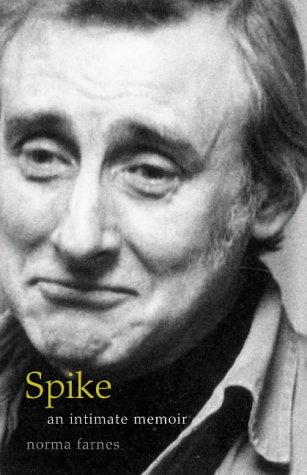
It is an old cliche that geniuses are tortured eccentrics. In her book "Spike Milligan: An Intimate Memoir" his long-time manager and publicist (add life-organiser, psychologist and general cleaner-up-afterer) paints a picture of a deeply troubled man, given both to bouts of unbearable depression and flurries of frantic anarchic creativity. While the world laughed at Spike's antics, Spike raged at the world, raged at his wives and girlfriends, publishers and broadcasters - and at Farnes. It's not as good a book as Humphrey Carpenter's biography of Spike - which is better written and more perceptive; but she knew the subject very closely.

Of the three Goons, Sellers is acknowledged to have been the greatest performer and also the most damaged individual; a man whose eccenticities crossed the line from malevolence to evil. A man of a thousand characters who professed to have no idea who he was. Milligan was the creative force behind the comic revolution of the 50s and 60s, and the surreal world of Goonnery flowed from his troubled mind. It was also Milligan who was the most troubled of the three, taking to his bed for a week when overwhelmed with gloom after seeing some vandalism; and lashing out at those he cared about - unable to maintain relationships with normal people. (Farnes it turns out manages him by herself being a person of unusual character). Then consider Harry Secombe. Farnes describes him as the least talented of the Goons. He was a genial TV host, a good singer and famous giggler; but not the explosive force of Milligan or an international star like Sellers.

However, both Sellers and Milligan said that they were jealous of Secombe. Why? Simply because of his happy home life with his wife to whom he was singly devoted for the entirety of their very long marriage. Sellers and Milligan with their strings of girlfriends and affairs, both during and in-between their marriages knew that he had something they didn't.

So, if it were the case that genius and self-destruction were linked, and that the less-talented are happier; which would I chose for my children (if I were able to do so)? Would I like them to have Milliganesque destructive brilliance, or Secombe's contended decency? Having chuckled to my Dad's Goons tapes as a kid, recited Milligan's poetry, loved his war memoirs and laughed at his novels, and having read Farnes' book about her life working for Milligan; I'd offer them Secombe's contentedness every time.

Saturday, May 20, 2006

Deafness Update

Young Norris was visited in Nursery by the hearing specialist yesterday, who made some very interesting observations. Firstly the nursery itself is in a very echoey hall, meaning that he will be able to distinguish very little speech from the backgound noise. Secondly he is spontaneously begining to lip-read, and reacts better to adults to speak directly to him than other children who don't. Thirdly his behaviour is typical of children with this condition and nothing to becomed too alarmed at because experience shows that grommet insertion usually has a positive effect on behaviour.

She also commented that 'glue-ear' cuts out the higher frequency sounds first, meaning that it is actually harder to hear a woman's pitch voice than a man's. The pitch of the female voice can apparently just become lost in the background noise.

My wife is sending me for grommets immediately.

Crawling

Little Doris has started crawling. No longer can I leave her in one place with a few toys, safe in the knowledge that she will remain safely where I left her. Guarding stairs, coal buckets, extra cleaning, safely storing away small objects; with three mobile kids, parenting threatens to get frenetic.

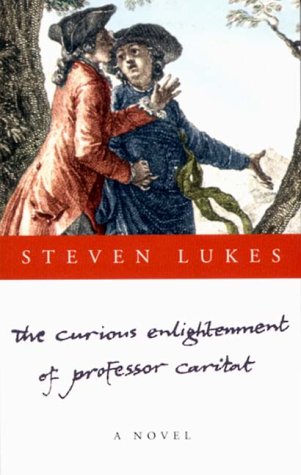
Book Notes: The Curious Enlightenment of Professor Caritat by Steven Lukes


I spotted a reference to this book and followed it up thinking that it sounded entertaining. I wasn't dissapointed. The novel charts the adventures of Professor Caritat as he travels through different countries each of which enshrines a different ideology as its organising principle; Militaria, Utilitaria, Libertaria etc.

Without long and detailed explanations of each system, Lukes provides a hugely entertaining introduction to the benefits and foibles of each; as his character ends up imprisoned in Utilitaria and destitute in Libertaria, for example. The book gets off to a rather slow start, and only really gets going when the Professor escapes from Militaria and begins his travels. The first few chapters are worth persevering with in order to enjoy what is then to come.

What makes the book all the more fun is the authors penchant for throwing in dreadful puns and some barely disguised caricatures of real people. Who could the free-market obsessed female Prime Minister "Jugula Hildebrand" possiby be? Or indeed the Rev Thwaite, communitarian priest and hostage negotiator?!

The book has reviews which suggest that it does for political philosophy what "Sophie's World" did for general philosophy and there is a parallel. While it is hugely enjoyable, provides loads of insight into political ideology and is carried along at a rip-roaring pace by the strange narrative; it isn't as subtle, engaging or absorbing as Sophie's world. Nevertheless, great fun and thought provoking reading.

Friday, May 12, 2006

Attenboroughing

Norris, Doris and myself have spent a happy afternoon watching a seal fishing in the Tay in the centre of Perth. The river was teeming with fish today, so he was in the right place. Norris' delight at seeing the seal up close was expressed a little too loudly for the seal, who took fright and dived under, only to re-appear a few hundred metres downstream.
Young Norris can whisper or yell; one day he will develop the ability to achieve something between the two.

Wednesday, May 10, 2006

What Have We Ear Then?

Young Norris (3) has been seen at the hospital today, had various tests and proddings and pokings. He has been put on the waiting list for the insertion of grommitts in his ears and the removal of his adenoids. I was a year or so older than he is when I had my adenoids removed and so remember well the bewilderment that my hospital stay caused. What we long to see is an improvement in the wee-man's behaviour and social skills, what concerns us is the thought of the little soul having general anaesthetic.

Really Nothing To Say

Really Nothing To Say

One of the more honest blogs I've read

Monday, May 08, 2006

Red Face of the Week

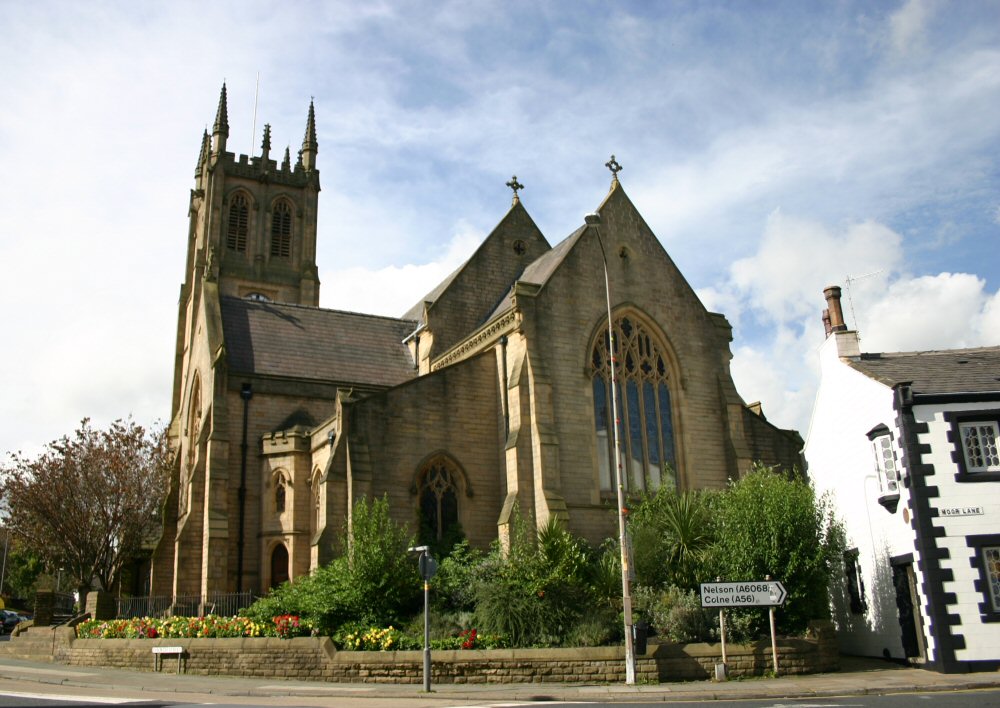
II am both ashamed and proud to announce that I have been awarded the red face of the week award. The wife and I were in a bit of hurry getting ready to leave our hotel to get to St Leonard's church, Padiham; for John & Vicky's wedding. All was going well until I realised that although I had packed my shirt, tie, shoes, and jacket - my suit trousers were msising. The only trousers I had with me were a pair of pale cords which somehow didn't quite go with my dark suit jacket and black shoes...

I couldn't just dress-down and sneak in at the back for the service either..... becuase I was preaching at it! Stress!!

Fortunately an Asda store 10 minutes from the hotel were able to furnish me with a cheap and cheerful pair of black trousers in a hurry. They did look a little perplexed when I ran from the changing room and jumped on the the checkout so that they could scan the trousers which I was wearing, though!

Gladly the farce ended before the proceedings got underway and the service went off smoothly. John and Vicky, had a great day celebrating with their friends and family. We enjoyed meeting all the weird and wonderful characters that make up these occasions, having our eardrums bleed in the loudest disco in the North, and are still trying to successfully imitate the Lancashire accent!

Friday, May 05, 2006

'No Vacancies'

So my little daughter has graduated from being a 'baby' and is now officially enjoying her first day as a 'little-girl'. Contrary to popular misconceptions however, this does not create a vacancy.

Thursday, May 04, 2006

Happy Birthday

Little Doris is 1 Today.

Not crawling, never mind walking. Just smiling!

Wednesday, May 03, 2006

Quote of the Day


"This is when people get to see if I really believe all I've been preaching about all these years".

The late Nigel Lee, the respected evangelist, on learning that he had terminal cancer.
(Friends report that "they have and he did").

"All" My Diseases?

2 Praise the LORD, O my soul, and forget not all his benefits
3 who forgives all your sins and heals all your diseases

In Psalm 103, David couples together two reasons to praise God - complete forgiveness and healing. However, despite the fact that in this verse David treats the two equally, most Christians believe that while the former is offered completely and immediately, the latter is at best sporadic.

Ps 103:3 is then problematic for us, in that if we wish to exegete it consistently we are invited either to proclaim at best a sporadic and patchy forgiveness of sin; or adopt an extreme Pentecostal view of healing in which the presence of pain is the result of a failure of faith. Sadly, the only attraction of either view is its consistency. The patchy-forgiveness approach falls at the hurdle of the rest of Psalm 103, in which our sins are removed "as far as the east is from the west"; the believers confidence in total forgiveness being one of the main points of the whole song. The illness=sin view is not only pastorally outrageous, but stumbles at numerous other texts, not least Job, 2 Cor 12:7, or John 9:1-3.

What then can we do with Psalm 103:3? In my church housegroup last night, several ways of interpreting it were suggested: Cultural, Sociological, Literary, and Eschatological.

Perhaps we can handle this text culturally in that there is a tendency for western Christians to individualise promises of God made to communities. Most of the proof-texts used for prosperity (health and wealth) theology involve taking promises of God to bless the nation of Israel and misapplying them to individuals. So, where Deuteronomy promises that the people will not just survive but thrive in the land, it means that God will provide the nation with sufficient health - not that every individual will live a pain-free life.

Perhaps we can handle this text sociologically in that the notion of what constitutes 'good health' is not a biological absolute but a social construct, governed by expectations and experience. Is it not feasible that David might have been praising God for his health, in the same physical state that we might be moaning to Him about our infirmities?

Then perhaps we could handle the text in regard to its literary type. This is, after all, a song not an epistle, an outflow of praise from the heart, not a thesis in systematic theology. David might be merely then expressing a testimony of what was true for him at one particular time but doing so in poetic absolutes. That a poet might have once have "wandered lonely as a cloud" is not lessened by being read during thick fog.

Or then perhaps we might interpret Psalm 103:3 eschatalogically as a reference to a future state in which healing will be as absolute as forgiveness is now. Certainly some commentaries take this line. More properly perhaps we might want to view this statement as proleptic, that is to say that David experienced the incursion of the future reality into the present. This view would see the healing David testifies to as a foretaste of the universal healing to come.

What then are we to make of these views? Last night's consensus was that the cultural method was probably true in regard to many other texts especially in terms of handling prosperity promises - but not this one where David is speaking personally. Psalm 103 starts off personal and ends up cosmic its scale and this verse is located at the heart of the personal section. The sociological view was thought to be generally useful in handling texts but not ultimately solving our dilemma.


The literary-type approach was far more helpful for most people. If David's praise is testimony, then we are invited to join him in praising God for the measure of life and health we enjoy. We need neither deny the possibility of healing, not universalise its immediate availability. This in turn is compatible with some of the sociological insight that we considered, especially in regard to the fact that many in our world joyfully and profoundly thank God for their daily survival, while we complain if our elevated western expectations are not met.

The eschatological approach was also found to be biblical and theologically powerful, undoubtedly true, but in all honesty probably not what David had in mind when he wrote this Psalm. However - that should not prevent us from interpreting the Old Testament in the light of the New and finding more hope in these words than the author intended. Just as Jesus rose from the dead - so we will rise from the dead, not as disembodied spirits but completed with non-decaying resurrection bodies.

When we are finally with The Lord, our constant testimony will match this outpouring of praise for God's total healing that David offers here. In fact, there is no good theological reason why we may not begin to praise Him for that already! While the Psalm is dominated by spiritual forgiveness, the 'benefits of the Lord' do not exclude the physical; and so it is inappropriate to miss, skip, ignore or Ps103:3. Far better to praise God now for the life we have had, do have and will have in Him - if as the rest of the Psalm stresses, we walk in fear of Him and embrace His forgiveness.

2 Praise the LORD, O my soul, and forget not all his benefits-
3 who forgives all your sins and heals all your diseases

Friday, April 28, 2006

Merely a Private Matter?


Today Gordon Brown has defended John Prescott, under pressure because the press have reported that he has been unfaithful to his wife - conducting an affair with a secretary.

The chancellor has offered the usual line of defence in these instances, "its a purely private matter". But is that actually the case? I think that personal relationships are indeed private, and usually nothing to do with the press or the public. However the situation is different when it involves marriage. Marriage is not a private matter - but a public contract, made before witnesses and the law (and frequently invoking God too). Whether someone has honoured or dishonoured a public commitment can be many things -but surely not "private".

That is not to say that someone who has erred cannot continue in public office; history tells us that many great statesmen's personal lives were less than exemplary. What it does mean is that "he is doing a good job" is a reasonable line of defense to try to advance, as a person can be judged on their record. However when it comes to marriage, "it's a private matter" just doesn't work.

Thursday, April 27, 2006

Quote of the Day

R. H. Strachan commented, on the act of Jesus washing the disciples' feet in John 13:1-4.

"...the great truth that this divine self-consiousness of Jesus, confronted by the final assault of the devil directed through his instrument Judas, manifested itself not in a sovereign display of omnipotence, but in an amazing act of self-humiliation."

Book Note: The Heavenly Good of Earthly Work by Darrell Cosden


I'm 2 chapters into this little book at the moment. I have had a couple of modules from the author at college, and as he is always so thought-provoking (not to mention provocative and controversial!) in lectures I assumed that his writing would be as well. So far I have not been dissapointed, although I have to say he is more irenic in print than in person!

The book sets out to demolish hierachical and dualistic thinking amongst Christians; in order make daily work part of our Christian mission in the world. In the introductory chapters he assaults traditional understandings of "soul-only" salvation; and points toward the rest of the book in which he will argue that the so-called 'mundane' aspects of our lives can equally be saved and gain eternal significance.

In order to do this he is going to examine key biblical passages and theological debates; and establish an eschatology based more on continuity and renewal than on complete abolition and reconstruction. (This will also have important implications for environmental theology).

Is our earthly work, (when done for, and with God), only of use in terms of being the context in which we forge relationships with God and others, or is it of eternal intrinsic worth? I have always just assumed the former. I'm interested to see if Darrell can persuade me of the latter.

Sunday, April 23, 2006

More than Balance Required

As someone involved in Bible teaching in the church, I resolve to do the following:
Preach free grace until they accuse me of antinomianism; and preach discipleship until I am accused of legalism!
It's just not enough to strike a balance between the two and sell each absolute short.

Thursday, April 20, 2006

Eight Hundred Miles and Forty-One Words


We've just arrived home from an Eight-hundred mile round trip to my brother-in-law's wedding, which was held at the remarkable Treowen House, near Monmouth in Wales. They filled this lovely ancient house with friends and family for the weekend to celebrate their marriage and formally exchange the forty-one words that constitute the civil wedding contract in British law. Around those required legalities they devised a lovely ceremony that captured both the seriousness of and the joy of marriage, and the heartfelt lifelong commitment that the vows taken demand. The ceremony, with its music, poetry, vows and words was moving in the way that it reflected both those values, as well as the people getting married. The celebrations continued with a great meal (Venison cooked in red wine!) and an evening of chat, log fires and an absolutely brilliant jazz band.

I haven't been to a civil wedding for a few years and was intrigued by it. Obviously with our faith, we didn't choose a secular wedding when we got married ten years ago - but that doesn't mean we couldn't fully enter into the spirit of this wedding or were any less thrilled for them. In fact every word said and sung in the ceremony was excellent and meaningful. Unlike the previous civil ceremony I went to, the celebrant and registrar were excellent and were really personal in their approach. I wouldn't have wanted them to take away anything that was said or promised on Tuesday.

My theological perspective (with which you have every right to disagree!) is that marriage is a gift of God (as distinct from merely an evolutionary convenient arrangement) whether you acknowledge Him or not! So, while I cheered out loud and shouted 'hooray' as we celebrated love and commitment on Tuesday, in my heart there was an echoed Amen! We all wished them a long and happy life together - I hope they'll forgive the fact that I prayed it too.

Wednesday, April 12, 2006

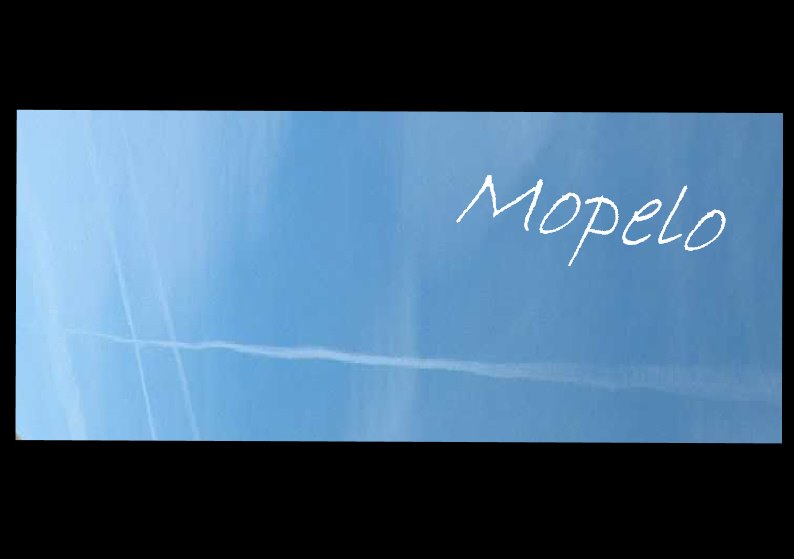
Mopelo

Today Boris has invented a new word, "mopelo". Where we live, transatlantic flights pass thousands of feet above us, leaving white trails of vapour in lines accross the sky. These, as of today, are "mopelo's".

Tuesday, April 11, 2006

Days of Dung

Time spent at home with Boris, Noris and Doris is usually a fairly entertaining experience. Today however, I am trapped here as two of my three delightful little offspring have tummy bugs and are puking and pooing their way through a malodorous day of dung-digging, poo-portering, crap-carrying and any other alliteration you care to add. All plans to take them for a day out in the spring sunshine have been cancelled in favour of tummy cramps and sprints to the toilet - some of which we make on time.


I am also learning that there must be some hidden art to washing puke out of babies’ hair, without missing great chunks behind the ears - which I clearly haven't mastered yet. The other skill I need to acquire is the observational power to notice such infant hygiene blunders and not leave them for immediate discovery by said child's (stressed) mother upon her return from work.

My father-in-law is a farmer - and as such is well acquainted with dung of various species, types, textures and odours. He collects it, he spreads it, he drives tractors through it and has even been known to wear it. All this without murmur or complaint! The thought of changing a human nappy though, fills him with complete horror and disgust - to the point that he never has done one, despite rearing a large herd of humans himself. I think I'm beginning to see where he's coming from......

Book Notes: A Bitter Revolution

I'm currently reading "A Bitter Revolution: China's Struggle with the Modern World" by Rana Mitter. My contacts with the Chinese Fellowship in Dundee made me interested to find out more about their history. Then I wisely listened to the counsel of Dr Stumpy Greenisland who pointed out that an astonishing array of cheap books is made available from Oxford University Press in their annual sale. When the OUP e-mail arrived earlier this year, this fascinating book was listed at a most aluring bargain price.

I have read the first third, about the 19th and early 20th century assaults upon the hierachical Confucian worldview which had dominated China for centuries, including Nationalism, capitalism, individualism, Christianity, colonialism, and communism. The book also looks at some of the social patterns which reflect this breakdown of the traditional order, women's rights, family structure, publishing and journalism, and political engagement - much of it told through some specific individuals and groups used to illustrate wider trends (within the so-called "May 4th Era"). Lines of continuity and contrast through the various movements are also helpfully outlined.

I can't really evaluate the stuff I'm learning as this is the only text on Chinese history I've read. However the writers blind acceptance that Christian mission work was the ideological component of the Opium-war-fighting British empire was dissapointing. The self-aggrandising aims of the opium traders and the self-impoverishment of so many of the missionaries should have been enough to demand a more nuanced view of this subject. The relationship between these two elements of westernisation was more complex than Mitter allows, and the writers prejudice at this point outruns his research. This however has been a minor criticism in comparison with the wealth of other stuff I have been learning.

On now to discover how Maoism emerged victorious.........

Monday, April 10, 2006

Am I a Hypocrite?

I spoke at church yesterday on the hypocrisy of the Palm Sunday crowd in Jerusalem, who proclaimed Jesus as Messiah on Sunday, but within a week demanded his execution. The point of such follies being in scripture are not so that we can judge them (and feel smug), rather that we judge ourselves and make sure that our profession of faith is not merely temporary, convenient, and hypocritical - as we are swept along in a crowd; but real.

How then can I know that my profession of faith is genuine? In short, how can I know that I am saved? I used an old formula to answer this question. It comes in the form of 3 tests.

Test One - the all important test

1) Have I truly 'come to an end of myself' through conviction of sin and cast myself entirely and exclusively on Christ? If so, I am saved by faith alone. (John 3:16)
Test Two - the subjective evidence

2) If I am really a Christian I will be learning to discern the Holy Spirit's inner witness. (Romans 8:16), and know His guidance through my life (Romans 8:14). However if we grieve or quench the Spirit we will be denied this blessing!
Test Three - the objective evidence

3) If I am truly a Christian I will observably be in the process of being changed by God, fruit, character, priorities. "A good tree produces good fruit" said Jesus. Not that perfection is required, just evidence that God is at work in us.

It is important to distinguish between the 1st test and the other two. The first test is about becoming a Christian, the other is merely evidence of it. If we find that we are not genuinely Christian the solution is not to be found in seeking experiences or doing works but in coming to the foot of the cross and trusting Jesus. Because here is cleansing, forgiveness, and assurance based not on presumption but on the promises of God in Christ, and His ability to save. "Bold I approach he eternal throne" says Wesley's hymn.

Monday Reinstated


Thanks to the loan of a camera from young Boris..

Wednesday, April 05, 2006

I Hate Soaps

I Hate Soaps, by which I mean the nightly televisual feast upon which the nation gorges, not the bodily cleansing stuff, with which I am more personally aquainted than some of you might imagine.

Why is it that normal, pleasant, friendly, yea intelligent people, allow their brains to be mauled by the third-rate ratings-chasing fodder that is 'Enders, Corrie and the like? Poor stories, weak acting, drawn-out repetative endings, stereotypes and cliches abounding, contrived cliff-hangers, and sensationalist claptrap they undeniably rejoice in, but far worse than this is their sheer banality and mind-numbing futility.

Yet, normally clear-thinking, sensible people are drawn in and their craniums deprived of adequate profusion by the tedium of soap. The 'need for escapism after a hard day' argument is a poor excuse, because the soaps seem to poison the minds of the unsuspecting even on holiday!

My theory is that soap addiction can only be explained because the stories are immediately accessible and full of human drama, and require absolutely no mental engagement. However they lure the uncritical in by steadily eroding the critical faculties of the viewer until they are unable to separate the wheat from the chaff. The moderately addicted actually start to become emotionally engaged with the story-lines, while hard-core users have even been known to be unable to separate fact from fiction, actor from character.

Soap-watchers beware, your short life is dripping, second-by-second down the drain of eternity! Your mind is being numbed, minute-by-minute. Press the off-switch on the telly, before it presses the off button of your mind.

Monday, April 03, 2006

Monday Cancelled

My camera has given up on me. Not slightly, not partially - but completely. New batteries failed to elicit any response from the wretched thing. So, Monday has been cancelled as a result.

Thursday, March 30, 2006

While you still can

A charity, whose aim is to further democratic participation in the UK, has set up a website called "Write to Them". The idea is that you go to the site, type in your postcode and it not only tells you who your elected representatives are (Councillor, MSP, MP, MEP) but also enables you to e-mail them directly via the site. Added features include a guide to which issues should be addressed to which tier of representation, and the site monitors responses, exposing any lazy MP's. A related site is called "They Work For You" which tells you what your MP has been doing in parliament, their attenance and voting records, tabling of questions etc.
Democracy is a privilege not available to all, and under threat. Let's use it while we can.

Monday, March 27, 2006

Friends, Romans, Countrymen......

Young Norris (3) has shown the first signs of improvement in his hearing since late November!
In the last few days he has misheard less, and in an amazing turnaround actually turned the T.V. down - saying that it was too loud! (we have been listening to kids programme's at an incredible volume for three months!). The fact that his deafness is fluctuating is a good sign because it indicates that it is probably nothing more sinister than fluid blocking the inner ear, causing the problem. This means that even if he still needs to have surgery, the insertion of bilateral grommits could well solve the issue for him. What we really long to see, of course, is the return of the contented, co-operative boy we saw before. Still this improvement is an answer to prayer, and a great encouragement at this stage.

Goodbye, Farewell and Thanks for the Whisky

This weekend we said goodbye to some good friends who strangely want to swap THIS for THIS for at least a year. I think that our Skype software is going to be put through it's paces over the next few months. Although we'll miss their conversation, odd-humour, faith, fellowship, hill-walking trips, wisdom and their lovely little boy; every cloud has a silver lining. In this case the silver lining came in the form of an unfinished bottle of Bruichladdich which they hadn't managed to polish off before fleeing the country. They very wisely didn't waste it but found it a good home. I had forgotten what a strong, full, smooth whisky it is - definitely has to be one of the top three varieties commonly available.

As I am such a light drinker, a bottle of malt lasts me over a year - so I have to be very choosy about what I get. To my uneducated palate this has taste of sea without the mouthfull of salt that you get with Oban, has a pungent aroma like Laphroaig minus the antiseptic aftertaste, plenty of peat to savour and is nice and spicy. It's not as firey as Lagavulin, but equally doesn't cost £35 a bottle! It's as flavoursome as my other favourite, Bowmore, but smoother I think.
So, seeya then. Goodbye, farewell, and thanks for the whisky. Our prayers go with you (but the Bruichladdich stays here).

Film Notes: Slaughterhouse Five

Over the weekend I watched the film of Slaughterhouse 5, having recently read the book. I was really dissapointed with the film, and not just because it's 1972 vintage makes it seem rather dated (that's usually a positive thing in my book). The dissapointment came with the way that the film just didn't seem to capture the atmosphere or spirit of the book at all. Vonnegut himself was excised from it (either in the autobiographical introduction) or properly as Kilgore Trout, his alter-ego - but that wasn't the problem. The strength of the book isn't the narrative, its the message, pathos, and bleak whimsy that tells. The film reverses this (inevitably perhaps) and overblows the action, losing the force of the book. No where is this more apparant than in the death of Valencia Pilgrim. Where Vonnegut announces the death almost in passing, the point is to contrast it with her husbands near-death survival. The film errs by making the death a farcical extravaganza, only hinting towards the author's sense of the incident when corpse and survivor's bodies pass each other on hospital trolleys. Why the reverse-bombing of Dresden wasn't the central point of the film remains a mystery - it is certainly a key to the book.
I'll read the book again one day. As for the film- well, it's one for the archives I suppose.

What price efficiency?

Last week I listened to Law in Action on BBC Radio 4, discussing the new "Legislative and Regulatory Reform Bill" about to go through parliament. The bill, designed to end red tape and speed up governmental business appears in fact to be the most significant shift in power from legeslature to executive in UK law for centuries. Presently, reform of bills already passed by parliament, can only be done by parliament. This new act would allow the government to reform bills passed by parliament in order to free parliamentary time, the goverment says. However, as well as doing so, the executive would gather to itself unprecedented and uncontrolable powers to change bills voted for by our elected representatives. The bill, naturally, has many safety features built ito it to prevent this new power being abused - but critics point out that this bill also contains within it, the mechanism for the unilateral abolition of these very safety features!
"Commentator Daniel Finkelstein ... thinks it is a nightmarish prospect that keeps him awake at night. And Cambridge Law Professor John Spencer QC says the bill would significantly weaken the power of parliament and allow the creation of an "elective dictatorship."" (from the BBC site)
My MP hasn't heard from me for a while, I think I can feel a new letter coming on. Watch this space......

Monday View


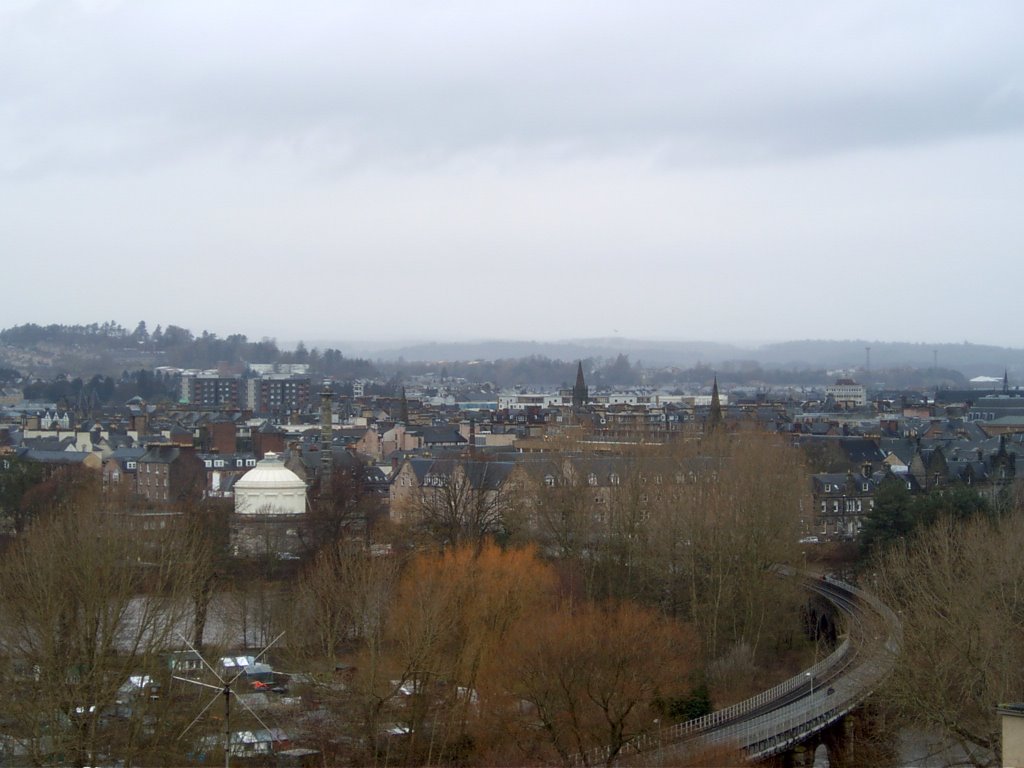
This morning is dull - however you want to look at it

Sunday, March 26, 2006

Dedication

Today I went here, as two of my friends were having their little baby dedicated. The dedication service was really good - giving thanks for the miracle of life in general and for little David in particular. It was a great family occasion, for them and the church too, the place was packed with their friends and relations from all over Perth and the country. I was also asked to do a talk at the service, so I based it on the previous post here contrasting thanksgiving with spoiled brathood!

Thursday, March 23, 2006

Am I a spoilt brat?

One thing about young children that really annoys me, is their frequent incapacity for gratitude. Everything done for them is 'expected' and even when a cursory 'thank-you' is offered, it can appear to be ritualised behaviour, rather than the overflow of a grateful heart. Genuine appreciation of what others do has to be taught, it rarely comes spontaneously. In all honesty, who doesn't cringe, when in the street you overhear a parent offering a child some kind of treat - only to hear it being thrown back in their face. "Its the wrong one, I didn't want that one, it's not fair!"
Part of the problem is that kids learn more by observation than they do by instruction. What I tell my children to do has only a minimal impact in comparison with that of my day-by-day behaviour. And here's the problem - I have re-discovered that spiritually at least, I am a spoiled brat!
Many years ago, these words were written:

One does not have to be in agreement with all of Finney's theology (or taste in beards) to acknowledge the power of this quote! Many years ago I did as Finney suggested and sat down and wrote down every good thing I could think of that I had never thanked God for. What I thought might be a ten minute novelty turned into an afternoon of soul searching. As my sheet of paper filled up, I needed another, and another and another - and I realised that by nature I am a selfish brat. I take and take from God (who gives so generously) and allow countless blessings to be taken for granted with barely an acknowledgement - let alone heartfelt thanksgiving to my gracious creator. Sometimes I even have the audacity to complain about His provision.

If a grateful, thankful attitude is something that I need to cultivate in my children. It is something I first must nurture in myself.

Tuesday, March 21, 2006

Deaf Update

Little 'Norris'' hearing continues to decline. Putting him to bed the other night, I said before turning the light out, "God bless you", to which he replied, "I love you too Dad". More and more he replies to what he anticipates you have said to him.

Monday, March 20, 2006

The view from Monday


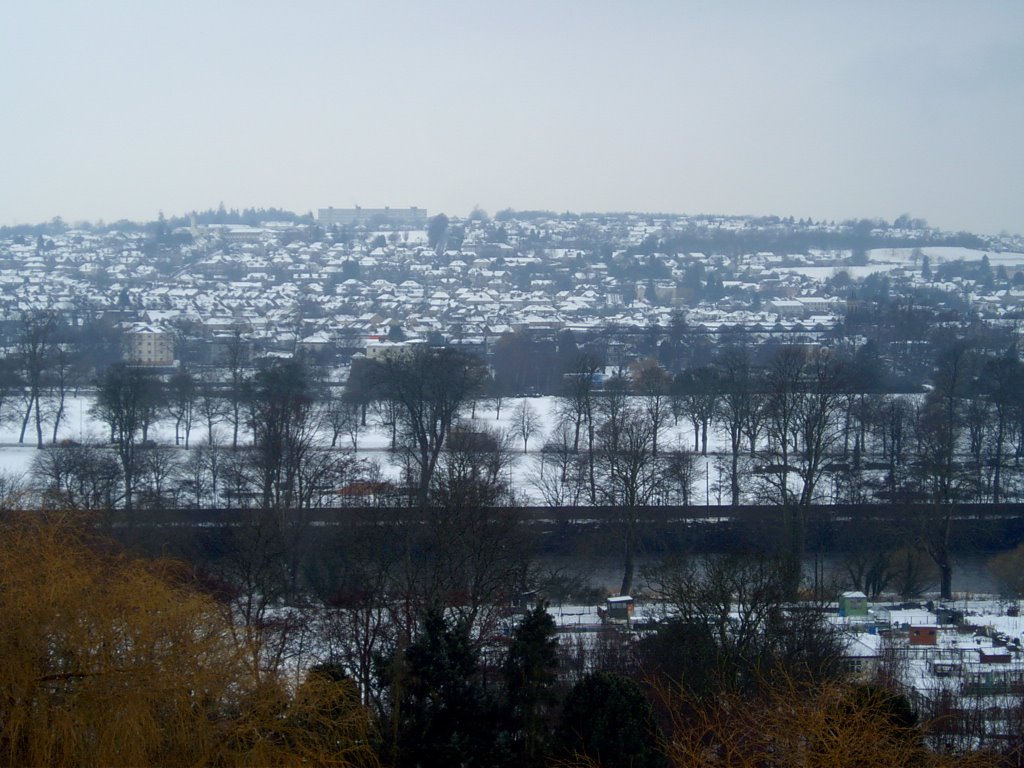
Snow still lying on the hills, although now only on higher ground. It's late March, but more snow is promised.

Birks o' Aberfeldy


The neighbours suggested taking all our children for a walk in the snow up the Birks o' Aberfeldy. We had a great afternoon, the kids were pretty well behaved, the spring sun shone through the woodland and glistened on the snow. The waterfalls looked fantastic too. Doris was riding in the pack on my back - and getting heavier and heavier with every step! However a tiring walk was followed by coffee and cake in a cafe in Aberfeldy - followed by the drive home, a beer by the fire and steaks to follow!
The photo was taken by Boris (when he was 5) last year.

Chinese

丹地華人基督徒團契
On Friday night I spoke at the Chinese Christian Fellowship. It's a place that I really enjoy going to and catching up with friends there who I have known for several years. They had asked me to speak on "integrity" - so I used a text that I know well and have spoken on several times, contrasting the integrity of Barnabus with the hypocrisy of Ananias and Sapphira.

Tuesday, March 14, 2006

Book Notes: Slaughterhouse Five


World of the Strange

I have just finished reading Kurt Vonnegut's classic novel "Slaughterhouse Five". After having it highly recommended and it sitting on my Amazon wish-list for a few years, I have finally bought it and read it, thanks to some birthday money from my Grandma.

I have read several rather odd books in my life, and this is certainly one of them! If someone had told me that a 150-page novel could contain, autobiography, time-travel, alien abduction, war, sex, concentration camps, optometry conferences, authorial cameos, a theory of time being concurrent rather than linear, mental illness, the illusion of human free-will, and death (lots and lots of death, so it goes) all revolving around the firebombing of Dresden I would have thought them mad. Yet here it is.

In fact, madness might be exactly the point. The author appears it at times, the central character Billy Pilgrim is accused of it by his family and the narrative told without reference to the normal conventions of chronology is frequently chaotic. In fact this method of storytelling would drive anyone who delights in tidy narratives without loose ends, completely nuts! But aside from the author presenting us to himself as maybe mad, the central character likewise and the maddening effect on the uptight reader; the real madness only becomes apparent if the lense is pulled back from the individuals to see the madness of humanity - especially as demonstrated at Dresden.

Written as "rolling thunder" bombing raids flattened vast areas of North Vietnam; it was quickly seen as a powerful anti-war book, gained cult status and was made into a film in 1972. I can't imagine how any director could do justice to the constantly changing mental landscapes with which Vonnegut bombards the reader. I have heard that a remake is planned for the near future and would love to see it.

Among the many, many highlights in the book are the famous reverse-bombing raid in which Pilgrim travels through time backwards and watches Dresden being "un-bombed", with aeroplanes sucking the fire up into their bomb bays, compressing it into canisters to be safely dismantled in factories. There was also the savagely ironic moment which during the firestorm Billy and his German captor both spot some naked women in the showers - and for a brief moment all enmity between them is forgotten as they are united together in sheer lust. There is also the lovely take on the famous prayer of St Francis: "Lord grant me the serenity to accept the things I cannot change, the courage to change the things I can, and the wisdom to know the difference." Among the things that Billy couldn't change were the past, the present and the future". The soldier executed for the theft of a teapot, while tens and tens of thousands lie all around torched by bombing is another key moment. Each death in the narrative is followed by the words "so it goes" and the inevitability of death and the lunacy of killing is mocked, whether it be murder or genocide.

Never was comedy so black and funny, or so deeply disturbing. I wonder if ebay have the 1972 DVD going cheap anywhere?

Thursday, March 09, 2006

Lend Me Your Ears

Little 'Norris', my three year old - was back at the audiology clinic today. His hearing has declined significantly since his last test a few months ago. The clinic are fast-tracking him for the insertion of gromits into his ears, and if that fails hearing aids for both ears. The 'fast-track' still involves several months wait for surgery, and with his behaviour and social skills suffering - that's a long time.

Film Notes: Good Night and Good Luck

Quality T.V. and the Guantanomisation of Justice

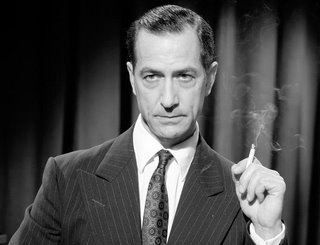
I'm just back from the cinema, where my wife, myself and about ten other people, watched George Clooney's new film, "Good Night and Good Luck". It's the historical-biography of campaigning investigative reporter Edward R. Murrow, and his battle against McCarthyism in 1950s America. It is all dialogue, little 'action', and shot entirely in black and white.

The cultural atmosphere of the times is nicely built up, with oddities such as cigarette advertising, and company marriage policies thrown in; to compliment the obvious visual setting. The fear, suspicion, and danger of the 'witch-hunt' era is well done, as journalists battle with the military, with advertisers, media owners and most of all their own consciences as to what issues to cover. Not content to hide in the safe waters of celebrity interviews and gossip, Murrow and his team decide to tackle McCarthy through documentary TV program making.

The strain on the characters is well played, as they anticipate the reaction from the McCarthyites, in response to their challenge. David Strathairn is excellent at Murrow (above), Clooney good as his writing partner, and Frank Langella as CBS boss William Paley is brilliant. Murrow's furrow-browed monologues to camera are compelling, and are made all the more dramatic as his 'on-air' studied concentration gives way to nervous glances around the studio on completion of the pieces.

The film makes two incisive contemporary points:
It is not co-incidence that a film about the McCarthy era has been made in 2006, in the USA. As Arthur Miller sought to expose McCarthy by historical precedent in 'the Crucible'; Clooney and Co, have used Miller's target narrative as their historical precedent. One of the critical points repeated in the film was Murrow's exposure of the failure of McCarthy to adhere to constitutional principles of justice, because of the perceived imminent threat of an outside malign influence. Murrow's consistent view was that circumventing 'habeas corpus type rights', abrogates our responsibility to maintain the moral high ground, thus strengthening the position of the 'enemy'. Furthermore, it demonstrates an inability of the perpetrator to win the battle of ideas, belying an insecurity - which all the protestations to the contrary do not remove. The fact that America is now holding hundreds of 'enemy combatants' without due process of law hardly needs to be stated.

The other major attack this film wages is against the idea that television and film can do no more than entertain, and ultimately numb and insulate the population (er, that's called dumbing-down today). The fact that the film starts and finishes with excerpts from Murrow's speech at an awards ceremony in which he rails against this, is significant. The writers clearly wanted to broaden the scope of the film's impact from the civil liberties issues, and into the realm of what television is for, and what standards of excellence it should persue.

Right, I'm off to watch "Today with Des and Mel".................

Wednesday, March 01, 2006

Boots!


Today I bought my 3rd-ever pair of walking boots. They were a present from the wife for my birthday, but being tight, I waited until the sale before going to the mountain shop! Once again I have gone for Raichle's - not because I am driven by brand names but because they seem to be the only ones that fit my feet. My last pair lasted 9 years and took an absolute kicking - if these perform even close to as well, I'll be happy.

Best of all though, if she has bought them for me - it would be illogical if she were to try and stop me going out to the hills to use them wouldn't it?

So the constraints of logic on human behaviour are about to be put to a scientific and irrefutable test! Watch this space for results during 2006.

Monday, February 27, 2006

Tuesday, February 21, 2006

Richard Dawkins and "The Root of All Evil?"


Many people were fascinated by Prof. Dawkins attack on faith in his recent TV series "The Root of All Evil" (Channel 4, 9th/16th Jan). What has been interesting has been how scientists with a Christian faith have responded to his claims. The following link points to an insightful review by Denis Alexander, first published in The Times Higher Ed Suppement.

Monday Pic on Tuesday

M-Way Madness


In the last four days I have driven to London and back, a nice little 1000mile trip. With 14 hours of driving, backache, and depressing depreciation on the car!
Now whenever I close my eyes, I can see the white road markings going past me - my own version of white line fever I suppose.
Boris, Noris and Doris were very well behaved on the long journeys, mostly due to the fact that my wife won an in-car DVD player on ebay and they were Disneyed into complete submission, if not stupifaction.

Wednesday, February 15, 2006

David Scott 1932-2006

On Monday, we went to the funeral for David Scott, who died the previous week. He was a warm hearted, gentle, sincere man of God, who had trusted Christ for decades. He had a wonderful, almost unique, ability to make individual people feel welcomed, loved, and valued both in the church community and elsewhere. Born to missionary parents in China before the war, David's family was imprisoned by the Japanese and then expelled from China by the Maoists. They moved back to Scotland, first to Wishaw and then to Perth, where they lived in the house we now own. David's parents lived in this house for the rest of their lives, and David visited us recently to look around the place and reminisce.

He had been ill for some time, and re-appeared at church at the end of 2005 for a few weeks, when he thought he was beating the illness. His final decline was rapid, and though that means he was taken from us sooner than anticipated, medically this was a mercy. My wife saw David shortly before he died. He still radiated love and delight at seeing people, and the enormous hug he gave her was full of strength.

So many people remember his smile, his warmth, his deep Christian commitment, his strong handshake and bear-hugs. We miss him because the love of Jesus radiated from him. Our thoughts and prayers are not with David, as he is now safe with The Lord - but with his wife Anne, and their children.

A Hazy Shade of Monday

Monday, February 13, 2006

thoughtfortheday

"For we are God's workmanship, created in Christ Jesus to do good works, which God prepared in advance for us to do." (Eph 2:10, NIV)

Whilst I am not convinced by that old line that "God has no hands but ours....", which seems to make Him dependent on our co-operation to achieve His purposes; I am concerned that unless I co-operate, I will miss my opportunity to be involved in what He is doing.
I pray that I will have the discernment and wisdom to know what good I should do today, and the responsive will to do it, and the servant's heart to do it joyfully. We may be God's workmanship - but judging myself alongside that prayer, I know I'm but a work in progress!

Friday, February 10, 2006

Number Thirty-Five

Happy Birthday to Me! The day got off to a fine start, then Boris, Norris (and to an extent Doris, too) sang Happy Birthday to me, and gave me some nice hill-walking related presents. 35 - that's OLD!

Wednesday, February 08, 2006

MP3 Bible Teaching


An amazing range of sermons is available for free download (you have to register - but there's no fee) from www.allsouls.org . You can search the sermon data base either by Bible passage or by preacher's name. If you do so - you'll find that virtually no corner of scripture is left untouched, while some of the well-known speakers include John Stott, Don Carson, Dick Lucas, Luis Palau, Alec Motyer, Alister McGrath, Rico Tice, Derek Tidball, Elaine Storkey, Peter Jensen, David Jackman and more.. (so loads of variety in both style and emphasis). Do yourself a favour - if you have an iPod and a long journey anywhere ahead of you - begin with John Stott's (pictured above) series on "The Integrated Christian".

Monday, February 06, 2006