For over a century, the Great Hall of Stirling Castle was sub-divided and used as a military barracks. Troops were initially stationed here as part of the strategy to repel a Napoleonic invasion. Since the troops' departure in 1964, a huge amount of money and skill has been invested in returning the place to it former grandeur. The reconstituted roof, is said to be made of over a thousand tons of Scottish oak, from over 600 trees. This great place was the centre-piece of the Royal Court of the Stuart Kings, up until James VI of Scotland became James I of England and went South.
Monday, April 04, 2011
Stumbling Upon the Vinyl Archive. 3. Jazz
The old muso-joke runs as follows: Q: "What do you call someone who hangs around with musicians?", A: "A Drummer"! The implication of this joke is that I really ought to become a drummer, or I will be merely a punchline in search of a joke; because I have always hung around with musicians.
The disadvantages of hanging around with musicians is that they can be vain, temperamental, insecure, and difficult! The advantages have been many however, in that musicians have been some of my best -friends over the years, and people who have influenced me greatly, not least by expanding my musical horizons.
This is especially the case when it comes to jazz. When I left school and went to Strode's College, I gained a group of muso-friends who played me all kinds of sounds I had never heard before. Some of it was recorded music that they had in their collections, more of it was what they allowed me to hear them playing themselves. Some of my LP re-discoveries at the back of the attic last week, date back to that era. The first LP in this vein (I suppose somewhat inevitably) was Miles Davis' Kind of Blue. A girlfriend I spent a lot of time with in those days bought me two albums, Gary Moore's Still Got the Blues on cassette, and Kind of Blue on Vinyl. The Vinyl still sounds good, while the cassette died a long time ago...
It's still hard not to be mesmerised by Kind of Blue, though. The melodic beauty and gorgeous atmosphere of the album rightly gives it a timeless quality which makes it regularly feature as the sole representative of jazz, in 'greatest-ever-album' lists. As well as its intrinsic worth, this album was also a gateway to all kinds of new musical appreciation for me. Furthermore, it is also loaded with memories of a critical part of my life, a time of growth and discovery. Soon after Kind of Blue, I went to a record shop, and asked for something similar - and came away with Birth of the Cool. Another treasure in the attic!
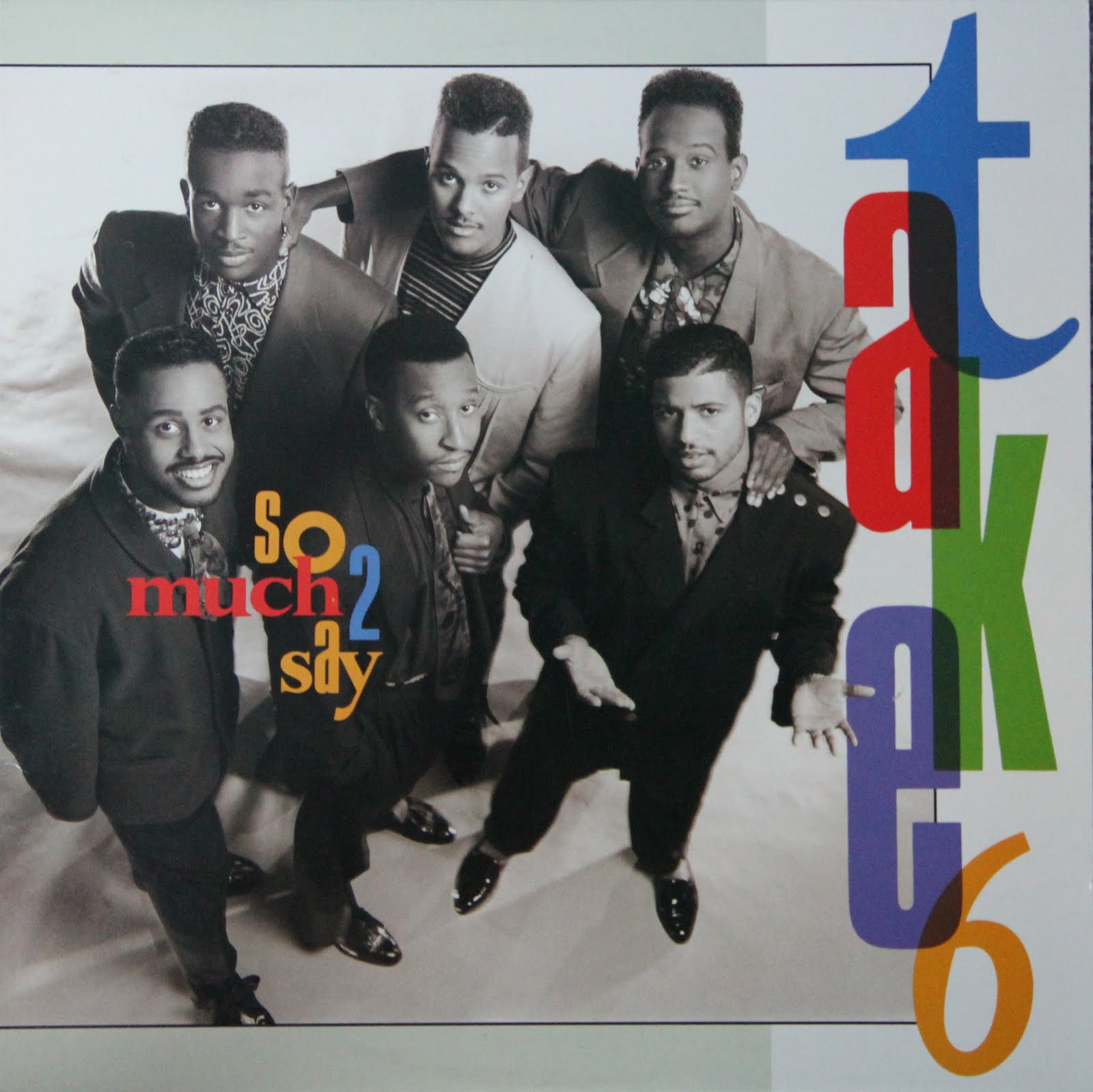
Amongst my other closest friends from that era was a certain Mr Goodman, a great friend and a fine musician. Being in his company inevitably involved exposure to music, he played it on various instruments, sang it, played it at home, played it in the car, and drove us to gigs, in venues like The Bull at Barnes Bridge, The Vortex Jazz Bar, The Jazz Cafe and the Half Moon in Putney. He played things as diverse as Al Jarreau, and Take 6, the spellbindingly exhilarating 6-part harmony acapella group - and everyone's very favourite 7th Day Adventists! When my old friend emigrated several years ago, he left me with some of his Vinyl LP's which have been part of what I unearthed. My wife and I went to hear Take 6, live in London a few years ago and were
utterly blown-away by the experience, despite our very-back-row seats at the Barbican!
Since those long-distant days of hearing these new sounds coming from my friends stereos, or keyboards, or saxes (etc) I have picked up a handful of other albums by great jazz-players. Most of these have been on CD, but the other notable forgotten one from the attic-archive was an old Dave Brubeck album, "Jazz at Oberlin". I remember taping this on my Dad's stereo and taking the cassette to Uni. I'm no muso, and I don't claim to understand the technicalities of all that goes on in such records, but the feel of music like this is riveting. I love it when a solo-ist appears to be playing something obvious, but then throws you off track, takes you by surprise only to elegantly resolve the aural conundrum he has created. It's great to be awestruck by a great piece of playing.
Friday, April 01, 2011
Stumbling Upon the Vinyl Archive. 2. Blues
I will never forget the night I watched a particular gig on the TV. Extremely late one evening, BBC 2 screened a remarkable event called "Fats and Friends". An all-star cast joined the redoubtable Fats Domino on stage to celebrate the lovable pianist's birthday. The gig has recently appeared on the Internet and can be seen here. Fat's performance was just delightful, his New Orleans boogie style is lovely - and who cold fail to be swept up in the enthusiasm and sheer joy the man brought to his music? Jerry Lee Lewis' performance was - well, very Jerry Lee Lewis! The star of the show that night was by far, one Ray Charles, a pianist I had barely heard of - but who from the first note he sang on that programme grabbed my attention, and held it by the throat. It was utterly spell-binding, hair-raising and gave me an instant affection for the Blues, which has never left me. Soon after that night I saw this Ray Charles vinyl album in a local shop - for not much money, bought it, loved-it, and played it to death! It was one of several albums I discovered again last week when clearing out my attic space. I picked this one again, with immense fondness.
After "Fats and Friends" and this LP, I had little idea that Ray had recorded all kinds of other music too. These happened (co-incidentally) to both be Charles' performances in which he explored a more straightforward stripped-down sound. The LP because it was all early material recorded before there were any backing vocalists or orchestras to complicate the sound, and the gig , because he was guesting with a house-band. I never loved Charles' forays into country or ballads, as much as this, timeless, wonderful music. I am so glad that I managed to see a Ray Charles gig before he died, several years ago. In his latter-years he was still an awesome performer, a wonderful piano-player with a voice so textured and crackly that he could stun and audience into silence with a single note. (see 34 mins into the Fats and Friends gig).

The 'master-of-the-Telecaster', was Albert Collins, another unique and gloriously eccentric player - and a natural entertainer. I saw him live in the company of Gary Moore, playing songs like Cold Cold Feeling, Too Tired, and Caldonia. This LP I picked up soon after that gig. It's a fun record too, with as much up-beat, light-hearted humour in it as their is soul-searching angst in Charles' record. I smiled when I pulled this one from the attic, happy memories, of along-time ago. Strange too, to realise that Ray Charles, Gary Moore and Albert Collins are now all dead. Three people of immense, and varied talents who strode Colossus- like across the stage, held countless people mesmerised by their talents - and have now departed. I'm grateful to have seen them all play live.
Muddy Waters is a strange one for me. Although I stumbled on The Blues and was immediately gripped by them, unlike all the other Blues-fans I knew - I really didn't somehow 'get' Muddy Waters. Although I picked this LP up from a friend decades ago, it it didn't get played very much. I have only recently discovered an appreciation for Muddy, (perhaps Electric Mud was a step too far for me!), and so this piece of Vinyl was a pleasant surprise to unearth, and now it will be played. Songs like Feel Like Going Home, and Long Distance Call - just brilliant.
Thursday, March 31, 2011
Stumbling Upon the Vinyl Archive. 1. Kids
Yesterday I had to clear out part of our attic to make space for an inspection of the timbers in our roof, which appear to be moving... While raking through its dusty corners I came across a long-forgotten collection of vinyl albums - which I have spent the last couple of evenings looking through and playing. I wasn't surprised to find some of the things I had bought as a teenager (this CD thing will never catch on, I'll buy another LP), but I hadn't remembered that some things from my childhood were in there too!

For me Ringo Starr was never the real voice of Thomas The Tank Engine and Friends, in fact Thomas wasn't even the band's front-man when I was a kid, they were just "The Railway Stories" - and they were read by Johnny Morris. Johnny Morris is probably best remembered for his BBC kids TV series, Animal Magic in which he voiced spoken parts for the animals, with his gentle unique voice, and whimsical wit.

His readings of the Railway Stories were lovely and he brought the characters alive - pompous officials, Imperious Express Engines, wicked trucks - all part of these wonderful stories. When Morris was the story-teller the pictures were better than the subsequent TV series. One of my friends told me recently that he had met Johnny Morris - and that he was as charming and friendly off-camera as he appeared on it. The Railway Stories are things which will always remind me of my two Grandfathers though. Both called "Grandpa", we distinguished between them as "Grandpa-shed" and "Grandpa-piano". Both were very creative; one, making useful things in his shed, the other at his piano, with his Mozart and Scarlatti. Amongst my earliest memories are Grandpa-piano reading Railway Stories to me at his house in Sunbury; and I can remember listening to this Johnny Morris album with Grandpa-shed - who liked copying the character voices too.

Next out of the archive were two albums of songs from Play-School, which was the BBC's flagship Under-5s programme during the 1970s. Brian Cant, Johnny Ball, Toni Archer, Derek Griffiths, Lionel Morton, Chloe Ashcroft, Don Spencer and all the others sang songs which were in turn educational and hilarious, told nursery rhymes, and produced this album which when I was about five I could sing along with word-perfectly. Pulling these albums out of their sleeves yesterday was a bizarre experience!

Of course, I was delighted that I could still remember a few of the songs, with the words! Better still my five-year old daughter was in the room - and it was fun watching her responding to the songs with the pure enjoyment that I had got from them back in the middle-ages. I had wondered if they would 'work' today, or whether in the world of ipods and Nintendo's, they would seem hopelessly quaint. Happily she danced and laughed and was thoroughly absorbed by my little nostalgia-fest. Now of course, I can't get the songs out of head... This isn't too bad when the song in question is a uniformly wonderful as Derek Griffiths' Spider Song. However if you catch me singing, "wouldn't it be funny if the moon were made of cheese - and everybody had to wear balloons around their knees?", be kind!
Wednesday, March 30, 2011
You crack me up..
If I lie on our bed and look up I can see the cracks that are working their way steadily around the ceiling and into the wall behind the headboard. The initial assessment is that there is a problem with the lintel above the bay window - which may need some bolstering, probably at appalling expense.
"Did the earth move for you, dear?" .... Well, the ceiling appears to have shifted a little.
Tuesday, March 29, 2011
Farewell, old car..
I have just said farewell to my old car, as it was ignominiously tipped up and dragged away by its hind-wheels. This dreadful old heap was but I youngster when we picked it up over a decade ago. Ah, (sigh) the places it has been, the things it has seen! We have brought babies home from hospital in it, gone on holiday, driven to work, driven round Scotland to speak in various churches in it, filled it with people, logs, rucksacks, bikes, sacks of coal, shopping, furniture, boots, sports equipment ... In recent years, the old heap was reserved for lesser duties especially hillwalking trips. The number of times I have peered down from a hill towards the road, and been able to spot this little car waiting for me, I cannot count!
The final insult however wasn't that the thing was dragged away to the knackers-yard, but that it was valued at a mere £150- Surely it was worth more than that!!!?!
Thursday, March 24, 2011
Across Perth
Wednesday, March 23, 2011
Platform 4
"The rubble lying strewn around on platform four looks
likely to remain there for several more months...."
Book Notes: The Orange Order, A Contemporary Northern Irish History by Eric P. Kaufmann

For external observers of the Northern Irish scene, there are few things which meet with such bemused incredulity as the parades of the Orange Order. While the quaint nature of their archaic costumes and incessant rhythms of the accompany bands might initially prompt a rather patronising amusement - all such thoughts are banished when it becomes apparent that these are the symbols of a deep-seated culture war. The men who wear the orange sash are grimly determined to maintain these traditions even when they are part of civil disobedience, while rogue elements on the fringes of Orangeism are willing even to kill to enforce them.
Kaufman's book is a fascinating insight into this organisation. Writing as an outsider, he has been given unparalleled access to the archives of the Grand Lodge of Ireland in order to explore this unique institution. The results of his work, are for the outsider, absolutely fascinating, and deeply revealing. It is always challenging to read in detail, the history of a people with whom you have no natural or cultural affinity. If the symbols and image of unthinking belligerent Loyalism, completely alienate so many people in Britain - the history of the struggles of these people at least enables the reader to understand their actions.
The picture Kaufmann paints is of a highly ritualised ethnic-defence organisation, whose numbers, power, and influence over Northern Irish life and politics has been steadily on the wane for over a generation. Significantly (and with a barrage of statistics) he analyses the rifts and divisions within the movement - which are far more significant than the media coverage would ever suggest. Rural-urban divides, class divisions, geographical-splits, and a strong secular-vs-Christian battle for the soul of the movement all emerge in competing traditions.
In practical terms the two strongest impulses, in response to the steady erosion of Loyal/Orange dominance of the province, have been to either work with traditional structures of church, UUP, and seek to restrict reform; or to pursue the 'rebel' Unionist cause, typified by the DUP, the 'Spirit of Drumcree' group or even for a small minority, the paramilitaries. The Christian-influence emerges as a significant brake on extremism, and the secularisation of the order a powerful radicaliser. This is an interesting observation, especially for those who (like me) have always been shocked that Christians, never mind clergy, could join such a narrow, sectarian body.
The book begins with a detailed analyses of the Order, and the sub-divisions and groups within it. Then it charts the breakdown of the Orange/UUP/Stormont control of Northern Ireland. Noteworthy is the role the order played in ending the leadership of politicians prepared to compromise Loyalist hegemony, under pressure from London. Charting the course the Order played during the troubles and proposed power-sharing deals of the 70s, the book comes to a finale around the events surrounding the peace-process, and Good Friday Agreement.
Significantly the book explores in great depth the contentious issue of parade-routes, and the Order's tense relationship with the much-resented Parades Commission. It explores the symbolic and political importance of marching to the Orangemen (going some way to making this comprehensible to the outsider, even if not always justifiable), and why Sinn Fein/IRA targeted these marches as part of their strategy through residents-groups. It explores the way in which the Order were cornered into losing the propaganda war so comprehensively around Drumcree, but why government strategy made it rational for both sides to ramp up the tension at every turn.
Finally the book examines the major threat to mainstream Orangeism, which turns out not to be Nationalism, or government indifference to their traditions (although those are undoubtedly present), but loss of members. The Order accounts for a smaller percentage of the male Loyal/Protestant population than it has for generations, its membership is ageing and many are leaving.
At the 'rebel-Unionism' end of the spectrum, the Order is seen as not radical enough, being too religious, and having made too many compromises. The former link to the UUP, which is no longer seen as the party of Molyneaux, Smyth and "No Unionism"; but of Trimble-ism, compromise, parades-commission and prisoner-releases, makes the order seem ineffective in defending the Loyalist heritage. In a sense, the book suggests that these rebels are right in their analysis. The steady erosion of the protestant majority, and its political and cultural control, has meant that each compromise offered by moderate leaders has not made London and Dublin appreciate their flexibility, but has in fact paved the way for the next series of concessions. Belligerence, intransigence, and even violence have achieved greater gains for both Loyalist and Nationalist communities, when they have been prepared to use it.
At the traditionalist and Christian end of the spectrum (frequently also the more educated and middle-class element), the loss of membership has been associated with an abhorrence at the violence and intransigence with which the Order has been associated. The involvement of the likes of Johnny 'mad-dog' Adair, the LVF, or the UFF at parade-stand-offs in Drumcree or on the Lower Ormeau road, has lead to many drifting away from the Order or actually resigning from it. The Twelfth might have been a 'family day out' many years ago, but the presence of the heavy-drinking, potentially violent, 'kick-the Pope' bands and radical-youths on the fringe of Orangeism, have lead many to abandon it altogether.
The Order emerges from Kaufmann's work as a frequently misunderstood, and beleaguered organisation, struggling to find its role and identity, in the new realities of Northern Ireland. It looked slow to learn the lessons of PR and news-management, and so was easy for its opponents to outmaneuver - which happened time and time again. Riven by internal divisions over both tactics and identity, the exploitation of such fissures was all too easy for deeply-hostile politicians such Mo Mowlem and especially Peter Hain.
This is a really helpful read for anyone, like me, who has ever looked at an Orange march in astonishment or even bewilderment - wondering who these people are, and what they are so angry about. It explains why some of their tactics, which from the outside look so incomprehensible and self-defeating, are coherent when viewed from within.
The book probably contains too much detail, of stats and quotations from Grand Lodge meetings, much of which could have happily been footnoted so that the argument and analysis could flow more happily. However, the one thing the book lacks is a brief sketch of the history running-up to the 1960s when its narrative begins. Other than that - great, incisive, informative stuff, and another bargain from this years Oxford Uni Press sale!
Labels:
Books,
History,
Northern Ireland,
Politics
Saturday, March 19, 2011
Friday, March 18, 2011
Thursday, March 17, 2011
Educaysh'nurlists
Is it just me, or do some of our educationalists need to do a few more spelling and grammar tests and a little less making dressing up costumes and having circle-time? If the image is too small to read the type, click to enlarge. I realise that I am sounding like a Daily Mail reading Victor Meldrew; 'dear points of view'; 'angry from Manchester', etc. Rant over. Lynn Truss has eaten, shot and left the building...
Friday, March 11, 2011
Teamwork
'Boris', belaying for 'Norris' as he edges towards the top of the Alien-Rock climbing wall in Edinburgh, in the 'blindfold-challenge' which the instructors set for the kids on Saturday.
We hope that giving our two sons a hard physical challenge which they have to complete with each other's assistance, will be a good so-called 'teambuilding-exercise'. In short - the idea is that if the boys have great fun, but their lives depend on each other during the activity, they will be less inclined to kill, dismember, loathe and wish to execute each other - during the rigours of everyday life.
I'll keep you posted...
Monday, March 07, 2011
When you're young - and in love...
Thursday, March 03, 2011
Perth: New Marriage Course!

The Marriage Course is a series of seven enjoyable evenings for couples to spend together investing in their relationship. It's suitable for couples at every stage of marriage, and can be used for getting the very best from a good marriage, as well as helping strengthen marriages going through a bad patch. The course comes from a broadly Christian perspective - but has been enjoyed by many couples who are not church-goers, who have benefited from it. In previous years when we have run The Marriage Course, couples have enthused about the difference it has made to their lives. The next course is planned to run on Thursday evenings beginning on April 21st. The course is really practical, down-to-earth, and as fun as it is challenging. Privacy is highly prized on The Marriage Course, so that while there are other couples in the room for the DVD part of the evening - the discussion times are solely between husbands and wives. There are no group discussions, and absolutely no suggestion or even invitation to share anything about your own marriage with anyone else! Likewise when we host the course - we have no idea what each couple are discussing, or how relevant the DVD was to them. We don't pry - just facilitate the evening!
If you are interested in finding out about the course, get in contact (e-mail address on my blogger profile). There are some places still available on the next course, although these will be allocated on a first-come-first-served basis! Incidentally, we do ask for a £30 ('or what you can afford') donation towards the cost of the course, including meals and the accompanying book. If you're interested, please get in touch. If you are interested but too far from Perth to join this course, click here to find a course near you. Likewise any questions about the course - just ask.
Tuesday, February 22, 2011
Saying Farewell to Woolly Wolstenholme, with John Lees' Barclay James Harvest in Buxton
This was no ordinary gig. When John Lees' Barclay James Harvest stepped on stage on Saturday night at the Buxton Opera House, they were met with the most astonishing outpouring of warmth and affection from fans who had travelled from all parts to be with them that night.
The gig had initially been billed as a celebration of the 4oth anniversary of the release of Barclay James Harvest's seminal work, "Once Again". Tragically, in December 2010, founder member, composer, arranger, keyboard and guitar player Woolly Wolstenholme took his own life after a long battle with debilitating depression. On Saturday night, the band took to the stage for the first time since the tragedy, to play a gig in his honour.
In the audience were many people who had loved the band's music for many years, many fans who had got to know Woolly through the gigs, and an array of his personal friends too. While the band, now a 4-piece, delivered an excellent set of songs drawn almost exclusively from the 'classic-era' of Barclay James Harvest - it was an evening of high emotion. Wolstenholme's influence was everywhere, songs he had written, arrangements he had penned, strange silences between songs where he should have been wise-cracking.... yet the evening was a great tribute by the four remaining members to their fallen friend and colleague. When Woolly used to sing his song, "The Poet", John Lees could often be seen singing along off-mic. On Saturday John sang the song, poignantly alone, his voice loaded with emotion, his hand quivering by his side - the crowd willing him on. I saw people smiling, with moist eyes. The gig ended with the most enthusiastic singalong of Hymn, I have ever heard - the crowd shouting "YEAH", in between verses like in the old days..
The music Barclay James Harvest made has a meant a huge amount to me for more than half my life. I was deeply saddened by the tragic death of Woolly Wolstenholme (about which I blogged here) and as a result made a special effort to get to this gig. It turned out to be a day that will live long in the memory, firstly meeting up with lots of other fans who I usually only know via their odd pseudonyms on the internet, which was fun. And then a most remarkable gig. I am by nature someone who scoffs at public displays of emotion, and would find such things embarrassing rather than affecting. However, the display of warmth, affection and grief from the crowd on Saturday night, was absolutely absorbing. A quite remarkable night.
Monday, February 21, 2011
PERTH Marriage Course Party - this Saturday!

We're holding a Marriage Course Party a party on Saturday night. We're inviting all the people who have done The Marriage Course here, as well as anyone who just wants to find out more about it; for an evening of food, drink, chat, live-music and a short DVD about the principles which lie behind the growth of a healthy marriage. As well as being an entertaining evening, it will also give anyone intrigued by the Marriage Course an opportunity to find out what it's about without committing to the full 7-weeks course. If you are in the Perth area and are interested, let me know!
Friday, February 18, 2011
Sunday, February 13, 2011
Saturday, February 12, 2011
Valentine's Day - A Moment for Romance...

You may have noticed that Valentine's Day is almost upon us once again, when card-shops tell us that we don't actually love our loved ones unless we make an additional contribution to their already magnificent profits. If any of you have left it just a little too late, and need to get a last-minute card, I suggest you click on the above and print it off. It is after all, it's the thought that counts - not the price tag.
Friday, February 11, 2011
New Camera - 1st pic!
My birthday present yesterday was a nifty new camera - I haven't learnt how to use it properly yet, but here's a quick shot of Perth town centre from Kinnoull Hill direction, to get things started!
Wednesday, February 09, 2011
40 - Licence to GRUMP!
I am only a few hours away now from being 40. The enormous leap from being "in my thirties" to being "in my fifth decade" is about to be made.. Happily I received my official Grumpy Old Man Licence in the post today though - which obviously cheers me up no end. Those of you who think that I do not need a licence-to-grump, are of course technically correct - I have been acting like a grumpy old man for many, many years. However - for all that time, I have felt like an under-age-drinker sneaking illicit pints in the pub - but all the while looking forward to my 18th birthday and the opportunity to look the barman in the eye and order a drink without fear of being caught. Now here we are 10-02-2011, and the great moment is upon us. I feel I can groan, and grump and complain to my hearts content - and no-one can say, "Oh stop acting like a grumpy old man". Because I am. And I have the licence to prove it.
Film Notes: Au Revoir les Enfants

Au Revoir Les Enfants, is Louis Malle's autobiographical film about a Roman Catholic boarding school in occupied Vichy France, in the latter years of WWII. The priests who ran the school not only sought to educate young Catholic boys in the faith - but also used the school as a place to hide Jews.
What impresses Au Revoir Les Enfants on the mind so forcefully is its intermingling of the ordinary and the dreadful, into a seamless whole. Malle manages to capture something of the way in which children view their own experience as 'normal' and 'unsurprising' when classmates being rounded up by Nazis is anything but.
The film provides some intriguing insights into life under Petain's regime, a part of WWII history rarely discussed, and features some excellent child-actors.
Much of the film is about the ordinary stuff of childhood in a boarding school, rivalries, fun, bullies, games, and is simply a nicely told childhood tale. All the time however, the nagging horror of the realities of life under Nazi occupation break into the normality, emerging from the shadows to centre stage - eventually smashing the ordinaryness to pieces. The thing that struck me as particularly sorrowful, was the way in which Malle pictured the Gestapo - clearly from his memories. So many war-films unwittingly present such characters as demonic, almost non-human figures, perhaps as a way of coping with the presence of human evil by seeking to externalise it, and make it only appear in ghoulish fantasy figures. The Nazi in Tarantino's Inglorious Basterds who stalks France rounding up Jewish people, is perhaps a good recent example of this. However when the Gestapo come to Malle's school in this film, the appalling fact is that they looked so damn ordinary. The man in charge of the ghastly 'ethnic-cleansing', the local agent of evil itself, looked and spoke like a bored bank-manager. This was chilling. He wasn't a creature apart from us - he was one of us. Here is the Christian doctrine of fallen-humanity writ-large.
This film is a profound, moving and delicately told story, poignantly recording the way in which Hitler's 'final-solution' impacted one group of boys in a little school in rural France. Remarkably, Malle gives the viewer a child's perspective on the events - not in a clumsy, obvious way - but through this distressing collision of the ordinary and evil.
Book Notes: Generous Justice by Timothy Keller

'Generous Justice' is Tim Keller's take on Christians and Social Justice, and is a great little book. It may be an increasingly out of date cliche to describe Christians on the 'left' as seeking only to present a Jesus who motivates them to pursue a more just socio-political order; while Christians on the 'right' present him as only interested in saving context-less souls: nevertheless many Christian people have never really thought out the links between the core Christian belief of 'salvation by faith' and the core Christian activity of serving the poor and pursuing justice. In short - they live as though Orthodoxy and Orthopraxis were at best separate compartments of life, or at worst actually in tension with each other.
With an array of fascinating examples, case studies, and the use of thinkers and practitioners as profound as Jonathan Edwards and John Perkins, Keller maps out a compelling vision of the Christian life in which the outworking of salvation by faith is a life committed to pursuing justice for the poor. In fact, Keller argues, an absence of social concern casts significant doubt on the veracity of any claim to conversion to Christ. As he does so, Keller roots the contemporary concern with human-rights as a development from the fully Judeo-Christian concept of the imago-dei, ie. humanity created in the image of God. As such, conversion to Christ, means not simply the remaking of the individual into Christ-likeness; but also the believer's increasing compulsion to treat every other human being in-line with the inherent dignity with which their creator endued them - when he bestowed his divine image upon them.
The book is a very stimulating and encouraging provocation to make compassion and the pursuit of justice central to our response to the gospel of Christ. It doesn't undermine or replace the gospel - but flows from it. The critical link (from Edwards) is that as the recipients of unmerited grace, we must be the vessels of unmerited grace to others. On a personal level the books contains a wealth of stories of individuals who have been moved by their sense of having been loved by God, to care and serve others. On a structural level, key to this is the re-activation of the dormant idea of the deaconate as found in the New Testament (the subject of Keller's doctorate - and the practice in the church where he pastors). In his view (which he describes briefly) the deacons were separated from the elders who led New Testament churches, specifically to enable them to focus on the church's social ministry. The book contains many practical pointers as to how this can be done, as well as a useful discussion on the proper extent of the church's involvement in social and political action.
I was given two copies of this great little book for Christmas, so I have one to give-away! The first person who e-mails me can have it, completely free. My e-mail address is on my blog-profile for anyone who doesn't know it.
Gary Moore 1952-2011
When I was a young teenager in the first half of the 1980s, the young people in the youth group I went to, were divided into two groups. Each group had its look, its music, its heroes, and its places. The Indie/Goth crowd looked either to The Sisters of Mercy or The Smiths for their inspiration, for those of us who were Rockers - our hero was undoubtedly Irish guitarist Gary Moore. The first 'proper' gig I ever went to was Gary Moore, at Hammersmith Odeon, on his Wild Frontier tour, revisiting the Celtic Rock he had enjoyed in his Thin Lizzy days a decade previously.
Memory is one of the strangest capacities of the human mind. Smells, sights, places - all trigger streams of recollections. For me, the music of Gary Moore brings a deluge of memories from those formative years. Our teenage years are critical in forming who we will be for the rest of our days, and Moore's guitar playing was the 'soundtrack to my early teenage years. For several years his music was almost constantly on my stereo - albums like "Live in Japan", "Corridors of Power", "Dirty Fingers" or "Run for Cover", filling my room - and leading to much air-guitaring.
By my mid-teens I was getting bored of the hard-rock format and was discovering all kinds of other music. The pastoral-sounds of Barclay James Harvest would form a strong pull in one direction - while blues and jazz started to pull me in another. The piano-blues of players like ray Charles, Memphis Slim and Champion Jack Dupree, and the Paul Jones radio programme grabbed my attention and these new sounds I heard resonated strangely, and deeply within me (and left my friends thinking I was just odd!). One day in an A-level economics lesson, it was Simon Welsh who told me that he'd heard that Gary Moore had also got tired of heavy-rock, and had produced an blues album, "with some old blues guitarists"....
"Still Got The Blues" was, by all accounts a huge risk for Gary Moore - but one which paid off, massively for him. It's the album of his I have played more than any other, packed full of gems. Moore's guitar was always more suited to Blues than to the hard-rock of albums like "After the War" where the format constrained the melodic, lyrical power of his playing. Moore was never a straightforward guitar-shredder (although he did do the silly thing that all post Eddie Van Halen guitarists do - when they stand and play silly scales, ridiculously fast) - he was in fact an extremely versatile player, who was so at one with his instrument that he could deliver enormous emotion through it. His expressiveness with the guitar "he makes it cry, he makes it scream, he makes it cry", still affects me after all this time.
With Collosseum II, Moore turned his hand to fusion/jazz-rock, delivering a series of albums of electrifying playing, with John Hiseman, and Don Airey. To countless sessions with all manner of people from The Travelling Wilbury's to Paul Rodgers, to Frankie Goes to Hollywood to Cozy Powell - Moore brought his trademark searing guitar. Moore was musically restless, roaming from style to style, always exploring and experimenting - he could play blindingly fast, he could play mournfully slow numbers, he ventured in classical territory, played with dance rhythms, celtic rhythms - with remarkable effect.
Live, Gary Moore was a consummate showman - giving his all in every performance. Having seen several of his rock and blues shows, I personally rate the Blues performances (especially in the days of the full 'Midnight Blues Band') as being far superior. Gary Moore - in full flight, playing songs such as "Midnight Blues", "All Your Love" or his trademark, "Still Got the Blues" was in fact an electrifying experience. His playing still makes the proverbial hairs on the back of my neck stand up!
Gary Moore died this weekend, of a heart-attack, while on holiday in Spain. He was only 58, and had several musical projects in the pipeline, including (apparently) an acoustic blues album, that will sadly now never be made. Only the day before his death, I was on his website, looking and hoping for the announcement of new live-dates. I was shocked to read, the next day of his demise. I will be 40 this week - and feeling rather old! What has made this even stranger is that within a few weeks of this milestone, two of the heroes of my youth, Gary Moore and BJH's Woolly Wolstenholme have died. These are the two musicians/bands, who I have listened to more than any other over the last 25 years. I'm not sure which makes me feel older, entering my 5th decade, or the heroes of my youth passing into history.
The final tragedy of Moore's passing has been the disgraceful behaviour of the gutter press - well actually just The Sun, in the UK. Without any proper evidence or sources, and within only a few hours of Moore's death they printed a story (full of lurid detail) about his death, claiming that he had a 'booze-up' on holiday and asphyxiated on his own vomit. The fact that witnesses say Moore left the hotel bar quietly after a couple of drinks at 11pm suggests otherwise - however what is really angering fans is that The Sun knew that a post-mortem had been ordered, but didn't wait for the results, simply sensationalised their 'rock-star death' story: which turned out to be completely made-up. The post-mortem indicated that Moore had suffered a heart-attack, and that this was the cause of death. When Moore's children, friends and family were in grief and shock - they deserved better than this. I hope they sue The Sun - and win such a huge sum from The Dirty-Digger that his noxious News Corp is forced to actually change its editorial standards. I have never bought a copy of The Sun - but if I was a Sun reader, I'd join The Sun boycott.
Sunday, February 06, 2011
Wednesday, January 26, 2011
The OUP Book Sale...

Every year OUP (Oxford University Press) has an online book sale. In the past this has been the source of some really good reading at excellent prices. Their annual e-mail came out today announcing this years sell-offs. There's some good bargains across the whole range of their catalogue this year - I've just grabbed three historical works, although they seem to be catering for all manner of tastes. Worth a look if you are a book lover: click here. (And no, I'm not on commission, and this blog isn't 'monetised'!).
Tuesday, January 25, 2011
Saturday, January 22, 2011
Album Cover 2 - The Blog!

Credit to Kecske Bak for so delightfully contorting the "Album Cover Game"!
Thursday, January 20, 2011
The Album Cover Game
Here's how the "Album Cover Game" works.
1 - Go to wikipedia and hit random. The first random wikipedia article you get is the name of your band.
2 - Go to quotationspage.com and hit random. The last four or five words of the very last quote of the page is the title of your first album.
3 - Go to flickr and click on “explore the last seven days”. Third picture no matter what ...will be your album cover.
4 - Use photoshop or similar (picnik.com is a free online photo editor) to put it all together.
Subscribe to:
Posts (Atom)